Nisi Dominus aedificaverit domum, in vanum laborant qui aedificaverunt eam - "Unless the Lord built the house, they worked in vain who built it" Ps. 127

Sunday, December 27, 2020

3rd Day of Christmas: The Holy Family of Jesus, Mary, and Joseph

Today, the Solemnity of the Holy Family, commemorates the Holy Family of Jesus, Mary, and Joseph, but also reminds us that “the family” in general, composed of father, mother, and children, is itself “holy”, a gift of God.  St. Paul underscores the sanctity of the family itself in his letter to the Ephesians:

 “For this reason a man will leave his father and mother and be united to his wife, and the two will become one flesh.” This is a profound mystery—but I am talking about Christ and the church. (Ephesians 5:31-32)

"The Flight Into Egypt" by Bartolome Murillo
Devotion to the Holy Family had been growing for some time, but the formal feast was not established until 1921, in response to increasing threats to the integrity of the family as traditionally understood.  The trends that already looked alarming a century ago have now grown and metastasized in ways that would have astounded our great grandparents. The family as traditionally understood is tottering under open and sustained attack.
It is in this regard that we see an interesting connection to tomorrow's Feast of the Holy Innocents, which commemorates King Herod’s slaughter of all the male children up to two years old in Bethlehem after he learned from the Magi that the Messiah had recently been born there.  The two different feasts, in fact, are really different sides of the same coin.  Where the Holy Family of Joseph, Mary, and Jesus is a model of God’s plan for the family, the slaughter of the Holy Innocents underscores how far we fall short, right now, of that model.  It is likewise noteworthy that one of the few places in Scripture where we see the Holy Family in action is the same passage from Matthew’s Gospel that describes the Holy Innocents:

And being warned in a dream not to return to Herod, they [the Magi] departed to their own country by another way. Now when they had departed, behold, an angel of the Lord appeared to Joseph in a dream and said, "Rise, take the child and his mother, and flee to Egypt, and remain there till I tell you; for Herod is about to search for the child, to destroy him." And he rose and took the child and his mother by night, and departed to Egypt, and remained there until the death of Herod. This was to fulfil what the Lord had spoken by the prophet, "Out of Egypt have I called my son." Then Herod, when he saw that he had been tricked by the wise men, was in a furious rage, and he sent and killed all the male children in Bethlehem and in all that region who were two years old or under, according to the time which he had ascertained from the wise men. (Matthew 2:12 -16)

Guido Reni, "St. Joseph With The Infant Jesus"
Joseph, like fathers and fatherhood itself today (and the crisis of the family is, to a great degree, a crisis of fatherhood), is often overlooked and forgotten. We know from Matthew’s Gospel, however, that God saw to it that his son would have a human father when he was born (see Matthew 1:18-25).  In the passage from Luke above he is clearly the leader of the family.  Like his Old Testament namesake, and the Wise Men from the East, he is warned in a dream, and takes action: he has the vision to guide and protect his family.
Even our separated brethren in the Protestant communities, who have sometimes feared that our devotion to the earthly parents of Jesus might distract us from the Savior Himself, are coming to a new appreciation of the example of St. Joseph.  In a recent post I quoted Russell Moore, president of the Southern Baptist Ethics and Religious Liberty Commission, who said:

For several years, I’ve been convinced that the model we most need in this day is that of Joseph of Nazareth. In a day when fathers are seen as expendable, we should look at Joseph, who sacrificed his own future for his wife and child. In a world filled with orphans in need of families, we should look at the example of this adopting father who poured out himself to become a father to one who was of no biological relation to him.

The family in our day and age is badly in need of guidance and protection.  On this Feast of the Holy Family, we would do well to pray for the intercession of the head and guardian of that Family, that he help our own families, and the institution of the family throughout the world.

Music for the Feast of the Holy Family: "Once in Royal David's City" by The Seekers


Saturday, December 26, 2020

2nd Day of Christmas: St. Stephen, Good King Wenceslas & The Power of Christ's Love

 Good King Wenceslas looked out
On the Feast of Stephen
When the snow lay round about
Soft and crisp and even


Today, the Second Day of Christmas, we (like King Wenceslas in the well-known carol quoted above) celebrate the Feast of St. Stephen.  The song does not actually tell us anything about Stephen himself: it describes instead how Good King Wenceslas goes out on the saint’s day, in an act of Christian charity, to share his Christmas bounty with a lonely and poverty-stricken old peasant.  And, whether or not the incident recounted in the song ever happened, Wenceslas himself was real.  He is based on Wenceslas I, Duke of Bohemia (the title of king was conferred on him posthumously by Holy Roman Emperor Otto I after his death in 935 AD). Wenceslas’ grandfather was the first Christian duke of Bohemia, but it was Wenceslas himself who firmly established the Church in Bohemia in the face of still strong pagan opposition, and aligned the church in his homeland with the Holy See in Rome.   
    Wenceslas stands at the beginning of Christianity among the Czechs. Likewise, St. Stephen’s feast is at the start of the Christmas season, and St. Stephen himself at the very beginning of the Church; he was, in fact, the first Christian to give his life for the Faith after Christ himself, for which reason he is known as the protomartyr, that is, first martyr. We find a vivid account of his death in the Acts of the Apostles:


But he [Stephen], full of the Holy Spirit, gazed into heaven and saw the glory of God, and Jesus standing at the right hand of God; and he said, "Behold, I see the heavens opened, and the Son of man standing at the right hand of God." But they cried out with a loud voice and stopped their ears and rushed together upon him. Then they cast him out of the city and stoned him; and the witnesses laid down their garments at the feet of a young man named Saul. And as they were stoning Stephen, he prayed, "Lord Jesus, receive my spirit." And he knelt down and cried with a loud voice, "Lord, do not hold this sin against them." And when he had said this, he fell asleep.
And Saul was consenting to his death.  (Acts 7:55-8:1)

The Stoning of St. Stephen, by Paolo Uccello


    Just as our Christmas joy is tempered by the realization that the child lying in the manger must someday hang on the Cross, St. Stephen reminds us, a mere day after the Feast of the Nativity itself, that following the Child of Bethlehem can mean our own Calvary.  Jesus himself tells us: “"Blessed are you when men revile you and persecute you and utter all kinds of evil against you falsely on my account” (Matthew 5:11).  How is it, then, that his coming is “Good news of great joy” (Luke 2:10)? Because, as our Lord goes on to say, “Rejoice and be glad, for your reward is great in heaven, for so men persecuted the prophets who were before you” (Matthew 5:12). Indeed, as we see in the account above from the Acts of the Apostles, St. Stephen doesn’t go to his death wailing and gnashing his teeth at the cruelty and injustice of it all, but gazing joyfully on his Savior in Heaven, and begging for forgiveness for his persecutors.  Countless martyrs since have done the same, up to the present day.  Christ our Savior didn’t come to save us from unpleasantness in this world, but to save for eternal happiness with him in the next, by rescuing us from our own sin.
    Which brings us back to Good King Wenceslas, who has more in common with St. Stephen than we might at first realize. It’s true that he established a strong foundation for the Church, and exhibited exemplary personal piety and charity; it is also the case that not everyone appreciated those qualities, including other nobles still sympathetic to paganism, as well as his brother Boleslav, who treacherously murdered him.  
    At the time, it must have seemed that Wenceslas was the loser, and that his scheming brother had won, just as St. Stephen seemed to be vanquished by his persecutors.  Today, however, over one thousand years later, Good King Wenceslas is still loved by the Czechs, and remembered as one of the founders of their nation, while his brother carries the odious sobriquet Boleslav "the Cruel."  Of more significance than his worldly reputation is the fact that Wenceslas is remembered by the Church as Saint Wenceslas, Martyr, whose feast we celebrate on September 28th. Saints Stephen and Wenceslas stand together among the "white-robed army of martyrs" whom we see in the ancient prayer known as the Te Deum, gathered before the throne of God, praising their Creator, and interceding for all of us.
 
   “Good King Wenceslas” is considered a Christmas carol, although it does not seem to have any direct reference to the Nativity of Our Lord.  It does, however, encourage us to emulate the saints, such as Stephen and Wenceslas, who conformed themselves to Christ, especially as exemplars of Christ's love [see St. Fulgentius of Ruspe's sermon from today's Office of Readings: St. Stephen - The Armor of Love]. The words with which St. Wenceslas encourages his cold and frightened page in the carol could easily be spoken by Christ himself, and addressed to every one of us:


"Mark my footsteps, good my page
Tread thou in them boldly
Thou shall find the winter's rage
Freeze thy blood less coldly."


Friday, December 25, 2020

Thursday, December 24, 2020

The Christmas Conversion of St.Thérèse

 In the lives of the Saints we can find some amazing stories of conversion: the Risen Lord literally knocking his persecutor Saul to ground and blinding him, in order to raise him up as St. Paul; the rich and spoiled son of an Italian cloth merchant who needed a year in a dungeon as a POW followed by a near fatal illness before he cast off self-indulgence to become St. Francis of Assissi; the vain and vainglorious Spanish nobleman who had his leg nearly shot off with a cannonball, and then went through months of excruciating recovery, before he could begin to see God in All Things as St. Ignatius of Loyola.  How startlingly different, and yet how strikingly the same is the conversion of the little French girl Thérèse Martin, now St. Thérèse of the Child Jesus, as she tells it her autobiographical Story of A Soul: 


     I had a constant and ardent desire to advance in virtue, but often my actions were spoilt by imperfections. My extreme sensitiveness made me almost unbearable. All arguments were useless. I simply could not correct myself of this miserable fault. . .  A miracle on a small scale was needed to give me strength of character all at once, and God worked this long-desired miracle on Christmas Day, 1886. . . 
     Now I will tell you, dear Mother, how I received this inestimable grace of complete conversion. I knew that when we reached home after Midnight Mass I should find my shoes in the chimney-corner, filled with presents, just as when I was a little child, which proves that my sisters still treated me as a baby. Papa, too, liked to watch my enjoyment and hear my cries of delight at each fresh surprise that came from the magic shoes, and his pleasure added to mine. But the time had come when Our Lord wished to free me from childhood's failings, and even withdraw me from its innocent pleasures. On this occasion, instead of indulging me as he generally did, Papa seemed vexed, and on my way upstairs I heard him say: "Really all this is too babyish for a big girl like Thérèse, and I hope it is the last year it will happen." His words cut me to the quick. Céline, knowing how sensitive I was, whispered: "Don't go downstairs just yet—wait a little, you would cry too much if you looked at your presents before Papa." But Thérèse was no longer the same—Jesus had changed her heart.
     Choking back my tears, I ran down to the dining-room, and, though my heart beat fast, I picked up my shoes, and gaily pulled out all the things, looking as happy as a queen. Papa laughed, and did not show any trace of displeasure, and Céline thought she must be dreaming. But happily it was a reality; little Thérèse had regained, once for all, the strength of mind which she had lost at the age of four and a half.
     On this night of grace, the third period of my life began—the most beautiful of all, the one most filled with heavenly favours. In an instant Our Lord, satisfied with my good will, accomplished the work I had not been able to do during all these years. Like the Apostle I could say: "Master, we have laboured all night, and have taken nothing."
     More merciful to me even than to His beloved disciples, Our Lord Himself took the net, cast it, and drew it out full of fishes. He made me a fisher of men. Love and a spirit of self-forgetfulness took possession of me, and from that time I was perfectly happy.

The Lord didn’t need to knock Thérèse down, beat her up, or have her shot in order to get her full attention; all he needed was to allow her to overhear a couple of stray comments from the father she loved so dearly.  That wounded her deeply enough to reveal to her the reality of her own selfishness, and to open her up completely to Christ’s Grace.  The meaning of conversion, after all, is to “turn around”, away from a way of life dictated by our own desires to one truly centered on God.
     Now, most of us need a wake-up more like the one which was granted to St. Paul or St. Francis; perhaps not quite as dramatic, but most of us, I suspect, are much more wrapped up in our sin than was little Thérèse Martin.  But that is precisely why the Little Flower’s conversion stands out: even someone who seems to be doing just about everything right is still in need of conversion, and not just in one instant, but continuously over a lifetime (and of course she did experience much greater suffering later in her short life). Sin will always be trying to turn us back. 
     St. Thérèse’s conversion story reminds us of something else.  There will always be opportunities for conversion.  We don’t need to go out looking for trouble, because we will all have ample opportunity to experience The Fall in our lives.  The more enmeshed we are in sin, however, and the higher the walls between ourselves and God, the harder our fall must be.  Wouldn’t it be better to come to Christ like Thérèse did, without too much collateral damage to ourselves and to others?


     Finally, on Christmas Day in 1886 St. Thérèse learned to turn her hurt and disappointment into generosity of spirit, her selfishness to selflessness.  What a wonderful reminder to all of us (myself very much included) that we need to ask our Lord for the Grace to do the same. O come, O come Emmanuel!

Wednesday, December 23, 2020

St. Servulus, Tiny Tim, and the Nativity of Our Lord


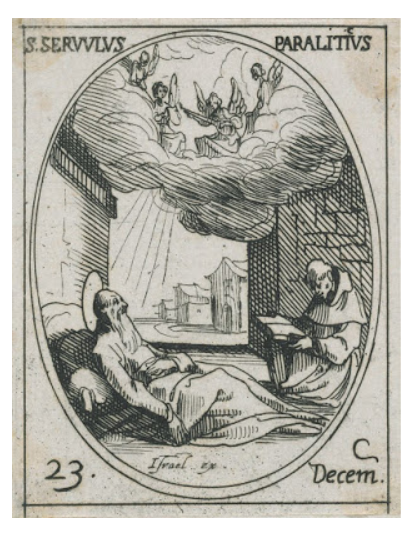
One understandable drawback to the great liturgical feasts, such as the magnificent celebration of the Nativity of Our Lord at Christmas, is that lesser observances can be overlooked in all the excitement. For instance, one of today’s Saints, St. Servulus: he is worth remembering for his own sake, but his life also gives us some very fruitful matter for meditation on the penultimate day of Advent, as we prepare for Christmas itself. Let’s take a look at the story of St. Servulus, from the 1894 edition of Butler’s Lives of the Saints (an account based on a homily by St. Gregory the Great):

December 23.—ST. SERVULUS

SERVULUS was a beggar, and had been so afflicted with palsy from his infancy that he was never able to stand, sit upright, lift his hand to his mouth, or turn himself from one side to another. His mother and brother carried him into the porch of St. Clement's Church at Rome, where he lived on the alms of those that passed by. He used to entreat devout persons to read the Holy Scriptures to him, which he heard with such attention as to learn them by heart. His time he consecrated by assiduously singing hymns of praise and thanksgiving to God. After several years thus spent, his distemper having seized his vitals, he felt his end was drawing nigh. In his last moments he desired the poor and pilgrims, who had often shared in his charity, to sing sacred hymns and psalms for him. While he joined his voice with theirs, he on a sudden cried out: "Silence! do you not hear the sweet melody and praise which resound in the heavens?" Soon after he spoke these words he expired, and his soul was carried by angels into everlasting bliss, about the year 590.

St. Servulus listens to Holy Scripture
Servulus is certainly an admirable model of heroic virtue.  In spite of a lifetime of constant suffering, he was filled with gratitude to his Creator, and was completely devoted to Him, as signified by his name (Servulus means “little slave”). Moreover, despite his own absolute poverty, he was keenly aware of the need of others.
   But there’s more to the story of this saint and his feast day, coming as it does right before the celebration of the Nativity of Our Lord.  When I first read Servulus’ hagiography, in fact, a passage from Charles Dickens immediately came to mind.  I was thinking of the scene in A Christmas Carol, where the Ghost of Christmas Present is showing Scrooge the Cratchit family’s Christmas dinner.  Scrooge’s underpaid clerk, Bob Cratchit, has just returned from church with his sickly, crippled son Tiny Tim on Christmas day.  After Tim is whisked off by his siblings to see “the pudding singing in the copper”, Bob has the following exchange with his wife:“And how did little Tim behave?” asked Mrs. Cratchit, when she had rallied Bob on his credulity, and Bob had hugged his daughter to his heart’s content.
“As good as gold,” said Bob, “and better. Somehow he gets thoughtful, sitting by himself so much, and thinks the strangest things you ever heard. He told me, coming home, that he hoped the people saw him in the church, because he was a cripple, and it might be pleasant to them to remember upon Christmas Day, who made lame beggars walk, and blind men see.”
Bob Cratchit & Tiny Tim

Tiny Tim sees himself as a living image of Christ’s mercy, reminding the faithful that the Nativity they’re celebrating is not just the birth of a baby, but the Incarnation of the God of Mercy as a Man. St. Servulus is also an icon, pointing out precisely who the Babe in the manger has come to be. He reminds us that in taking on human flesh, Jesus is taking to himself all that is human, excepting sin.  That very emphatically includes human suffering. It is often said that when God took on human form, he sanctified humanity.
Likewise, since Jesus has participated in our pain and sorrow, through his suffering we can unite ourselves to the living God. St. Servulus puts flesh on the words of St. Paul: “Now I rejoice in my sufferings for your sake, and in my flesh I complete what is lacking in Christ's afflictions (Colossians 1:24).”  Small wonder that the suffering saint could hear the voices of angels even before he left this world for the next.
    In two days we will be celebrating Christmas, the birth of our Savior, which is indeed, as the angels tell the shepherds of Bethlehem, “good news of a great joy” (Luke 2:10).  St. Servulus reminds us that He comes not so much to save us from the hardships of this world, but to save us through those hardships, so that we can be eternally happy with Him in the next.
    May your Christmas be a merry one . . . and God Bless Us, Every One.


Sunday, February 2, 2020

The Presentation and God's Strong Hand

"Moses Striking the Rock", by Francesco Bacchiacca
    Today in the secular world (at least in the United States) we observe the venerable tradition of Groundhog Day, which involves allowing an earth-dwelling rodent to forecast our weather for the next few weeks. It's just a fun bit of nonsense, and yet it receives an enormous amount of attention.
The Church, as we should expect, has something much more substantial for us. Today, forty days after the birth of Jesus at Christmas, we observe the Feast of the Presentation, in which we commemorate Mary and Joseph bringing the infant Jesus to the Temple in Jerusalem to consecrate Him to God, as was the Jewish custom with first-born sons. In this event we can see how, as St. Augustine put it, the New Covenant in the Old is concealed, and the Old is in the New revealed; similarly, we can catch a glimpse of the whole of the life and mission of Jesus on earth, from beginning to end.
Let's start with the depiction of the event in Luke 2:22-40, the Gospel reading at today’s Mass, which begins as follows:

When the days were completed for their purification according to the law of Moses, Mary and Joseph took Jesus up to Jerusalem to present him to the Lord, just as it is written in the law of the Lord, Every male that opens the womb shall be consecrated to the Lord, and to offer the sacrifice of a pair of turtledoves or two young pigeons, in accordance with the dictate in the law of the Lord.  (Luke 2:22-24)


The passage from Exodus to which Luke refers above appears in today’s Office of Readings.  There we see the origin of the mandate that Jewish families offer up their eldest male child to the Lord:

And when the LORD brings you into the land of the Canaanites, as he swore to you and your fathers, and shall give it to you, you shall set apart to the LORD all that first opens the womb. All the firstlings of your cattle that are males shall be the LORDs. Every firstling of an ass you shall redeem with a lamb, or if you will not redeem it you shall break its neck. Every first-born of man among your sons you shall redeem. And when in time to come your son asks you, 'What does this mean?' you shall say to him, 'By strength of hand the LORD brought us out of Egypt, from the house of bondage. For when Pharaoh stubbornly refused to let us go, the LORD slew all the first-born in the land of Egypt, both the first-born of man and the first-born of cattle. Therefore I sacrifice to the LORD all the males that first open the womb; but all the first-born of my sons I redeem.'  (Exodus 13:11-15)

   The injunction to consecrate the first-born males sends a powerful, and serious, message: that the chosen people were saved not through any virtue of their own, but through the favor, and by the power, of God.  By dedicating to the Lord their eldest sons, who will someday become the head of their families, they are putting God at the head of every family.  It is a reminder that future generations are in God’s hands as much as the generation that he liberated from Egypt.

   As we commemorate the Presentation of Jesus, we might also want to consider the passage above in its larger context in the Book of Exodus.  The Hebrews have been released by Pharaoh, but their struggle is just beginning; they have a long road ahead of them.  Here are the verses that immediately follow the reading in today’s Office:

When Pharaoh let the people go, God did not lead them by way of the land of the Philistines, although that was near; for God said, "Lest the people repent when they see war, and return to Egypt." But God led the people round by the way of the wilderness toward the Red Sea. And the people of Israel went up out of the land of Egypt equipped for battle. (Exodus 13:17-18)

The Israelites will not be able to simply walk in and take up residence in the land the Lord is giving them; they will need to fight, but God knows they’re not ready for that yet.  Before that time they will be prepared and tempered by a close escape from Pharaoh’s army (again, only by the “strength of the hand the LORD”), and forty years of struggle and hardship in the Sinai desert, punctuated by transcendent reminders of God’s Grace (Manna, Water from the Rock, the Ten Commandments).  God makes his Grace available, but the recipients are expected to cooperate actively with it.
   Now let’s look at Luke’s Gospel.  God has shown his strong hand again, in the birth of Jesus, the firstborn (and only born) son of The Father.  The Holy Family encounters a prophetic old man in the Temple named Simeon, who says:

       Lord, now lettest thou thy servant depart in peace,
according to thy word;
for mine eyes have seen thy salvation
which thou hast prepared in the presence of all peoples,
a light for revelation to the Gentiles,
and for glory to thy people Israel. (Luke 2:29-32)

And yet, as was the case with the escape from Egypt, this is only the beginning.  He also tells Mary:

Behold, this child is set for the fall and rising of many in Israel, and for a sign that is spoken against (and a sword will pierce through your own soul also), that thoughts out of many hearts may be revealed. (Luke 2:34-35)

"The Presentation", Hans Holbein the Elder
Simeon says that he can die content now after seeing the Savior, but also reveals that, here as in Moses’s day, salvation can only come after trial and suffering.


   We can see this reality reflected in the Liturgical Calendar: today is our last celebration of the Christ Child, and so our last glance back at the Christmas Season; in just a few weeks it will be Ash Wednesday, the beginning of Lent.  We can’t separate the Incarnation from the Via Dolorosa and Calvary.  And it’s no different for any one of us: God doesn’t make his Grace available to spare us our forty years in the desert, or release us from our own Way of the Cross.  Rather, it is to help us through them, because there’s no other way to get the Promised Land beyond.

Sunday, January 26, 2020

The Power of Christ: Saint Paul vs Caesar

We know that in everything God works for good with those who love him, who are called according to his purpose. (Romans 8:28)


    The boxer Robert Fitzsimmons, who was slated to fight the much larger James J. Jeffries in a heavyweight title match in 1902, supposedly quipped: “The bigger they come, the harder they fall.”  While Fitzsimmons failed to demonstrate the truth of his remark on that occasion (he lost the bout to Jeffries in the 8th round), it has become something of a proverb.  How many times have we seen that the more formidable the opponent, the more dramatic the impact when he comes crashing down?

    The nascent Church faced just such an opponent in the days after the ascension of Jesus, an opponent much more formidable than James Jeffries and Robert Fitzsimmons put together.  This man “was ravaging the church, and entering house after house, he dragged off men and women and committed them to prison” (Acts 8:3).  Not satisfied with terrorizing the followers of Christ in Jerusalem, “still breathing threats and murder against the disciples of the Lord, [he] went to the high priest and asked him for letters to the synagogues at Damascus, so that if he found any belonging to the Way, men or women, he might bring them bound to Jerusalem” (Acts 9:1-2). And yet this man, Saul of Tarsus, reached Damascus a very different man, because on the way he met the Risen Christ:


Now as he journeyed he approached Damascus, and suddenly a light from heaven flashed about him. And he fell to the ground and heard a voice saying to him, "Saul, Saul, why do you persecute me?" And he said, "Who are you, Lord?" And he said, "I am Jesus, whom you are persecuting; but rise and enter the city, and you will be told what you are to do." The men who were traveling with him stood speechless, hearing the voice but seeing no one. Saul arose from the ground; and when his eyes were opened, he could see nothing; so they led him by the hand and brought him into Damascus. (Acts 9:3-8)


“Oh what a fall was there!”, as Shakespeare’s Mark Antony says of the death of Caesar.  And when Saul fell to the ground it was indeed a great fall, one which the Church commemorated yesterday, as it does every January 25th, as the Feast of the Conversion of Saint Paul.  Saul, of course, later calls himself Paul, and goes on to become Saint Paul. While both might have been great falls, each in its own way, Saul's was a very different fall than Caesar's.  Caesar pursued greatness to satisfy his own ambitions, and any lasting good that came of it was simply a happy consequence God’s working everything for good (see the quote from the same St. Paul’s Letter to the Romans at the top of this post).  This working for good  took a very different form in the case of St. Paul himself. When Paul arrives in Damascus the Lord tells a man named Ananias to “come in and lay his hands on him so that he might regain his sight” (Acts 9:12).  Ananias has heard about Paul, and is afraid of him, but the Lord assures him that “he is a chosen instrument of mine to carry my name before the Gentiles and kings and the sons of Israel” (Acts 9:15).  Unlike Caesar, who lived only for his own glory, Paul now lives for the Glory of God or, as he himself puts it: “it is no longer I who live, but Christ who lives in me” (Gal 2:20). While Caesar's fall was the end of his life ("Now die, Caesar!"), Saul's was the beginning of new, more glorious life.

The laying on of hands: Joseph Ratzinger (later
Pope Benedict XVI) is made a cardinal
    Likewise, any power that St. Paul and the other Apostles wielded was very different from the sort of power that Caesar fought for.  Caesar’s power died with him under the jealous daggers of conspiratorial senators, and it would take almost two decades of ongoing civil war before another man, his great-nephew Octavian, seized supreme command in the Roman Empire and had himself proclaimed Augustus, the first emperor.  It generally happened that emperors after Augustus gained power through violence and bloodshed, and lost it in the same way.
St. Paul, on the other hand, was simply a conduit for the power of Christ, who tells him "My grace is sufficient for you, for my power is made perfect in weakness" (2 Cor 12:9).  It is a power that comes from outside of him, which was before him, and which continues after him.  We can see this in the fact that yesterday’s feast of the Conversion of St. Paul is usually followed by today’s memorial of Saints Timothy and Titus, just as Timothy and Titus themselves followed Paul (since today is a Sunday, we are not observing the customary feast of Timothy and Titus).  St. Paul made both men bishops by the laying on of hands, just as Ananias had laid hands on him, and wrote letters addressed to both that are now included in the canon of Sacred Scripture. Timothy and Titus likewise passed the power of Christ on to other bishops.  This power is still working through our bishops today, centuries after the bodies and the power of the Roman Emperors have crumbled into nothing.


    The bigger they come, the harder they fall.  We all fall at some point in our lives.  Let us pray that we fall not like Caesar, in a futile pursuit of worldly ambitions, but like St. Paul, born to a new life in Christ.