Nisi Dominus aedificaverit domum, in vanum laborant qui aedificaverunt eam - "Unless the Lord built the house, they worked in vain who built it" Ps. 127

Showing posts with label Advent. Show all posts

Thursday, December 23, 2021

Even Little Saints See the Face of God: St. Servulus, Tiny Tim, and the Nativity

 ". . . but Jesus said, "Let the children come to me, and do not hinder them; for to such belongs the kingdom of heaven." And he laid his hands on them and went away." (Matthew 19:14-15)

Antique St. Servulus Prayer Card
One understandable drawback to the great liturgical rfeasts, such as the magnificent celebration of the Nativity of Our Lord at Christmas, is that lesser observances can be overlooked in all the excitement. For instance, today (December 23rd) is the memorial of St. Servulus: he is worth remembering for his own sake, but his life also gives us some very fruitful matter for meditation on the penultimate day of Advent, as we prepare for Christmas itself. Let’s take a look at the story of St. Servulus, from the 1866 edition of Butler’s Lives of the Saints (an account based on a homily by St. Gregory the Great): . . .

[click HERE to continue reading this post on Spes in Domino]

Sunday, December 19, 2021

From Small Beginnings: the 4th Sunday of Advent

Samuel anointing David, by François-Léon Benouville, 1842
 "The New Testament in the Old is concealed, the Old Testament in the New is revealed," as St. Augustine once said.*  We can see the truth of these words in the amazing event that Christmas commemorates.  Consider the opening verses of the first reading for the 4th Sunday of Advent, from the Book of the Prophet Micah:


Thus says the LORD:
     You, Bethlehem-Ephrathah
        too small to be among the clans of Judah,
    from you shall come forth for me
        one who is to be ruler in Israel;
    whose origin is from of old,
        from ancient times. (Micah 5:2)

We can see this Old Testament prophecy (as well as other prophecies from Isaiah, et. al.) come to fruition in the New Testament in a literal way in the birth of Jesus the Messiah in Bethlehem.  As always, however, there are deeper and deeper layers of truth underneath the surface.  Bethlehem is so small as to seem insignificant, but it will produce the Christ, just as it had once produced the great King David (the last two lines of the verse above indicate that the Messiah will be of the line of David).  
Speaking of great things coming in small packages, David himself was something of a surprise.  When the Prophet Samuel comes to Bethlehem to choose a new king for Israel from among Jesse's sons, David is not with his brothers; he has been left behind tending the sheep in the fields, since, as the youngest and the smallest, he seemed the least likely to wield the sceptre . . . 

* a remark that sounds as snappy in Latin as it does in English: Novum Testamentum in Vetere latet, Vetus Testamentum in Novo patet (Quaest. in Hept. 2,73: PL 34, 623; cf. DV)

[click HERE to continue reading this post on Spes in Domino]

Sunday, December 22, 2019

The Last Sunday of Advent (Lo, How A Rose E'er Blooming)

Nativity With The Torch, Nain Brothers
  The beautiful hymn "Lo, How A Rose E'er Blooming" (originally the 16th century German song "Es Ist Ein Ros Entsprungen") is one of my favorite songs of the Advent Season.  It draws its inspiration from the following Messianic passage from the Prophet Isaiah:
There shall come forth a shoot from the stump of Jesse, and a branch shall grow out of his roots. And the Spirit of the LORD shall rest upon him, the spirit of wisdom and understanding, the spirit of counsel and might, the spirit of knowledge and the fear of the LORD. (Isaiah 11:1-2)
In Isaiah’s time the Davidic kingdom had been destroyed, and the people of Israel were living in exile.  Nonetheless, it was clear to the Jewish people that the Prophet was speaking not only of their return to their earthly homeland and the rebirth a truncated  political entity: he was delivering God’s promise that, when things looked most hopeless in this world, He would send a Savior, his Messiah, to usher in a Kingdom greater that any conceived by mere men. In this song the “shoot” (the Messiah Jesus, descended through his human mother Mary from King David, Jesse’s son) is depicted as a lovely Rose, a small but vibrant manifestation of God’s presence where all seemed dead:
It came, a flow'ret bright,
Amid the cold of winter,
When half spent was the night.
     In the Season of Advent the Church reminds us that God has also promised to send his Messiah again in glory at the end of time.  This past year has given Catholic Christians plenty of reasons to feel that our world is collapsing, and that we are living in a sort of internal exile (we need not go into specific details here).  Our Hope will not be realized in this world, but only in the New Jerusalem in the world to come.
     For this reason, we look to the Blessed Mother as our model, who staked  her life on trusting in the promise of an angel. And so the song invites us to join her in gazing on the Rose springing from the stump of Jesse:
With Mary we behold it,
The virgin mother kind;
To show God's love aright,
She bore to men a Savior,
When half spent was the night.
May the remainder of your Advent be a blessed one, as we waith in hope for the coming of our Savior Jesus Christ!
The Lord is close at hand - come, let us worship Him


Saturday, December 17, 2016

Awaiting the Arrival of the God Who is Man (movie Arrival)

God Only Knows


  What would we do if we were God?  “Well”, we might think, “what wouldn’t I do!”  I'm sure we could all think of things we would do differently if it were up to us.  Hunger, disease, suffering . . . who needs those?  Gone! Looks easy, doesn’t it?  

The Fall of Phaethon by Ferrau Fenzoni
It looks easy, that is, until we start to think about it a little more deeply.  Holding the entire infinitely complex universe in being requires multi-tasking of a sort we can’t even imagine.  To get just a glimpse of the problem, consider ancient Greek story of Phaethon. Phaethon was a young man who eagerly leapt at the chance to drive the chariot of the Sun - what could go wrong?  Plenty, as it turned out: the foolish, overconfident mortal couldn’t control the Sun god’s horses, and left the world a smoking ruin.  We have seen real-world parallels in more recent times in the calamity that has consistently resulted even from more down-to-earth ambitions, such as planned economies (see: North Korea, mass starvation).
    And yet we can’t seem to help ourselves.  We all understand what Phaethon’s crash is supposed to tell us, and nobody will deny that our intellects are finite.  We still seem to think, however, that we can judge the mind of God.  For instance, we have all heard objections to Christian beliefs phrased as, “Why would God do that? Why would a good God allow suffering? Couldn’t God have made a world without sin? Wouldn’t an all-powerful God find a more direct way to make his wishes known?” and so on.  All such objections can really be reduced to: “That’s not what I would do if I were God!”  But we’re not God, and a God capable of creating an entire universe ex nihilo can’t help but be something, or better yet someone, of an entirely different order than ourselves.  


The Lord Works In Mysterious Ways


    Understanding the radical difference between our Creator and ourselves is essential to accepting and working within our own limitations.  Explaining it to an unbelieving world, however, presents something of a challenge to Christian evangelists.  One the one hand, an infinite God is necessarily beyond our comprehension in many respects; on the other, as sceptics have correctly pointed out, simply dismissing difficulties with “The Lord works in mysterious ways!” can be an awful convenient way of skirting potential problems . . . and will persuade precisely nobody.   And yet we Christians are called to “Always be prepared to make a defense to anyone who calls you to account for the hope that is in you” (1 Peter 3:15).   

Louise (Amy Adams) attempting to communicate with alien in Arrival.

    My sons and I watched a film recently, Arrival, which raises similar questions.  Arrival is the story a linguist named Louise Banks (played by actress Amy Adams) who is called upon by the U.S. government to attempt to communicate with the occupants of one of twelve UFOs that have come down to Earth.  Like the Star Trek episode “Darmok” (which I discuss HERE), this film explores the difficulties, and potential rewards, of learning to comprehend not simply the language, but the very different thought processes of beings whose way of understanding is profoundly different from ours. As far as I know, the makers of the movie did not have any any specifically Christian intent, but there are some interesting connections.  Bishop Robert Barron has published an insightful essay in which he uses Arrival to explore the way in which God speaks to us through the human writers of Holy Scripture.


How Can We See God?


    Bishop Barron addresses himself to a specifically Scriptural question; when I saw the film, it led me to think about some other aspects  of God’s self-revelation as well.  Let's start, however, with "Darmok", the Star Trek episode mentioned above: here we see human beings interacting with utterly alien creatures who are nevertheless at a roughly equal stage of development.  In Arrival the aliens are clearly much more advanced than the earthlings in a number of respects, but they still struggle mightily to make themselves understood.  Their human interlocutors need to work just as hard as they do to make a connection, and the whole project nearly ends in world-wide disaster. In some ways their more developed technology and (for lack of a better term) more developed awareness makes them even more threatening and inaccessible to humans, making the task of establishing communication that much harder.
    Let’s consider now the situation of the Infinite God, immeasurably more advanced than the aliens in Arrival.  How can this gap, infinitely wider than that between the movie aliens and humanity, be bridged? Suppose he were to reveal himself to us directly, as the doubters demand.  How would He do that? If  a being so radically beyond us were somehow visible, would we even understand what we were looking at? Also, if other creatures can frighten us, how do we react to an entity more powerful than the entire universe itself?  As God tells Moses, “No one may see me and live” (Exodus 33:20).  How can He reveal himself to his creatures without overwhelming them?


The Face of the Living God


The Crucifixion, by Leon Bonnat
An all-powerful God, fortunately, who created us and knows us better than we know ourselves, can do what otherworldly aliens, however advanced, cannot: he can speak to us clearly through our fellow humans. We see this pattern throughout Salvation History, from Abraham through Moses through the prophets.  Even here, however, it was all too easy for people to reject God’s messengers; after all, weren’t they only men as well?  Jesus Himself explains this difficulty, and the solution to it, in a parable:


There was a householder who planted a vineyard, and set a hedge around it, and dug a wine press in it, and built a tower, and let it out to tenants, and went into another country. When the season of fruit drew near, he sent his servants to the tenants, to get his fruit; and the tenants took his servants and beat one, killed another, and stoned another. Again he sent other servants, more than the first; and they did the same to them. Afterward he sent his son to them, saying, 'They will respect my son.'  (Matthew 21:33-37)


In Jesus Christ, then,  the Eternal, Infinite God comes to us in human form.  As Jesus says in another place:


He who has seen me has seen the Father; how can you say, 'Show us the Father? Do you not believe that I am in the Father and the Father in me? (John 14:9-10)


In Jesus Christ God does reveal himself directly, but in a form we can truly understand, as a fellow creature with whom we can identify. When we look at Christ we look at God, “For in him the whole fulness of deity dwells bodily” (Colossians 2:9).


His name shall be called Emmanuel, which means God With Us (Matthew 1:23)


    Even that, however, is not the whole story. Let’s return to Jesus’ parable from the Gospel of Matthew,  and see what the wicked tenants do when the the Father sends his Son to them:


But when the tenants saw the son, they said to themselves, 'This is the heir; come, let us kill him and have his inheritance.' And they took him and cast him out of the vineyard, and killed him. (Matthew 21:38-39)


The Annunciation of the Shepherds, Jules Bastien Lepage
    In real life, as we know, the true Son is indeed killed on the Cross, then proves his Divinity by rising from the dead: a clear, tangible sign.  Through his Incarnation, Crucifixion, and Resurrection, he shows us not only what sort of God he is, but also what sort of men and women  we can be if we follow his example.  And in fact he has continued to communicate to us through men and women who have followed that example over the past two millennia, and we now venerate these people as Saints.
    The Incarnation, then, is the Big Breakthrough that the Aliens in Arrival can’t hope to accomplish, the Breaking Through of the Infinite God into our world in the form of a finite man.  God’s answer to the problem is suffering is that, as a man, He shares in our suffering; if we in turn join our suffering to his, we can spend eternity with Him far beyond the pain and sorrow of this world.  That’s a better solution than anything we could come up with on our own.
    For this reason the Incarnation is, as the Angel tells the shepherds of Bethlehem, “good news of a great joy which will come to all the people” (Luke 2:10). That is why we devote these four weeks of the Season of Advent preparing for the arrival (adventus in Latin) of the Messiah in the form of the baby Jesus: He is the One Man who truly knows how to be God.

Sunday, December 11, 2016

The Reasons for the Season of Advent

    “Why aren’t you putting up the Christmas tree?”  I’ve heard that from my students I can’t tell you how many times every school day since Thanksgiving. “For the same reason we’re not having an Easter egg hunt”, I growl back, “it’s Advent, not Christmas!”  I have a nice Advent Wreath in my classroom with electric candles (state law prohibits real candles and, honestly, they could be the occasion of all sorts of mischief in a high school classroom).  We have special Advent prayers (printed on purple paper) taken from the Liturgy of the Hours for every day until Christmas, including the O Antiphons on the last seven class days before Christmas.  I have carefully explained to my young charges that this is a season of preparation and penitence, distinct from the Christmas Season.  To all of which I receive as a response: “Christmas and Advent are the same thing! Put up the tree!”

Classroom Advent Wreath last week, the 2nd week of Advent
I have to admit that the entire world outside my classroom (with the exception of Catholic churches, and those of other Christians who still honor the traditions of our forebears) is taking the side of my students on this one.  My second job, in fact, is at a retail store, where I work in the seasonal department.  Here, I find myself stocking and sorting Christmas lights and decorations before Halloween has even passed, and well before Thanksgiving I’m blasted with endless repetitions of the most execrable “Christmas” songs (most of which have virtually nothing to do with the Nativity of Christ) ever spawned in the brains of Tin Pan Alley songsters.  I’m convinced that if I ever succumb to a state of raving, maniacal insanity, it will be from having to hear “Santa Baby” one time too many.
So, why fight the tide?  Am I just being stubborn, rigid one might say, by sticking with the “old-fashioned” way of doing things? Not at all.  “Tradition”, G.K. Chesterton tells us, “is the democracy of the dead”.  It allows our ancestors the chance the present their perspective on whatever issue we may be facing.  If we’re smart, we’ll pay attention to them (which is not the same as mindlessly following them), because they normally spent generations dealing with the same, or similar issues.  Most human traditions represent the wisdom acquired through many years, often centuries, of trial and error. We who are Catholics ought to be particularly deferential toward those traditions which have also been established by the Church, because our Faith tells us that Christ created the Church to act on his behalf here on Earth.  I’m not suggesting that traditions such as liturgical seasons enjoy the same status as Dogma (“You’re risking hellfire if you put up that tree on December 4th!”), simply that it would be wiser to give serious consideration to why we have a separate season of Advent, for instance, than to simply go along with the secular conventional wisdom.
    Here, as always, the Church is happy to give us reasons for what she has established (see 1 Peter 3:15).  As it happens, there are three main purposes for setting aside this special time in the liturgical year. As the entry on Advent in the Catholic Encyclopedia explains:


During this time the faithful are admonished
  • to prepare themselves worthily to celebrate the anniversary of the Lord's coming into the world as the incarnate God of love,
  • thus to make their souls fitting abodes for the Redeemer coming in Holy Communion and through grace, and
  • thereby to make themselves ready for His final coming as judge, at death and at the end of the world.

Moretto da Brescia's "Christ in the Wilderness"
    The first reason is the most obvious: we are preparing ourselves for the arrival (
adventus in Latin) of the Messiah at Christmas. It’s impossible to overstate the importance of the Incarnation in human history; the only possibly greater event is the Resurrection at Easter, and one can argue that it makes more sense to look at both Christmas and Easter as different sides of the same event (see below). Furthermore, it is an enduring feature of humanity that we need to prepare, spiritually and psychologically, for important events.  Jesus spent forty days in the desert before undertaking his ministry, St. Paul several years before his; in a similar way, couples prepare themselves during a period of betrothal prior to marriage.  One used to be able to underscore this point by noting that the consummation ought to take place not after the engagement, but only after the wedding itself; unfortunately, in a society that believes in waiting for marriage no more than it believes in waiting for Christmas, this example doesn’t clarify for most people.  In any case, the special period set aside before the event impresses upon us the importance of the event itself.  The four weeks of preparation before Christmas tells us, on an experiential level, that the Nativity is a Very Big Deal indeed.
    The second reason (to prepare us to more fittingly receive Holy Communion) reminds us that Christ comes to us in different ways, which should not surprise us, as the events of Salvation History typically embody different layers of meaning, and hence the traditional four senses of scripture. In much the same way, we can find different dimensions to liturgical observances. Jesus, therefore, does not incarnate only as the child of Bethlehem.  In fact, we experience His adventus and incarnatio every time we receive His Body and Blood in Holy Communion.  The Nativity itself only makes sense in light of Christ’s offering up of Himself on the Cross, the baby resting on the wooden trestles of the manger as He will later hang on the wooden beams of the cross.  And so, during Advent we are called to reflect on Christ's coming bodily among us in the Holy Eucharist.
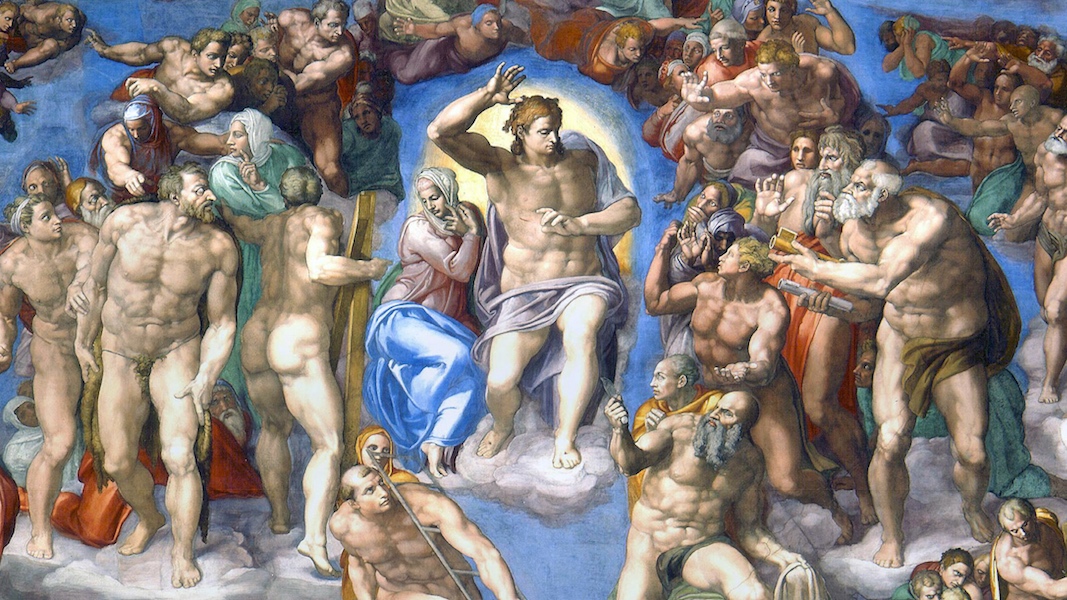
    Finally, there is yet a third adventus of the Messiah, a further way in which Christ comes into our world.  Like the Nativity, and unlike Holy Communion, it is a unique, one-time event: His coming in glory at the end of time. There’s still another meaning here as well, as each one of us receives a preview of sorts when He comes for us individually at death, the end of our own time here on Earth. Whether we are facing our own end, or the Ultimate End, we need to be ready to face our Judge.  As John the Baptist, who figures prominently in the Second sunday of Advent, warns us: “Even now the axe is laid to the root of the trees; every tree therefore that does not bear good fruit is cut down and thrown into the fire” (Matthew 3:10). For this reason Advent, much like Lent, and unlike Christmas, is a penitential season.


From Michelangelo's "Last Judgment"

    And yet Advent is different from Lent, too, as Christmas is a less complicated celebration than the Triduum and Easter, the observances that follow Lent.  Let’s return for a moment to our wedding analogy.  Advent, as I said above, can be compared to the period of engagement before a wedding.  Even though we know that marriage will also entail trials and hardships, it is a fundamentally good and happy thing, and so we anticipate the coming wedding with joy. We start making arrangements in advance (planning a reception, choosing a dress, sending invitations, etc.).  As the wedding day itself draws closer, our preparations intensify with bridal showers, rehearsals, and the rest.  Likewise the celebration of Advent intensifies as we draw nearer to the joy of the Nativity: the 3rd Sunday of Advent is called Gaudete Sunday because the introit for the Mass comes from St. Paul’s letter to the Phillipians, Gaudete in Domino semper: iterum dico, gaudete (“Rejoice in the Lord always, I say again, rejoice”, Philipians 4:4); we show our joyful anticipation with a pink candle on our advent wreaths on this Sunday. Then also, from December 17th (the first day of the O Antiphons) the daily liturgy becomes more Christmas-centric.
    And so, in a spirit of preparation, I will at last relent and put up the tree in my classroom (an artificial tree, of course, in keeping with state law) in the last week before Christmas break. I will remind my students, however, that it’s not Christmas quite yet.  And, when they return the first week of January, when the decorations have already been disappearing out in the world, the tree will still be there to greet them . . . because then ‘twill be The Season To Be Jolly.

Tuesday, December 6, 2016

St. Nicholas: Lover, Fighter . . . or Both?


St. Nicholas of Myra Saves Three Innocents From Death (Ilya Repin)

     Hang out your stockings: today, December 6th, is the feast day of St. Nicholas of Myra.  Over the last couple of centuries the modern Santa Claus has somehow developed from the figure of this 4th century bishop, but the real Saint has retained a strong devotion in both the Eastern and Western churches.  I say the “real Saint” with the proviso that he is another one of those Saints about whom little is known with historical certainty; as the biography at Catholic Online [here] tells us, “his episcopate at Myra during the fourth century is really all that seems indubitably authentic.”  Nonetheless, I think it’s reasonable to assume that what has come down to us has some basis, at least, in his life and in the way he conducted himself. 
     The most well-known story today concerns his generosity.  Having inherited great wealth from his parents, he decided, while still a young man, to give his money to the poor.  He famously rescued three poverty-stricken young women from being sold into prostitution by secretly throwing bags of money in through their windows. This incident is the inspiration for the tradition of leaving gifts in shoes or stockings on St. Nicholas Day.  He is also known as an exemplar of mercy, which fits nicely with generosity (and with the image of Santa Claus).  The best-known story about him in the first millennium tells how he appeared in a dream to the Emperor Constantine on behalf of three men who had been imprisoned unjustly; having learned that the official who was holding the men had a similar dream, and that the men had been praying for Nicholas’s help, the Emperor set them free.
St. Nicholas (R) has a theological discussion with Arius (L)
     Another old story about St. Nicholas, one which has recently enjoyed new popularity, tells of him attending the Council of Nicaea in 325 where, in a fit of anger, he slapped Arius, for whom the Arian Heresy is named.  This story has an irresistible appeal for many Catholics involved in apologetics, particularly when cast as a humorous contrast to affable image of Santa Claus (the Saint’s slap is often upgraded in these accounts to a more manly punch).  One can find numerous reproductions online, for instance, of ancient frescoes depicting the incident with captions like “I came to give kids presents and punch heretics . . . and I just ran out of presents!”  I have to admit, I have chuckled at some of these myself.  At the same time, it would seem that smacking Arius, heresiarch though he was, falls a little short of the Christian Charity test; the council fathers thought so, at least: we are told that they “deprived [Nicholas] of his episcopal insignia and committed him to prison”. We are also told that Jesus freed him from prison and restored him to his bishopric, so we can take that as confirmation that, despite his impulsiveness, his heart was in the right place. In any case, the incident illustrates another important aspect of the Saint: a man who was fiercely dedicated to preserving and defending the Truth.
     There may seem to be an incongruity between the Jolly Old Saint Nick who comes to the aid of poor maidens and innocent prisoners on the one hand, and the righteous crusader who puts a whuppin’ on heretics on the other, but that’s not the case.  The salvation that Jesus lived, suffered and died to bring us is salvation from sin, not from discomfort or physical hardships.  What could be more generous or merciful than rescuing a brother from sin, or even more so, preventing him from leading others into it [see here]?  Granted, we are called to do so with love (Ephesians 4:15), so I wouldn’t recommend emulating St. Nicholas’s smackdown of Arius.  Nonetheless, St. Nicholas embodies an important truth: that Generosity and Mercy are not opposed to Justice and Truth, but are, indeed must be, different sides of the same coin, as Scripture attests:

Show us thy steadfast love, O LORD,
and grant us thy salvation.
Let me hear what God the LORD will speak,
for he will speak peace to his people,
to his saints, to those who turn to him in their hearts.
Surely his salvation is at hand for those who fear him,
that glory may dwell in our land.
Steadfast love and faithfulness will meet;
righteousness and peace will kiss each other.
Faithfulness will spring up from the ground,
and righteousness will look down from the sky.  (Psalm 85:7-11)


That’s not a bad thing to reflect on this week as we celebrate the Feast of St. Nicholas -  Bishop, Lover, and Fighter.

Thursday, December 24, 2015

Lo, How A Rose E're Blooming

The hymn "Lo, How A Rose E'er Blooming", with its quiet, understated intensity, beautifully captures the spirit of Advent.  The song starts out recalling Isaiah's humble image of the shoot from the stump of Jesse and the people waiting in darkness:


Lo, how a Rose e’er blooming from tender stem hath sprung,
of Jesse’s lineage coming, as men of old have sung.
It came, a flow’ret bright, amid the cold of winter,
when half-spent was the night.


Isaiah ’twas foretold it, the Rose I have in mind . . .


We then turn our attention to the Blessed Mother, and see that tender shoot come forth in the person of Jesus:


With Mary we behold it, the virgin mother kind.
To show God’s love aright, she bore to men a Savior,
when half-spent was the night.


Finally, we are shown how God uses that seemingly small beginning to bring about great things:


This flow’r, whose fragrance tender with sweetness fills the air,
dispels with glorious splendor the darkness ev’rywhere.
True man, yet very God; from sin and death he saves us
and lightens ev’ry load.


Today, the last day of Advent, the night is more than half-spent, and we wait in joyful anticipation of God Himself, Emmanuel, coming among us in the form of a little human baby.  O come, o come Emmanuel!


(See also: We all get the conversion experience we need: “The Christmas Conversion of St.Thérèse” http://goo.gl/YSc1dh)