Nisi Dominus aedificaverit domum, in vanum laborant qui aedificaverunt eam - "Unless the Lord built the house, they worked in vain who built it" Ps. 127

Showing posts with label politics. Show all posts

Friday, July 30, 2021

The Bishops, the Politicians, and Abortion: What Would St. John Fisher Do?

  "You may not be interested in war, but war is interested in you."


Joe and Jill Biden at Mass

     The quote above is often attributed to communist revolutionary Leon Trotsky.  There is no record of his actually having said it, but it's widely repeated because it pithily sums up a terrifying truth about the relentlessness of war.  In an age when a large and influential segment of the population wages political warfare on all who seem to stand in the way of their urgent drive to replace reality as it is with a vaguely envisioned utopia, we can amend that to "You may not be interested in politics, but politics is interested in you."

 For a long time now the Catholic bishops in the United States have dabbled in politics, mostly in a manner that we would call "virtue signaling" today: a statement about nuclear war in the 1980s, expressions of concern about capital punishment in the 1990s, some hand-wringing about immigration in more recent years.  All issues with legitimate moral dimensions, it's true, but all likewise issues on which serious Catholics can have legitimate differences of opinion.  In none of them were the bishops confronting Catholics or others who were clearly advocating anything directly contrary to the moral law, or promoting an intrinsic evil.  And for what it's worth, none of them are areas in which Catholic bishops have particular competence.

  Over the same stretch of time there has been another issue looming, one which is indeed a matter of intrinsic evil, about which there is no room for prudential judgment, and which is very much within the competence of the episcopacy: abortion.

[click HERE to continue reading this post on Spes in Domino]

Tuesday, June 15, 2021

Discerning the Body: The Bishops, The Politicians, and The Eucharist

      It is now abundantly clear to all of us, I hope, that St. Paul's warning about the eternal battle "against the principalities, against the powers, against the world rulers of this present darkness, against the spiritual hosts of wickedness in the heavenly places" (Ephesians 6:12) is not just a rhetorical trope.  It's raging all around us with a palpable intensity.  One of the clearest signs is that more and more of our institutions are taking up and loudly proclaiming the ancient lie first whispered by the Father of Lies to our first parents: "your eyes will be opened, and you will be like God, knowing good and evil." (Genesis 3:5) The New Orthodoxy, in fact, goes beyond determining good and evil for ourselves: even external realities like male and female must bow before the the power of the "awakened" human will.  Anyone with the temerity to question the new teachings will be told, as Lot was by the men of Sodom:  "This fellow came to sojourn, and he would play the judge! Now we will deal worse with you than with them." (Genesis 19:9)

    When you consider the nature of the current struggle, it seems clear that language is one of the main fronts in the war right now.  Above I referred to Satan as the "father of lies".  That title is bestowed on him by Jesus himself: "When he lies, he speaks according to his own nature, for he is a liar and the father of lies. But, because I tell the truth, you do not believe me." (John 8:44-45) To the extent that we're wading through a sea of lies, we're fighting on the Enemy's chosen ground.  We need to find a way to move the battle back to dry land, to the truth . . . 

[click HERE to continue reading this post on Spes in Domino]


Monday, June 14, 2021

Who's really "politicizing" the Body of Christ?


    An unusual and unfamiliar expression, "Eucharistic Coherence", has been showing up on a lot of Catholic websites lately. I've written about the abuse of language on more than one occasion in the recent past (here and here, for instance), but this term is not itself abusive, rather it's intended to expose and correct abuse.  It refers to the coherence that ought to exist between the way Catholics profess and live out their faith in public on the one hand, and their worthiness to receive the Body and Blood of Our Lord in Communion on the other.  To put it more plainly, it's a fancy way of saying that public figures who actively promote abortion and other egregious violations of the moral law are not "devout Catholics", despite their self-professed devotion to Mother Church, and ought not receive communion.

   Seems pretty simple, doesn't it?  And yet it's not.  Here's the short version of the story: given the
exuberance with which certain nominally Catholic politicians in the United States promote the killing of the unborn, the dismantling of the family as an institution, and other unlovely manifestations of the Culture of Death, the U.S. Catholic Bishops are preparing to discuss Eucharistic Coherence (i.e., what to do about the scandal caused by said politicians) at their annual meeting later this month. You will no doubt be surprised to hear that a group of 68 American bishops (I could name names, but you probably know them already) have written to Archbishop Gomez, head of the Bishops Conference, asking him to halt the discussion . . . 

[click HERE to continue reading this post on Spes in Domino]

Thursday, April 29, 2021

What We Owe to Caesar

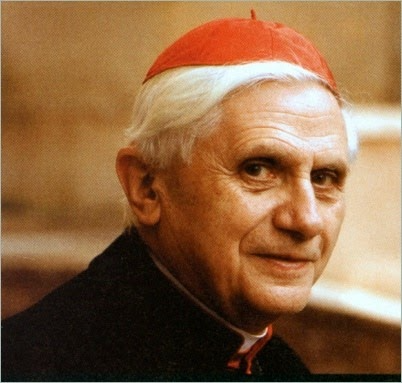
       Deciding how to balance what we really owe to Caesar with what we owe to God is a perennial issue for a believing Christian.  In the age of Covid and related governmental tomfoolery that question has become, let us say, even more acute.  This coming weekend I'll take a more specific look at recent events; today I'm posting an updated version of something I first published a few years ago drawing upon the work of a certain Joseph Cardinal Ratzinger when he was head of Congregation for the Doctrine of the Faith.  It's an oldie (in keeping with Throwback Thursday), but, as they say, a goodie.

Cardinal Ratzinger (Pope Emeritus Benedict XVI)

One need not buy in to the confusing and often intentionally obfuscating "Wall of Separation" language here in the United States to understand that the proper role for a believing Christian in public and political life is not always clear. As in other areas of decision-making, we need to apply our personal judgment in determining how to act in specific situations, but we should form those decisions in the light of the moral law and the teaching of the Church.  An enormously helpful guide in sorting out these questions is the Doctrinal Note On Some Questions Regarding The Participation Of Catholics In Political Life [text here], published November 2002 with the authorization of Pope (now Saint) John Paul II, and under the name of Joseph Cardinal Ratzinger, then Prefect of the Congregation for the Doctrine of the Faith, now Pope Emeritus Benedict XVI.

     The Doctrinal Note, despite its brevity (it’s only about eight pages long) is a wonderfully rich yet concise discussion . . . 

[click HERE to continue reading this post on Spes in Domino]

Wednesday, March 3, 2021

From Spes in Domino: St. Agnes of Bohemia - Bride of the King

 We mortal men and women need stories.  I don't mean "stories" in the sense of things that are untrue or simply made up. I mean that we learn and understand some things best, even perfectly true things, when we encounter them in story form.  We need the arc of narrative to capture and hold our imagination.  In order to really absorb concepts we need to see them embodied, literally, in people like ourselves and in the things that people do.

     That is part of the purpose of the cult of the saints.  Through intercessory prayer they advocate for us before the throne of God, but they are also examples for us: through the stories of their lives, they show us in a way we can't fail to understand what it is to be a follower of Jesus Christ.

     One of those things that they show us is how important each one of us is to God: "the wisdom of this world is folly with God." (1 Corinthians 3:19) One of today's saints, St. Agnes of Bohemia (also known as St. Agnes of Prague) provides a good example of just how foolish the "wisdom" of the world can be . . . 

[click HERE to continue reading this post on Spes in Domino]

Wednesday, May 2, 2018

Slavery in Rationalia

An earlier version of this Worth Revisiting post was first published 16 October 2016 . To enjoy the work of other faithful Catholic bloggers see Worth Revisiting Wednesday, hosted by Elizabeth Reardon at theologyisaverb.com and Allison Gingras at reconciledtoyou.com.

I was in a small local fish store recently when a sign taped near the cash register caught my attention.  The notice assured us that the raw shrimp, a product of the U.S. Gulf Coast, was “slavery free”. The cooked cocktail shrimp, on the other hand, was from Indonesia, so there was a good chance that slave labor was part of the process that brought it to market.  The shop was donating all proceeds from the cooked shrimp to “a foundation that works to end slavery in that part of the world” (one wonders why they didn't simply cook American shrimp themselves, but that's a question for another day).

Burmese slaves rescued in Indonesia (AP photo)
I have to admit, I was a little taken aback by a business touting its product as "slavery free".  I shouldn’t have been too surprised, of course: in an abstract way I was aware that slavery still exists in many parts of the world, much as it has from the earliest times. I also knew that certain forms of it exist, albeit less visibly, even in places where legal slavery has been abolished, including here in the United States (something that I had actually addressed in a recent blogpost). It’s still a bit of a shock, however, to come upon so tangible a reminder that human slavery is not just an abstraction, but a very concrete, very ugly, reality.
The persistence of slavery points to a deeper truth: human nature doesn’t change.  This is something that secular “progressives” are at great pains to deny.  Recently, for instance, Neil DeGrasse Tyson (astrophysicist and all-around cool science dude) published an essay in which he longs for a Utopia he calls “Rationalia”, where human reason, unhindered by the chains of religious superstition and what not, orders all things for supreme human happiness.  Tyson seems blissfully unaware of the complete and often bloody failure that has befallen all attempts at establishing the Rule of Pure Reason here on earth, from small-scale projects like Robert Owen’s New Harmony in 1825-1827 to the colossal horrors of 20th century communist regimes (Marxist theory held that simply changing the economic order of society could change human nature, and create a "new man". No such luck).  Nor does he acknowledge that the very science to which he looks as a savior has increasingly been coming to the conclusion that much of what happens in the natural world is apparently random, or at the very least beyond our powers of prediction.

Skulls of victims of Marxist Khmer Rouge in Cambodia (Wikipedia)
Ironically enough, reason itself should tell us that a human regime such as Rationalia (Tyson envisions its constitution as reading simply: "All policy shall be based on the weight of evidence") is hopelessly impossible.  For one thing, because of our finite knowledge and capabilities, we very often can’t even begin to assess all the possible variables that go into a particular issue (one of the major flaws in planned economies).  Not only that, different people can reach different conclusions using the same data because they legitimately have different values and interests.  
An even greater difficulty than either of those, however, is our legacy of original sin.  This is a topic that I have touched on before; the short version of the story is that our conclusions are very often determined more by our desires (very often disordered desires) than they are by the data.  One of the benefits of healthy religion is that it provides a reliable authority greater than our desires that can help guide us to sound conclusions.
    Christians, of course, know even more than that.  We know that the authority provided by our faith has in fact been empirically tested by human experience over several millennia (unlike the schemes of secular social engineers). Not only that, we know that the Author of that Faith is Himself our creator, and knows exactly what we need to be happy.  We are also aware that we can never perfect ourselves through our own efforts alone.  Perfection can only come through the Grace of our Creator, who offered himself up on the Cross in the person of Jesus Christ in order to make that Grace available to us.
The interesting thing is, the evidence of the persistence of human nature, and of our limits and radical imperfection, is abundantly clear: the further our society moves away from God, the more the primeval ugliness of our race rises again to the surface.  We may try to disguise it with euphemisms, but is anybody really fooled, for instance, by whitewashing sexual slavery with terms such as “sex workers”?  Well, maybe some people.  Those who most identify themselves as citizens of “Rationalia” seem to ignore the mounting evidence (so much for "All policy shall be based on the weight of evidence"). Instead, they cling to the fantasy that, somehow, all we need to do is expel God from the Garden in order to achieve perfect human bliss here on Earth.  Reason, however, tells us otherwise: the rational thing is to follow Christ, and listen to the teachings of the Church he has given us.

Tuesday, May 1, 2018

St. Joseph the Worker: We Are More Than What We Do

    They say that necessity is the mother of invention but, as today's feast of St. Joseph the Worker shows us, sometimes measures taken for practical purposes can point to deeper truths.


Holy Family Father and Son, by Corbert Gauthier
    The memorial of St. Joseph the Worker is a very recent addition to the liturgical calendar. Pope Pius XII, who wanted to present a Catholic alternative to the Communist celebration of May Day, instituted it in 1955.  Who better to counter the self-proclaimed "vanguard of the workers" than a great Saint who was also a laborer, a man known for his patience and perseverance, but also his piety?  As such, St. Joseph is also the ideal embodiment of the Dignity of Work.  He shows us that work is not simply something we do to survive, or that connects us to a certain economic class, but is an essential part of our humanity, a way in which we act, at least in a small way, as co-creators with God (see St. John Paul II's Laborem Exercens).
     At the same time, we can see that while a worker may be honored for his work, he is not defined by it.  Here the Catholic view stands in sharp contrast to the outlook of Marxism, where a working person's primary identification is with his class, and he finds meaning by working toward the "workers' paradise" of a fully communist society; since the realization of the workers' aspirations is the Greatest Good in this worldview, those who are seen as obstacles (such as members of the Capitalist Class) deserve to be extirpated.  Western market-driven societies have their own false anthropology in the phenomenon of the workaholic, whose whole life centers on his career, and who sees no meaning beyond it.  
     Christians, however, see our primary identification as adopted sons an daughters of God: equal in dignity (regardless of externals such as class, sex, race, etc.), called to love, and all of us members of the One Body of Christ who are are made in the image and likeness of God the Creator. What we do is an expression of what we already are, particularly when, as Christians we dedicate our work to the Greater Glory of God (Ad Maiorem Dei Gratiam), as St. Ignatius Loyola put it.
     Now look at St. Joseph.  There have probably been carpenters more skillful than Joseph, or more productive, but none of them have feast days. We honor him today in his role of worker, but that's not why he is a Saint.  He's a Saint, and a great Saint, because he cooperated in God's great work of salvation.  Today's feast reminds us that we can all aspire to sanctity, even humble laborers, and that whoever we are, and whatever we do in this world, what we do for the Kingdom of God and who we are in the eyes of the Father is what matters in the end. 

Wednesday, April 25, 2018

The Satan Club: One H*** of an After School Club for Children

An earlier version of this Worth Revisiting post was first published 7 October 2016 . To enjoy the work of other faithful Catholic bloggers see Worth Revisiting Wednesday, hosted by Elizabeth Reardon at theologyisaverb.com and Allison Gingras at reconciledtoyou.com.


There's A New Club In Town


    Here’s some happy news: the Nehalem Elementary School in Portland, Oregon, has approved a “Satan Club” for its young (i.e., pre-teen) students.  The club is sponsored by a group going by the felicitous name of The Satanic Temple. Does that, or does it not, sound uplifting?
Charming illustration from "Educatin With Satan" website
    I don’t doubt that there are some people who do consider it good news that there will be a club upholding the Prince of Darkness as a role model for youngsters.  In particular, some of a more secular bent may appreciate that this puts those of us in with, shall we say, more traditional religious views, in something of a bind.  After all, aren’t we always carping about religious freedom, and complaining about efforts to exclude religious belief from the public square? Don’t we claim that government has no business deciding what is legitimate religion and what is not?  Are we not, in fact, hypocrites if we try to prevent the satanists from sharing their enthusiasm for Lucifer with the boys and girls at Nehalem Elementary School?


Keeping The Satan In Satanism?
    The answer is, I think, simpler than it might at first appear.  We absolutely ought to oppose as strenuously as we can anything as poisonous as a “satan club” in schools, and no, there is nothing whatsoever hypocritical about it.  Consider the following:
    The satanists themselves make it clear that they are not really a religion.  For instance, The Satanic Temple is also trying to install an after school club in the Seattle, Washington area. The Seattle Times (story here)  quotes Tarkus Claypool, campaign manager for the group in that area, as saying: “We don’t worship a deity . . . We only see Satan as a metaphor for fighting religious tyranny and oppression.” This is a fairly common trope among Satanists, one you might have heard before.  There was a similar quote in the original Fox News article about the Oregon satan club.  That quote has since been removed, perhaps because the spokesperson in Portland also added that most satanists are really atheists, which tends to undercut even further their claim to religious status.
Illustration from the "Educatin With Satan" site
    So, if the satanists don’t really believe in Satan, what is the purpose of their club? “Our curriculum is about teaching them logic, self-empowerment and reasoning”, according to Claypool,  “The most Satanic thing about it is in the healthy snack — we have an apple.”  Finn Rezz, speaking on behalf of the newly-approved Nehalem group in Oregon, adds that, in addition to “science and rational thinking”, the club will promote "benevolence and empathy for everybody."
    If only that were true.  After all, if  all they wanted to do was to promote rational thinking, why not a “Reason Club”? Why not a “Science and Empathy Club”?  Those are perfectly legitimate viewpoints. Why not even an “Atheists Club”?  However much we believers might dislike it, the same laws that allow Christian clubs on school grounds also protect the nonbelievers.  The Satanic Temple has chosen a different route, however, and their choice of the Prince of Lies as their public persona tells us what they’re really about; it has nothing to do with reason or benevolence.


The Devil Is In The Details
    To begin with, let’s talk about Satan.  He has a track record: he’s been a public figure, so to speak, for millennia.  If you were to go out on the street and ask people at random what the Devil represents, what responses will you get?  Most people will, of course,  answer "evil", "sin", "death", "corruption", etc.  How many do you think will say “a metaphor for fighting religious oppression”?  There may be a few, perhaps, but a very few indeed. No, Lucifer’s image has remained true to the source that introduced him to us, the Scriptures.  There we read:


He who commits sin is of the devil; for the devil has sinned from the beginning. (1 John 3:8)
He was a murderer from the beginning, and has nothing to do with the truth, because there is no truth in him. When he lies, he speaks according to his own nature, for he is a liar and the father of lies. (John 8:44)
Satan disguises himself as an angel of light. (2 Corinthians 11:14)
Be sober, be watchful. Your adversary the devil prowls around like a roaring lion, seeking someone to devour. (1 Peter 5:8)


How rational is it to hold up as a paragon of “reason” a figure who is the enemy of truth, a born liar who hides his true nature?  How appropriate a personification of “empathy and benevolence” is someone known as a murderer who seeks to “devour” the unwary?  My purpose here is not to make a Biblical argument against the satan club, I’m simply pointing out who and what its patron has always been known to be, and what he actually represents. One doesn’t need to believe in the truth of the Bible to recognize that Satan represents the exact opposite of what the satan club claims to promote.


Reason and empathy? A science Lab?  Botticelli, Dante's Inferno Canto XVII


"By Their Fruits You Shall Know Them"
    In fact, their choice of the universally acknowledged personification of every evil as their public face brings to mind another applicable scripture passage: “You will know them by their fruits. Are grapes gathered from thorns, or figs from thistles? So, every sound tree bears good fruit, but the bad tree bears evil fruit.” (Matthew 7:16-17).  That’s just common sense, isn’t it? And what are the "fruits" of the satan club advocates? Do the satanists act like people committed to reason, love, and kindness, and do their own self-explanations emphasize any positive message of their own . . . or are their fruits of a different kind?  Let us look again at what they say about themselves.  Seattle satanist Tarkus Claypool says of the satan club, “It’s designed to be a counterpoint to the Good News program.” Portland Oregon’s Finn Rezz says that their satan club "will be held on Wednesdays once a month at the same time as the Good News Club."  In fact, if we look at the FAQ page from the satanists “Educatin With Satan” website, we find that they really have more to say about this “Good News Club” than they do about their nominal patron demon, and certainly more than they do about reason, science, benevolence, empathy put together.  In several places they cite the Good News Club as their reason for being, and they even advise those who might wish to establish a satan club (my bold):


Please keep in mind that The Satanic Temple is not interested in operating After School Satan Clubs in school districts that are not already hosting the Good News Club. However, The Satanic Temple ultimately intends to have After School Satan Clubs operating in every school district where the Good News Club is represented.  


Seattle area Satanic Temple members (Seattle Times photo)


    Now, if their reason for existing were really simply to spread reason and goodwill they’d want to do that everywhere, don’t you think?  By their own admission, their true purpose is to antagonize the Good News Clubs.


Good News: What's Not To Like?
 
    What are these Good News Clubs that so exercise the good people at the Satanic Temple? The Good News Clubs are a ministry of the Child Evangelism Fellowship.  From CEF’s website they appear to adhere to a fairly traditional Evangelical Protestant understanding of Christianity.  They describe the purpose of their Good News Clubs as follows:


Our ministry teaches morals and respect for others, helps build character, strengthens families, assists schools and encourages children. We frequently receive comments of support from school officials, bus drivers and parents which complement the positive change in the behavior of the boys and girls who attend Good News Clubs. Our mission is to serve the children, their parents, the school and the community.


They also give a succinct explanation of their methodology:
Photo from CEF website
. . . trained teachers meet with groups of children in schools, homes, community centers, churches, apartment complexes, just about anywhere the children can easily and safely meet with their parent's permission. Each week the teacher presents an exciting Bible lesson using colorful materials from CEF Press. This action-packed time also includes songs, Scripture memory, a missions story and review games or other activities focused on the lesson's theme.


As with all CEF ministries, the purpose of Good News Club is to evangelize boys and girls with the Gospel of the Lord Jesus Christ and establish (disciple) them in the Word of God and in a local church for Christian living.


Here and in numerous other places they emphasize that they only meet children with their parents’ permission, and do not seek to supplant their family’s church. Also, while they are straightforward in proposing sin as something that infects everyone, they at the same time emphasize Christ's saving love and forgiveness: "Now, because of what Jesus has done for you, you can have your sins forgiven. Read on to see how!"


J'Accuse!

Most fair-minded people, even if they take issue with the Child Evangelism Fellowship on some points of theology and ecclesiology, would have a hard time objecting to this program. Perhaps you won’t be surprised that the Satanic Temple doesn’t take a positive view.  On their FAQ page they say:


[T]he twisted Evangelical teachings of The Good News Clubs “robs [sic] children of the innocence and enjoyment of childhood, replacing them with a negative self image, preoccupation with sin, fear of Hell, and aversion to critical thinking . . . ”


Forgive me for observing that this angry, accusatory smear seems neither rational nor objective, nor terribly benevolent or empathetic.  In fact, it reminds me of nobody so much as the satan clubs’ standard bearer, of whom I observed in an earlier post:
For this reason he is called “the Devil”, from the Greek διάβολος (diabolos), which means “slanderer, perjurer, false accuser, and can also mean “deceiver, one who misleads”.  It derives from the verb διαβάλλω (diaballo), whose original meaning is “drive through”, or destroy.  Satan seeks to destroy us, eternally, by using falsehood and deception to separate us from God.


Isn’t that just what the satan club is about?  They pose as “angels of light” with their talk of empathy and science, but it’s clear by their own words and deeds that their true agenda is to disparage and harass a particular Christian group, and separate Christian children from the religious beliefs of their families; the only plausible reason to choose as their public face Satan, the personification of mindless hatred, untruth, and evil from the Christian Scriptures, is to taunt and insult Christians; their stated policy is to form their clubs only where they can target the Evangelical Christian Good News clubs.  Clearly, their purpose is not to promote a religion they assure us they don't believe, and they manifestly don’t model the virtues they claim to advocate.  They are in reality a hate group dedicated to denying Christian students the right to exercise their own right of free expression in their own clubs.  Far from being hypocrites, we have solid legal and moral reasons to work to deny them access to public facilities.


Sunday, February 5, 2017

Killing Is Not Compassion


I call heaven and earth to witness against you this day, that I have set before you life and death, blessing and curse; therefore choose life, that you and your descendants may live, loving the LORD your God, obeying his voice, and cleaving to him . . . (Deuteronomy 30:19-20)

True Crime Story?

    Imagine you’re reading a book, or watching a film.  In this story a caregiver, a trusted figure, secretly puts a sleep-inducing drug in the coffee of an unsuspecting person under her care.  Once the victim is no longer conscious, the perpetrator tries to administer a more powerful drug, a lethal drug.  The victim (who had previously expressed to her care provider a desire to continue living) wakes up and fights back.  The caregiver calls upon accomplices (from the victim’s own family, no less!) to restrain her, and forcibly administers the deadly injection. Sounds like a crime thriller, doesn’t it?  But wait, there’s more . . . here the story changes from a crime thriller into a Kafkaesque dystopian nightmare. The deed comes to the attention of the authorities, who conclude that the killer should indeed go to trial . . . but not to punish her wicked crime.  Rather, despite conceding the lurid details above, they conclude that she “acted in good faith”, and seek a trial in order to establish a legal precedent that other health care providers may likewise kill unknowing, and even unwilling, persons without fear of punishment.

Healer, or killer? (detail from painting by Mikhail V. Nesterov)


    As you may have guessed, the scenario above is in fact a true story, which recently took place in the Netherlands, as detailed in this article from LifeNews.com. The only major detail left out of my retelling, and the only thing (at least in the minds of the Dutch Review Committee that investigated the case) that makes what appears to be an act of unspeakable wickedness into a “good faith” medical procedure, is the fact that the victim was suffering from dementia.  As more and more places are following the Netherlands along the path of the legalized killing of the old, infirm, and, increasingly, those who are simply unhappy, it would be wise to take a look at cases like this to see what lies ahead.

In the Eyes of the Law

Prof. Theo Boer (Daily Mail photo)
    The case above is a chilling illustration of how, once we cross the line of giving legal sanction to the direct taking of innocent life, we unleash a force beyond our control, in which the “logic” of death overwhelms supposedly rational considerations.  Let’s start with what Dutch law provides for, and see how it compares to what actually happened in the situation above.  Theo Boer, a professor of Health Care Ethics at Kampen Theological Seminary in the Netherlands recently published an article in the British Catholic Medical Quarterly explaining why he no longer favors the pioneering Dutch law allowing physician assisted suicide. We’ll get to his reasons in a moment; first I’d like to take a look at his summary of the law in question.  Pr. Boer explains that, according to Dutch law:  
-1. “First, there should be a request from the patient” - There was no such request, and in fact, according to an article in the UK’s Daily Mail,
. . . the patient said several times ‘I don’t want to die’ in the days before she was put to death, and that the doctor had not spoken to her about what was planned because she did not want to cause unnecessary extra distress. She also did not tell her about what was in her coffee as it was also likely to cause further disruptions to the planned euthanasia process.
-2.  “there should be unbearable suffering without prospect of improvement” - The daily Mail tells us that “she often exhibited signs of fear and anger, and would wander around the building at nights. The nursing home senior doctor was of the opinion that she was suffering intolerably”, but  adds that “she was no longer in a position where she could confirm that the time was now right for the euthanasia to go ahead”. In other words, in the subjective judgment of outside observers her life was no longer “worth living”; other facts in the case indicate that the person living that life didn’t concur in that judgment.
-3. “the doctor should inform the patient of his situation” - demonstrably no.
-4. “doctor and patient together should have come to the conclusion that there is no acceptable alternative” - again, manifestly not.
-5. “the doctor should have consulted a colleague” - it is unclear from the Daily Mail article whether the “senior doctor” is the same who administered the lethal injection, but it is likely that more than one doctor on the staff participated in discussing the case.  If so, this is the one point on which the doctor unambiguously complied with the actual requirements of the law.
-6. “The assisted dying should take place in a medically sound manner” - well . . .
. . . secretly drugging a patient, then forcibly injecting her as she fights for her life doesn’t fit my standard of sound medical manner, but others may have a different opinion. In any case, the attending physician incontestably violated provisions 1,3, and 4 of the law, arguably number 2 and, if one is to take a civilized view, number 6 as well.  Setting aside for the moment the morality of any such law (I’ll get to that), the doctor euthanizing this patient blatantly flouted most of the specific provisions of the law. How in this world is it possible that the Review Committee would not only bless the doctor’s efforts, but would also be so confident that the courts would agree?

Gospel of Life
    To answer that question, I suggest we go back to St. John Paul II’s Encyclical Evangelium Vitae (The Gospel of Life), published in 1995, six years before the passage of the Dutch assisted suicide law.  St. John Paul, in speaking of both legalized abortion and legal euthanasia, wrote (my bold):
The end result of this is tragic: not only is the fact of the destruction of so many human lives still to be born or in their final stage extremely grave and disturbing, but no less grave and disturbing is the fact that conscience itself, darkened as it were by such widespread conditioning, is finding it increasingly difficult to distinguish between good and evil in what concerns the basic value of human life. (Evangelium Vitae 5)
St. John Paul II
In other words, not only are the acts themselves immoral and unjust, but they tend to corrupt the moral understanding of society as a whole, and consequently the morals of everyone in it.  Why should we expect anyone to honor the specific provisions of man’s laws if we no longer recognize the legitimacy of the moral law, God’s Law, itself?
    There is a clear pattern to the way this corruption works in concrete instances, which we can see in the legal history of contraception and abortion over the past century: The rare, extreme case is offered as an exception to a ban on something that had previously been considered intrinsically wrong; once the line has been breached, however, there is no longer any reason in principle to deny to others what was at first permitted to only a few.  If it’s not wrong for married couples experiencing certain difficulties to use contraception, why should it be wrong for others? If it’s not murder for one woman to abort her baby, how can it be so for another? We have now seen the same thing happen here in the United States with marijuana laws: first only “medical” marijuana for people with glaucoma and other conditions, but followed in short order by the general lifting of restrictions.  We should expect that, once rare “hard cases” have been used to legitimize legal euthanasia, the killing will become increasingly more commonplace, and “acceptable” in an ever wider range of situations.

It Can’t Happen Here . . . Can It?
    Pr. Boers details how this exact thing has happened in the Netherlands with assisted suicide and direct euthanasia.  The law was proposed to apply to people who were suffering late-stage terminal illness and suffering extreme pain.  Before very many years, those people became the exception to the rule:

. . . what was once considered a last resort, now becomes a default mode of dying for an increasing number of people. The unbearable character of the suffering is lesser described in terms of physical suffering and more in terms of ‘meaningless waiting’.

    In fact, most of the people requesting euthanasia aren’t dying at all:

Whereas in the first years hardly any patients with psychiatric illnesses or dementia appear in reports, these numbers are now sharply on the rise. Cases have been reported in which a large part of the suffering consisted in age related complaints. Loneliness occurs in 50 out of the last 500 cases that I reviewed before stepping back. Many of these patients could have lived for months, others for years or even decades. We have seen a number of ground breaking cases: ‘euthanasia for two’, for example couples in which the caregiver gets cancer and his partner chooses to die the same day and the same way; euthanasia in blindness; euthanasia for a man with autism who fears retirement; assisted dying for a mother of two suffering from tinnitus. Undeniably, assisted dying for one group of patients leads to demands from others.

    Similar results are reported in Oregon, the first US state to legalize assisted suicide, and in other states that have followed since.  There, the most common reason given is the abstract, amorphous "loss of autonomy" (see chart below). Less than a third cite pain (and not all of those are actually experiencing pain: for some it is only fear of possible pain). In fact, the most common factor among those seeking assisted suicide is not pain or terminal illness but depression, a treatable, non-fatal condition.  Studies conducted in both the United States and the UK indicate that over 90% of those seeking assisted suicide are suffering from mental problems. Nevertheless most of these people receive no psychiatric assistance prior to their death.   In fact, we have seen in the United States, and Pr. Boer reports the same in the Netherlands, that the doctors who preside over these deaths often have no professional relationship at all with their patients, and sometimes don’t even know them.


The Law as a Teacher
    The idea that “The Law is a Teacher” is an old one, going back at least to St. Paul’s letter to the Galatians.  So what does a law permitting killing people because they are old or sick teach us?  Surely it sends the message that human life is not sacrosanct, but instead something that can be disposed of when it becomes difficult . . . and if difficult lives are expendable, then why not inconvenient lives?  And where do we go from there?  St. John Paul explains that:
It is a problem which exists at the cultural, social and political level, where it reveals its more sinister and disturbing aspect in the tendency, ever more widely shared, to interpret the above crimes against life as legitimate expressions of individual freedom, to be acknowledged and protected as actual rights.  (Evangelium Vitae 18)

    Pr. Boer, in language strikingly like that in the passage above, confirms that such has in fact been the case in the Netherlands, saying that “there is a shift in public opinion. Whereas in the beginning assisted dying was seen as a last resort, public opinion is shifting towards considering it a right” (my italics).  Boer goes even further, however, adding:

. . . public opinion is shifting towards considering it a right, with a corresponding duty on doctors to act. A law that is now in the making obliges doctors who refuse to actively refer their patients to a ‘willing’ colleague.

The Culture of Death
Dance of Death by Venne Adriaen Pietersz
   We can expect the pressure on doctors to participate in killing to grow more intense in jurisdictions that have legalized euthanasia.  The idea of such killing as a legitimate good likewise puts pressure on family members to seek it for loved ones who may be unable to ask for it themselves (which may have been a factor in the Dutch case discussed above), and also on those who are themselves suffering to “spare” their relatives the trouble of caring for them.  This very concern is among the most cited reasons given by those asking for assisted suicide or euthanasia.  And so we see the corrupting power of sin: doctors, who have dedicated themselves to healing, are increasingly compelled to do the opposite and kill; close family members see themselves in mortal conflict with those whom they love . . . and killing off grandma becomes little more exceptional than "putting to sleep" the family dog.
    That’s the future that’s in store for us if we continue down the path of killing as a remedy for suffering, old age, and mere ennui.  We can look forward to more and more people implicated in ever greater acts of injustice, and ever wider waves of corruption spreading throughout society as a whole.  As we can see from events in the Netherlands this is no longer conjecture, but, in many places, a reality, a reality famously described by St. John Paul II as a "culture of death"  (Evangelium Vitae 12). The people who are relentlessly pushing Death as the solution to a myriad of problems will try to paint killing as “compassionate”, but the truth is very different. Killing is not Compassion.