Nisi Dominus aedificaverit domum, in vanum laborant qui aedificaverunt eam - "Unless the Lord built the house, they worked in vain who built it" Ps. 127

Showing posts with label faith. Show all posts

Wednesday, September 29, 2021

Has Tradition Become A Dirty Word?

     Picture Sunday Mass in a typical parish.  A mother comes up for communion holding a small child in her arms.  As she approaches the priest, she awkwardly holds on to her infant with one arm in order to free up the other to take the Eucharistic host and quickly pop it into her mouth before she drops it, or her squirming child, to the floor.  I’ve witnessed this scene on numerous occasions over the years, and I always wonder why the harried parent doesn’t avail herself of a simple and effective method of protecting both the safety of her son or daughter and the dignity of all the parties involved (very much including Christ present in the Eucharist): hold her child securely in both arms, extend her tongue, and receive the Body of Christ in the same manner as her ancestors did for centuries before her: the manner that is still, officially, the norm for the entire Church.

"Les Premières Communiantes" by Blanchard,
Musée de la Civilisation, Québec
    But let’s set aside, for the moment, the issue of Church norms. Why should the young mother holding her baby receiving communion, or any of us for that matter, care what our ancestors did?  That is to say, what is the point of tradition?


     The question of the value of tradition has been given a certain currency by Pope Francis’ recent motu proprio Traditionis Custodes, which seeks to restrict the Traditional Latin Mass (TLM). G.K. Chesterton called tradition “the democracy of the dead” because it gives our forebears a “vote” in how we conduct ourselves here and now.  This is something unique to humanity . . .

[click HERE to continue reading this post on Spes in Domino]

Sunday, August 15, 2021

Practical Apologetics: The Geometry of Faith

 Once upon a time I was a teacher in a (more or less) Catholic school, where I was occasionally called upon to teach an introductory theology course to the bright-eyed young men & women of the ninth grade.  Of the roughly 16 students per class there would usually be 2-3 Catholic students whose families attended Mass at least weekly, and a like number of non-Catholic Christians who were regular church goers.  The rest were raised in a secular environment, ranging from occasionally religious to explicitly atheist.  

     I soon found that most of these young people, even many of the regular church attendees, had been so indoctrinated into a materialist way of thinking by teachers, mass media, and society in general that I found it difficult to explain even basic religious ideas.  It was almost like speaking a foreign tongue.  Some of these students were fans of the then-popular "new atheists" (Dawkins, Hitchens, etc.), and most had been affected to some degree by "scientistic" thinking, that it, the idea that scientific explanations were the only serious or valid explanations. I found that I had to get them outside of these narrow ways of understanding reality before they could even begin to understand the purpose of or the need for religious faith.

      Many of my blog posts grew out of discussions with these students, including some republished here ("Has Pascal's Wager Really Been 'Debunked'?", "God's Existence Isn't A Dark Matter").  The post below is another of these, in which I try to get my students to look at the world from a different - ahem - angle . . .

[click HERE to continue reading this post on Spes in Domino]          

Monday, July 19, 2021

Finding the Future in the Past: Why The Latin Mass is not Going Away

       The scene is a parish church.  A congregation has assembled for Sunday Mass. The opening hymn begins with a grand flourish.  The celebrant processes into the church amid alleluias and mighty blasts from the organ. We reach a mini-climax.  The music ends. Then, there is a moment of silence while the celebrant adjusts his microphone. He smiles.  And what are the first words out of his mouth? "Good morning, everybody" THUD! You can almost hear something collapsing . . . The church building, the music, and the celebrant in flowing robes all seem to to say, "This is a ritual," an event out of the ordinary.  Then, the "Good morning" intrudes itself and indicates that this is really a business meeting and not a liturgy, after all. -Thomas Day, Why Catholics Can't Sing

In Why Catholics Can't Sing Thomas Day takes a close and often acerbic look at what is wrong with the liturgy as it is all too often celebrated in Catholic churches. A major theme, as we can see in the excerpt above, is that reformers and others (both clerical and lay) who are responsible for planning and conducting liturgical celebrations ignore the importance of ritual - of sights, sounds, scents, and actions - in fostering our relationship with God.  While there have been some marked improvements since Day's book was first published in 1991 (most notably Pope Benedict  XVI's Apostolic Letter Summorum Pontificum in 2007, about which more below), we're nowhere near out of the woods yet.  

"David Bearing the Ark of the Covenant into Jerusalem" by Domenico Gargiulo, c. 1640


     This is not just a matter of aesthetics, by the way.  Yes, a poorly celebrated or even a lackadaisical Mass can still be valid, and the Eucharist confected by an irreverent priest is still the Body and Blood of Christ.  The Mass, however, is more than just a delivery system for the Eucharist.  It is also the highest form of prayer. It helps us to find communion with our Lord on a number of different levels, and prepares us, ideally, to be properly receptive to the Grace of the Eucharist.  And, if we truly believe that the Mass is bringing us the Real Presence of the Second Person of the Trinity, well, can we possibly be reverent enough?

[click HERE to continue reading this post on Spes in Domino]


A Brief Visit to Hell

"Lucifer" by Cornelius Galle, 1595
      Who wants to talk about Hell?  Just about nobody, and we can hardly blame them - why dwell on something as, well, hellish, as eternal torment?  Many people, both inside and outside the Church, only mention the Abode of the Damned at all in order to discount it.  At the same time, we don't have the luxury of ignoring it. Hell and eternal damnation are spoken of often and explicitly in Scripture, very often by Jesus Himself. He tells us in Matthew's Gospel, for example: "The Son of man will send his angels, and they will gather out of his kingdom all causes of sin and all evildoers, and throw them into the furnace of fire; there men will weep and gnash their teeth." (Matthew 13:41-42)  This is not an isolated statement, neither on the part of Jesus himself, nor elsewhere in the New Testament.  The most vivid description outside of the words of Christ is in the Book of Revelation, which on four separate occasions refers to the "Lake of Fire"  into which the Devil, his angels, and other evildoers are cast.


   It's difficult for us to balance the idea of a Hell of eternal torment with the image of a God who "is Love" (1 John 4:8), especially in our world today where sentiment is king: Hell "feels" wrong.  In fact, I recently had a reader of my discussion of Pascal's Wager who accused me of believing in a "monster" God who "would torture you forever" if you didn't believe in him. I answered that neither I nor the Catholic Church believe in a God who "tortures" people "forever" . . .

[click HERE to continue reading this post on Spes in Domino]

Tuesday, June 15, 2021

Discerning the Body: The Bishops, The Politicians, and The Eucharist

      It is now abundantly clear to all of us, I hope, that St. Paul's warning about the eternal battle "against the principalities, against the powers, against the world rulers of this present darkness, against the spiritual hosts of wickedness in the heavenly places" (Ephesians 6:12) is not just a rhetorical trope.  It's raging all around us with a palpable intensity.  One of the clearest signs is that more and more of our institutions are taking up and loudly proclaiming the ancient lie first whispered by the Father of Lies to our first parents: "your eyes will be opened, and you will be like God, knowing good and evil." (Genesis 3:5) The New Orthodoxy, in fact, goes beyond determining good and evil for ourselves: even external realities like male and female must bow before the the power of the "awakened" human will.  Anyone with the temerity to question the new teachings will be told, as Lot was by the men of Sodom:  "This fellow came to sojourn, and he would play the judge! Now we will deal worse with you than with them." (Genesis 19:9)

    When you consider the nature of the current struggle, it seems clear that language is one of the main fronts in the war right now.  Above I referred to Satan as the "father of lies".  That title is bestowed on him by Jesus himself: "When he lies, he speaks according to his own nature, for he is a liar and the father of lies. But, because I tell the truth, you do not believe me." (John 8:44-45) To the extent that we're wading through a sea of lies, we're fighting on the Enemy's chosen ground.  We need to find a way to move the battle back to dry land, to the truth . . . 

[click HERE to continue reading this post on Spes in Domino]


Monday, May 10, 2021

What Do We Do When Our Priest Is A Communist? (Part II)

   In my prior post, "What Do We Do When Our Priest Is A Communist? (Part I)" we saw that the true Church is not reducible to the people who occupy its offices at any particular point in time, not even to those in the highest positions of authority.  The true Church is the Mystical Body of Christ extending through time. We depend upon that Church for our salvation, and we can't abandon it because of the malfeasance of its temporary caretakers, whether they are priests, bishops, or even (if you can believe it) popes.

Bad popes: "Pope Formosus and Stephen VII"
by Jean-Paul Laurens, 1870

 At the same time, while the immorality and infidelity of bad clerics can't unmake the Church itself, it can do a lot of damage to members of the Church, and Church institutions, in particular times and places.  It can cause souls to be lost.  That was in fact the concern of the original comment that led to these posts.  A father was afraid that the bad example and erroneous teaching of certain prominent churchmen (including some at a decidedly higher pay grade than his parish priest) would damage the faith of his children, and that he might need to leave the Church for their protection . . . 

[click HERE to continue reading this post on Spes in Domino]

Thursday, May 6, 2021

A Tertullian for our Time: Merton for Better and for Worse

  "The blood of the martyrs is the seed of the Church"

    You’re probably familiar with the quote above, a favorite of Pope St. John Paul II.  It’s author is Tertullian (c. A.D. 160 – c. A.D. 220), one of the foremost Christian writers and apologists of his age, who also gave us such essential terms as “Trinity” (Trinitas) and “Three Persons, One Substance” (Tres Personae, Una Substantia).  Despite his enormous achievements, however, and his lasting influence, Tertullian is not considered a Father of the Church; we don’t even call him “Saint” Tertullian:  he chose, sadly, to follow his own judgment rather than that of the Apostolic Church, and fell into heresy in the latter part of his life.


     I first wrote this post six years ago, as a follow-up to my essay "Merton's Parable of the Trappists and Icarians".  I had been reminded of Tertullian by several things I read at that time about the Trappist monk Thomas Merton who, if he had still been with us, would have been celebrating his 100th birthday at the time (January 31st 2015).  I don’t mean to suggest that Merton was a figure on a par with Tertullian: the late Trappist made no lasting contribution to the development of Catholic Doctrine, and added no new words to our vocabulary, although he was quite influential in his time (and still is, to a degree).  Like Tertullian, however, he didn’t stay the course: while he never considered himself to have left the Church, his growing involvement with Zen Buddhism in his last years appeared to be carrying him outside the bounds of Christian belief and practice . . .

[click HERE to continue reading this post on Spes in Domino]

Wednesday, May 5, 2021

What Do We Do When Our Priest Is A Communist? (Part I)

 "Lord, to whom shall we go? You have the words of eternal life" (John 6:68)


Is this your parish priest?

  We live in scary times.  It looks like our secular institutions in the West are collapsing, to be replaced by mob rule (which really means, as always, a tyranny of the elite who manipulate the mob).  More frightening still for Catholics, the institutional Church appears to be experiencing a parallel slide.  A commenter on my post about the Trappists and Icarians  expressed his unhappiness at attending Mass where, as he put it, the priest "preaches communism."  He was not just concerned, however, that many Catholic clerics, from parish priest on up, are abandoning the Faith for a poisonous brand of politics, but also, on a more practical level, that the Catholic Church itself was not a safe place for his children.

    The commenter raises some valid and important points, which deserve a better answer than I can give off the cuff in a social media combox . . . I was thinking about how to approach this topic Friday morning, when I received some timely help from the daily Mass readings.  . . . 

[click HERE to continue reading this post on Spes in Domino]

Tuesday, May 4, 2021

Merton's Parable of the Trappists and the Icarians (Spes in Domino)

Thomas Merton
 Thomas Merton is a name that can provoke a reaction from all manner of Catholics . . . all manner of reactions as well, depending on whether you invoke the Merton of the 1940's, a doctrinally orthodox convert to Catholicism who was enamored of his new life in a Trappist monastery, or the Merton of the 1960's who, although still a monk, seemed more interested in anti-Vietnam politics and Buddhist mysticism.  This article, an update of a post I first published six years ago at the time of Merton's hundredth birthday, is about an illuminating story in one of his early (i.e., orthodox) books.  I'll publish a follow-up post about Merton himself next week.

       Although vowed to silence in his everyday life in the Trappist abbey of Gethsemani in Kentucky, Thomas Merton was a gifted writer whose literary work was first permitted, and then encouraged by his superiors.  His first and best book is The Seven Storey Mountain, the autobiography he published in 1948.  It's a  beautifully written, compelling story of his conversion to Christ and to Catholicism.  He was not without his failings, however, some of them rather serious. Not only that, but toward the end of his life in the mid to late 1960’s he became increasingly drawn to Zen Buddhism.  It was not clear that he could still be truly considered a Catholic at the time of his unexpected death in Thailand in 1968 . . . 

[click HERE to continue reading this post on Spes in Domino]

Thursday, April 29, 2021

What We Owe to Caesar

       Deciding how to balance what we really owe to Caesar with what we owe to God is a perennial issue for a believing Christian.  In the age of Covid and related governmental tomfoolery that question has become, let us say, even more acute.  This coming weekend I'll take a more specific look at recent events; today I'm posting an updated version of something I first published a few years ago drawing upon the work of a certain Joseph Cardinal Ratzinger when he was head of Congregation for the Doctrine of the Faith.  It's an oldie (in keeping with Throwback Thursday), but, as they say, a goodie.

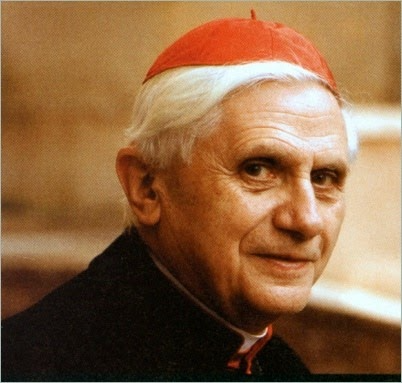
Cardinal Ratzinger (Pope Emeritus Benedict XVI)

One need not buy in to the confusing and often intentionally obfuscating "Wall of Separation" language here in the United States to understand that the proper role for a believing Christian in public and political life is not always clear. As in other areas of decision-making, we need to apply our personal judgment in determining how to act in specific situations, but we should form those decisions in the light of the moral law and the teaching of the Church.  An enormously helpful guide in sorting out these questions is the Doctrinal Note On Some Questions Regarding The Participation Of Catholics In Political Life [text here], published November 2002 with the authorization of Pope (now Saint) John Paul II, and under the name of Joseph Cardinal Ratzinger, then Prefect of the Congregation for the Doctrine of the Faith, now Pope Emeritus Benedict XVI.

     The Doctrinal Note, despite its brevity (it’s only about eight pages long) is a wonderfully rich yet concise discussion . . . 

[click HERE to continue reading this post on Spes in Domino]

Saturday, April 17, 2021

Welcome to Mission Territory

 "When a man stops believing in God he doesn’t then believe in nothing, he believes anything."


G. K. Chesterton
    You have probably run across the quote above, usually attributed to G.K. Chesterton.  While Chesterton never actually said it in quite those words, it does appear that he really did express this sentiment in a somewhat different form in several places (for more information, see this discussion on the website of The Apostolate of Common Sense).  More to the point, the events of the recent past have shown this observation by the  "The Prince of Paradox" to be tragically on target.

      In that regard, allow me to direct your attention to some other quotes (albeit somewhat less witty) that you have probably run across.  In the run up to last year's election yard signs started popping up with a rainbow colored litany that ran something like this . . . 

[click HERE to continue reading this post on Spes in Domino]

Thursday, April 15, 2021

God's Existence isn't a Dark Matter


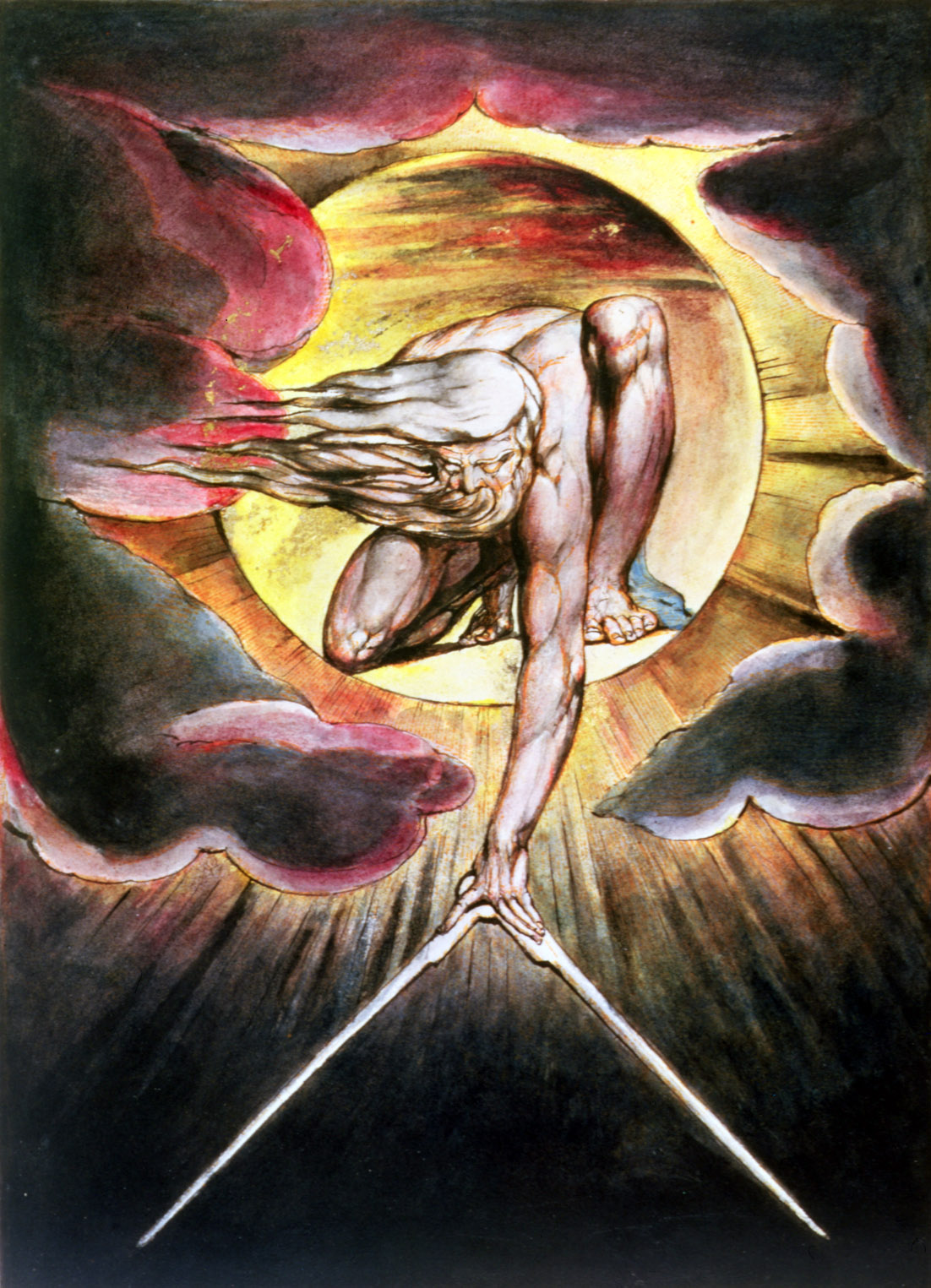
"Ancient of Days" by William Blake,
 from 
Europe a Prophecy, 1794
Once upon a time I taught in a (more or less) Catholic high school.  Occasionally I was called upon to teach religion to the bright-eyed young men and women of the 9th grade. At the time the so-called "New Atheists" (Dawkins, Hitchens, Dennett, etc.) were in vogue, and so class usually contained two or three students eager to try out the  latest anti-Christian tropes that they had picked up online or wherever it is that aspiring atheist proselytizers hang out.  Needless to say, we had many a lively discussion. A number of these discussions became blog posts.

      In the course of these conversations I became aware just how much our educational system and our cultural institutions have become imbued with an unspoken materialist  orientation. Virtually all my students, even professed Christians, seemed to take it for granted that a transcendent God who cannot be measured or detected with scientific instruments could not be shown to exist . . .

[click HERE to continue reading this post on Spes in Domino]

​

Thursday, March 25, 2021

"Let It Be Done To Me According To Thy Word" - The Annunciation and Us (From Spes in Domino)

       I often used to admire a stained glass window that looks down on the altar in the cathedral where I used to attend Mass with my family.


     The scene in the window is the Annunciation. It depicts the young Mary, kneeling on the floor and surrounded by angels, while God the father looks down on her from above, sending forth a beam on which rests the Holy Spirit in the form of a Dove.  God the Son is there, too, although we don’t see him, a human embryo in Mary’s womb, the Omnipotent Divine wrapped in mortal human flesh.  That’s how we encounter Jesus in the Gospels: the Eternal Word in human disguise. That’s how we receive him in the Holy Eucharist: the Second Person of the Trinity in the form of simple bread.  It’s a marvelous image to contemplate as we approach the Altar of the Lord to receive Holy Communion.

   Mary’s willingness to give up herself to be a part in God’s Great Drama of Salvation, perhaps the greatest (solely) human actor, is the big picture; as is often the way, there’s a little picture, too, a way in which the Annunciation is reflected in our own lives.  God has a plan for all of us . . .

[click HERE to continue reading this post on Spes in Domino]

Friday, March 12, 2021

From Spes in Domino: What to do about Vatican II

  Do you want to start an instant fight in a group of Catholics, any group, no matter how large or small?  Here's a method guaranteed to work 100% of the time: just mention Vatican II. That's all it takes, just toss it in there like a hand grenade and watch the fireworks begin!


    You can find the latest evidence for the volatility of any discussion of the Second Vatican Council by looking at the comments section of an article called "How should we think about Vatican II?" published earlier this week by Douglas Bushman on the Catholic World Report website. It's clear that, over half a century after the close of the Council, the dust from Vatican II still hasn't settled. Maybe it's about time that it did . . . 
[click HERE to continue reading this post on Spes in Domino]

Monday, March 1, 2021

"The Way" to Where, Exactly?

  Beware of anyone whose key concept is power.


   Some years ago I worked in a Catholic school which decided to assign summer reading to the entire school community, including both staff and students. The idea was to have a school wide discussion of the book in September focusing on some key component of our Catholic Identity.  The book chosen for the first year was a dystopian science fiction novel set in a future where water is a scarce commodity, and our "Catholic" theme seems to have been Climate Change (unfortunately, this was about the time of Laudato Si'). When I first saw the prepared questions we were given to guide the discussion with our students I was immediately struck with the fact that every single question was about "power": who had the power in this situation, what did so-and-so do with his power here, what sort of power could such-and-such a person apply there, etc.  

It all seemed very foreign to the Christian, Biblical worldview.  That's not the way St. Paul talks. In his Second Letter to the Corinthians he says, "but he said to me, 'My grace is sufficient for you, for my power is made perfect in weakness . . .

[click HERE to continue reading this post on Spes in Domino]

Saturday, February 13, 2021

A Smaller, Purer Church?

 Fr. Ratzinger


 "It seems a good time to take a break from all the culture war stuff."  So I said in the introduction to my last post.  The Lord knows we could all use a break, and yet the hits keep on coming, don't they? Well, as that witty old atheist Leon Trotsky might have said, "You may not be interested in the Culture War, but the Culture War is interested in you".  The forces pushing culture war don't seem to feel the need for a break at all, and they're coming right at us.

     But the Culture War, you might recall, is only one front in the larger war.  In some earlier posts (here and here) I used the image of a pyramid to illustrate the different levels upon which our society is built, with politics the top (and least important), with culture underlying politics, and religion as the bottom level, the basis for the whole structure. I've touched previously on the political and cultural fronts of the war (which is, at root, a spiritual conflict); today we're going to look at the religious front . . .

[click here to continue reading at Spes in Domino]

Sunday, February 2, 2020

The Presentation and God's Strong Hand

"Moses Striking the Rock", by Francesco Bacchiacca
    Today in the secular world (at least in the United States) we observe the venerable tradition of Groundhog Day, which involves allowing an earth-dwelling rodent to forecast our weather for the next few weeks. It's just a fun bit of nonsense, and yet it receives an enormous amount of attention.
The Church, as we should expect, has something much more substantial for us. Today, forty days after the birth of Jesus at Christmas, we observe the Feast of the Presentation, in which we commemorate Mary and Joseph bringing the infant Jesus to the Temple in Jerusalem to consecrate Him to God, as was the Jewish custom with first-born sons. In this event we can see how, as St. Augustine put it, the New Covenant in the Old is concealed, and the Old is in the New revealed; similarly, we can catch a glimpse of the whole of the life and mission of Jesus on earth, from beginning to end.
Let's start with the depiction of the event in Luke 2:22-40, the Gospel reading at today’s Mass, which begins as follows:

When the days were completed for their purification according to the law of Moses, Mary and Joseph took Jesus up to Jerusalem to present him to the Lord, just as it is written in the law of the Lord, Every male that opens the womb shall be consecrated to the Lord, and to offer the sacrifice of a pair of turtledoves or two young pigeons, in accordance with the dictate in the law of the Lord.  (Luke 2:22-24)


The passage from Exodus to which Luke refers above appears in today’s Office of Readings.  There we see the origin of the mandate that Jewish families offer up their eldest male child to the Lord:

And when the LORD brings you into the land of the Canaanites, as he swore to you and your fathers, and shall give it to you, you shall set apart to the LORD all that first opens the womb. All the firstlings of your cattle that are males shall be the LORDs. Every firstling of an ass you shall redeem with a lamb, or if you will not redeem it you shall break its neck. Every first-born of man among your sons you shall redeem. And when in time to come your son asks you, 'What does this mean?' you shall say to him, 'By strength of hand the LORD brought us out of Egypt, from the house of bondage. For when Pharaoh stubbornly refused to let us go, the LORD slew all the first-born in the land of Egypt, both the first-born of man and the first-born of cattle. Therefore I sacrifice to the LORD all the males that first open the womb; but all the first-born of my sons I redeem.'  (Exodus 13:11-15)

   The injunction to consecrate the first-born males sends a powerful, and serious, message: that the chosen people were saved not through any virtue of their own, but through the favor, and by the power, of God.  By dedicating to the Lord their eldest sons, who will someday become the head of their families, they are putting God at the head of every family.  It is a reminder that future generations are in God’s hands as much as the generation that he liberated from Egypt.

   As we commemorate the Presentation of Jesus, we might also want to consider the passage above in its larger context in the Book of Exodus.  The Hebrews have been released by Pharaoh, but their struggle is just beginning; they have a long road ahead of them.  Here are the verses that immediately follow the reading in today’s Office:

When Pharaoh let the people go, God did not lead them by way of the land of the Philistines, although that was near; for God said, "Lest the people repent when they see war, and return to Egypt." But God led the people round by the way of the wilderness toward the Red Sea. And the people of Israel went up out of the land of Egypt equipped for battle. (Exodus 13:17-18)

The Israelites will not be able to simply walk in and take up residence in the land the Lord is giving them; they will need to fight, but God knows they’re not ready for that yet.  Before that time they will be prepared and tempered by a close escape from Pharaoh’s army (again, only by the “strength of the hand the LORD”), and forty years of struggle and hardship in the Sinai desert, punctuated by transcendent reminders of God’s Grace (Manna, Water from the Rock, the Ten Commandments).  God makes his Grace available, but the recipients are expected to cooperate actively with it.
   Now let’s look at Luke’s Gospel.  God has shown his strong hand again, in the birth of Jesus, the firstborn (and only born) son of The Father.  The Holy Family encounters a prophetic old man in the Temple named Simeon, who says:

       Lord, now lettest thou thy servant depart in peace,
according to thy word;
for mine eyes have seen thy salvation
which thou hast prepared in the presence of all peoples,
a light for revelation to the Gentiles,
and for glory to thy people Israel. (Luke 2:29-32)

And yet, as was the case with the escape from Egypt, this is only the beginning.  He also tells Mary:

Behold, this child is set for the fall and rising of many in Israel, and for a sign that is spoken against (and a sword will pierce through your own soul also), that thoughts out of many hearts may be revealed. (Luke 2:34-35)

"The Presentation", Hans Holbein the Elder
Simeon says that he can die content now after seeing the Savior, but also reveals that, here as in Moses’s day, salvation can only come after trial and suffering.


   We can see this reality reflected in the Liturgical Calendar: today is our last celebration of the Christ Child, and so our last glance back at the Christmas Season; in just a few weeks it will be Ash Wednesday, the beginning of Lent.  We can’t separate the Incarnation from the Via Dolorosa and Calvary.  And it’s no different for any one of us: God doesn’t make his Grace available to spare us our forty years in the desert, or release us from our own Way of the Cross.  Rather, it is to help us through them, because there’s no other way to get the Promised Land beyond.

Tuesday, December 24, 2019

December 24th, 1969: Fr. Ratzinger speaks . . .

Fr. Joseph Ratzinger (now Pope Emeritus Benedict XVI) delivered the following address on German radio 50 years today, on Christmas Eve 1969:
“The future of the Church can and will issue from those whose roots are deep and who live from the pure fullness of their faith. It will not issue from those who accommodate themselves merely to the passing moment or from those who merely criticize others and assume that they themselves are infallible measuring rods; nor will it issue from those who take the easier road, who sidestep the passion of faith, declaring false and obsolete, tyrannous and legalistic, all that makes demands upon men, that hurts them and compels them to sacrifice themselves. To put this more positively:
The future of the Church, once again as always, will be reshaped by saints, by men, that is, whose minds probe deeper than the slogans of the day, who see more than others see, because their lives embrace a wider reality. Unselfishness, which makes men free, is attained only through the patience of small daily acts of self-denial. By this daily passion, which alone reveals to a man in how many ways he is enslaved by his own ego, by this daily passion and by it alone, a man’s eyes are slowly opened. He sees only to the extent that he has lived and suffered. If today we are scarcely able any longer to become aware of God, that is because we find it so easy to evade ourselves, to flee from the depths of our being by means of the narcotic of some pleasure or other. Thus our own interior depths remain closed to us. If it is true that a man can see only with his heart, then how blind we are! 
“How does all this affect the problem we are examining? It means that the big talk of those who prophesy a Church without God and without faith is all empty chatter. We have no need of a Church that celebrates the cult of action in political prayers. It is utterly superfluous. Therefore, it will destroy itself. What will remain is the Church of Jesus Christ, the Church that believes in the God who has become man and promises us life beyond death. The kind of priest who is no more than a social worker can be replaced by the psychotherapist and other specialists; but the priest who is no specialist, who does not stand on the [sidelines], watching the game, giving official advice, but in the name of God places himself at the disposal of man, who is beside them in their sorrows, in their joys, in their hope and in their fear, such a priest will certainly be needed in the future. 
“Let us go a step farther. From the crisis of today the Church of tomorrow will emerge — a Church that has lost much. She will become small and will have to start afresh more or less from the beginning. She will no longer be able to inhabit many of the edifices she built in prosperity. As the number of her adherents diminishes, so it will lose many of her social privileges. In contrast to an earlier age, it will be seen much more as a voluntary society, entered only by free decision. As a small society, it will make much bigger demands on the initiative of her individual members. Undoubtedly it will discover new forms of ministry and will ordain to the priesthood approved Christians who pursue some profession. In many smaller congregations or in self-contained social groups, pastoral care will normally be provided in this fashion. Along-side this, the full-time ministry of the priesthood will be indispensable as formerly. But in all of the changes at which one might guess, the Church will find her essence afresh and with full conviction in that which was always at her center: faith in the triune God, in Jesus Christ, the Son of God made man, in the presence of the Spirit until the end of the world. In faith and prayer she will again recognize the sacraments as the worship of God and not as a subject for liturgical scholarship.
“The Church will be a more spiritual Church, not presuming upon a political mandate, flirting as little with the Left as with the Right. It will be hard going for the Church, for the process of crystallization and clarification will cost her much valuable energy. It will make her poor and cause her to become the Church of the meek. The process will be all the more arduous, for sectarian narrow-mindedness as well as pompous self-will will have to be shed. One may predict that all of this will take time. The process will be long and wearisome as was the road from the false progressivism on the eve of the French Revolution — when a bishop might be thought smart if he made fun of dogmas and even insinuated that the existence of God was by no means certain — to the renewal of the nineteenth century. But when the trial of this sifting is past, a great power will flow from a more spiritualized and simplified Church. Men in a totally planned world will find themselves unspeakably lonely. If they have completely lost sight of God, they will feel the whole horror of their poverty. Then they will discover the little flock of believers as something wholly new. They will discover it as a hope that is meant for them, an answer for which they have always been searching in secret.
“And so it seems certain to me that the Church is facing very hard times. The real crisis has scarcely begun. We will have to count on terrific upheavals. But I am equally certain about what will remain at the end: not the Church of the political cult, which is dead already, but the Church of faith. It may well no longer be the dominant social power to the extent that she was until recently; but it will enjoy a fresh blossoming and be seen as man’s home, where he will find life and hope beyond death.
-Fr. Joseph Ratzinger, 24 December 1969

Wednesday, January 16, 2019

St. Vitalis, Love & Human Traffficking


An earlier version of this Worth Revisiting post was first published 16 January 2016. To enjoy the work of other faithful Catholic bloggers see Worth Revisiting Wednesday, hosted by Elizabeth Reardon at theologyisaverb.com and Allison Gingras at reconciledtoyou.com.


When a man dies, his life is revealed.
Call no man happy before his death,
for by how he ends a man is known.  (Sirach 11:27-28)


Back when I was new to the world of bloggery I published a post which I called "St. Julia of Corsica - A Saint For Our Times." And, of course, she was a timely saint. As it happens, every time I write about another saint, I find myself wanting to title the post the same way: "St. [Fill In The Blank], A Saint For Our Time", or " . . . A Saint For Today". And it stands to reason, because sanctity, a reflection of the Eternal God, has a universal quality about it: every saint has something that all the rest of us who hope to rest their hearts in the Lord want to find. At the same time, every Saint is a distinct individual, and sometimes by identifying with some of the unique aspects of a particular Saint's life, their sanctity seems a little less remote, and therefore a little more attainable, for ourselves. For just that reason we have Patron Saints and devotions to particular Saints.
It is also true that the unique stories of particular Saints illuminate specific problems or issues that are still with us today (which is another reason why we have Patron Saints). For instance, earlier this week (January 11th 2016; the scripture quote above is from the same day's Office of Readings) we commemorated St. Vitalis of Gaza. St. Vitalis is venerated both in the Orthodox Churches and in the Catholic Church as the Patron Saint of both day laborers and "ladies of the night" (that is, handy-men and prostitutes: the reasons for both will be made clear below).  His hagiography [Here and Here] tells us that, around 625 A.D.,  when he was already advanced in years, he came to Alexandria in order to minister to the prostitutes.  His method, as described in the brief biography on Catholic.org, was as follows:


[A]fter obtaining the name and address of every prostitute in the city, he hired himself out as a day laborer, and took his wage to one of these women at the end of the day. He then would teach her about her dignity and value as a woman and that she did not deserve to be used by men as an object of their lust.


He followed the same routine every day, and he succeeded in rescuing a large number of women in this way.  Many fellow Christians misunderstood his motives, however, as he insisted that the women he helped not tell anybody about his role in their conversion, or the real reason for his nocturnal visits (presumably these women - and their handlers - only let him in because they believed the he was a paying “customer": if they knew what he really wanted, they would have barred the door . . . or worse).  One righteously indignant young Christian, assuming the worst about Vitalis, struck him a blow to the head that resulted in his death.  Only then, freed from their promises of silence, were the women he had helped to save able to clear his name by their testimony.  
   There are a number of compelling angles to the story of St. Vitalis.  One is that, yet again, we have confirmation that “there is nothing new under the Sun” (Ecclesiastes 1:9).  The scourge of prostitution is still very much with us and, as St. Vitalis understood fourteen centuries ago, it is a vicious form of exploitation that not only enslaves the body but sickens the soul.  Despite the push in some quarters today to whitewash prostitution with terms like “sex workers”, it is becoming more commonly recognized for the evil it is, and included under the broader heading of “human trafficking” (slavery, in other words).  Nonetheless, not only is prostitution still with us, but it is in fact worse, and more pervasive, than most of us realize.  I recently had the opportunity to hear a talk by Darlene Pawlik, now a pro-life and anti-trafficking activist, but formerly an exploited teen who was first “trafficked” on her 14th birthday. Darlene remained under the control of various traffickers, a virtual slave, for the next several years . . . all right here in United States.  She was eventually saved by turning to Christ, and with the help of Christians who, like St. Vitalis, made it their mission to reach out to the victims of the “sex trade”.  There are in fact many groups today that similarly follow in the footsteps of St. Vitalis, both among Catholics and other Christians as well.

From  http://awakenreno.org/myths-and-facts-about-nevada-legal-prostitution/

    Another point that stands out in the mission of St. Vitalis is his desire to save one soul at a time, like the shepherd in Jesus’ parable (see Luke 15:4) who leaves behind the 99 sheep to recover the one who is lost.  St. Vitalis treated each woman as an individual, and talked to her about her life, and the salvation of her own soul.  He treated each prostitute as a thinking, feeling child of God instead of an object to be used, and he was therefore able to offer real Love, as opposed to the tawdry simulacrum of love they were used to seeing.  I can't help but think, in a way, of St. Mother Theresa of Calcutta, who also insisted on treating each human being like, well, a human being. Secular leftists such as the late Christopher Hitchens criticized her for being an ineffectual sentimentalist: she should have been addressing "The Real Causes" of poverty (capitalism, inequality, etc.) instead of “merely” comforting the poorest of the poor in their distress.  While there is certainly a place for governmental and political action, Mother Theresa understood that laws can't save souls, and that Christ didn’t suffer and die to save us from abstractions, or to establish a perfect political or economic system: he came to save us from sin, through the great outpouring of  His Divine Love on The Cross.
    His Love is still the only thing that can save us from sin.  That’s why so many of us have come to conversion through the example of others, or because of the loving attention of a Christian who, like Christ Himself, showed an interest in us, not as a means to an end, but simply for our own good.  Not all of us are called to start seeking out prostitutes, of course; as the death of St. Vitalis shows, that was and remains a risky undertaking, for a number of reasons.  We can, however, offer material assistance to those who are willing and able to take the risks (perhaps some of the groups linked above), and offer our prayers for their safety and success, and also for the salvation of the exploited women (and men) they seek to help.  We should certainly support appropriate laws to thwart traffickers and to help their victims.
Something every one of us can do is pray, and in this context we could ask specifically for the intercession of St. Vitalis of Gaza. We could ask, for instance, that St. Vitalis pray for our own continued conversion and growth in holiness. We could also pray that he help us recognize the seriousness of sexual sin, including not only prostitution but other varieties of commercial sex such as pornography, and how permissiveness in this area can help create an environment in which a soul-killing evil like the “sex trade” can flourish. Finally, we could ask him to intercede both for the conversion and repentance of the traffickers in human flesh, but, most especially, for the redemption, body and soul, of their victims.


St. Vitalis of Gaza, pray for us, and for all victims of human trafficking.