Nisi Dominus aedificaverit domum, in vanum laborant qui aedificaverunt eam - "Unless the Lord built the house, they worked in vain who built it" Ps. 127

Showing posts with label Eucharist. Show all posts

Sunday, February 2, 2020

The Presentation and God's Strong Hand

"Moses Striking the Rock", by Francesco Bacchiacca
    Today in the secular world (at least in the United States) we observe the venerable tradition of Groundhog Day, which involves allowing an earth-dwelling rodent to forecast our weather for the next few weeks. It's just a fun bit of nonsense, and yet it receives an enormous amount of attention.
The Church, as we should expect, has something much more substantial for us. Today, forty days after the birth of Jesus at Christmas, we observe the Feast of the Presentation, in which we commemorate Mary and Joseph bringing the infant Jesus to the Temple in Jerusalem to consecrate Him to God, as was the Jewish custom with first-born sons. In this event we can see how, as St. Augustine put it, the New Covenant in the Old is concealed, and the Old is in the New revealed; similarly, we can catch a glimpse of the whole of the life and mission of Jesus on earth, from beginning to end.
Let's start with the depiction of the event in Luke 2:22-40, the Gospel reading at today’s Mass, which begins as follows:

When the days were completed for their purification according to the law of Moses, Mary and Joseph took Jesus up to Jerusalem to present him to the Lord, just as it is written in the law of the Lord, Every male that opens the womb shall be consecrated to the Lord, and to offer the sacrifice of a pair of turtledoves or two young pigeons, in accordance with the dictate in the law of the Lord.  (Luke 2:22-24)


The passage from Exodus to which Luke refers above appears in today’s Office of Readings.  There we see the origin of the mandate that Jewish families offer up their eldest male child to the Lord:

And when the LORD brings you into the land of the Canaanites, as he swore to you and your fathers, and shall give it to you, you shall set apart to the LORD all that first opens the womb. All the firstlings of your cattle that are males shall be the LORDs. Every firstling of an ass you shall redeem with a lamb, or if you will not redeem it you shall break its neck. Every first-born of man among your sons you shall redeem. And when in time to come your son asks you, 'What does this mean?' you shall say to him, 'By strength of hand the LORD brought us out of Egypt, from the house of bondage. For when Pharaoh stubbornly refused to let us go, the LORD slew all the first-born in the land of Egypt, both the first-born of man and the first-born of cattle. Therefore I sacrifice to the LORD all the males that first open the womb; but all the first-born of my sons I redeem.'  (Exodus 13:11-15)

   The injunction to consecrate the first-born males sends a powerful, and serious, message: that the chosen people were saved not through any virtue of their own, but through the favor, and by the power, of God.  By dedicating to the Lord their eldest sons, who will someday become the head of their families, they are putting God at the head of every family.  It is a reminder that future generations are in God’s hands as much as the generation that he liberated from Egypt.

   As we commemorate the Presentation of Jesus, we might also want to consider the passage above in its larger context in the Book of Exodus.  The Hebrews have been released by Pharaoh, but their struggle is just beginning; they have a long road ahead of them.  Here are the verses that immediately follow the reading in today’s Office:

When Pharaoh let the people go, God did not lead them by way of the land of the Philistines, although that was near; for God said, "Lest the people repent when they see war, and return to Egypt." But God led the people round by the way of the wilderness toward the Red Sea. And the people of Israel went up out of the land of Egypt equipped for battle. (Exodus 13:17-18)

The Israelites will not be able to simply walk in and take up residence in the land the Lord is giving them; they will need to fight, but God knows they’re not ready for that yet.  Before that time they will be prepared and tempered by a close escape from Pharaoh’s army (again, only by the “strength of the hand the LORD”), and forty years of struggle and hardship in the Sinai desert, punctuated by transcendent reminders of God’s Grace (Manna, Water from the Rock, the Ten Commandments).  God makes his Grace available, but the recipients are expected to cooperate actively with it.
   Now let’s look at Luke’s Gospel.  God has shown his strong hand again, in the birth of Jesus, the firstborn (and only born) son of The Father.  The Holy Family encounters a prophetic old man in the Temple named Simeon, who says:

       Lord, now lettest thou thy servant depart in peace,
according to thy word;
for mine eyes have seen thy salvation
which thou hast prepared in the presence of all peoples,
a light for revelation to the Gentiles,
and for glory to thy people Israel. (Luke 2:29-32)

And yet, as was the case with the escape from Egypt, this is only the beginning.  He also tells Mary:

Behold, this child is set for the fall and rising of many in Israel, and for a sign that is spoken against (and a sword will pierce through your own soul also), that thoughts out of many hearts may be revealed. (Luke 2:34-35)

"The Presentation", Hans Holbein the Elder
Simeon says that he can die content now after seeing the Savior, but also reveals that, here as in Moses’s day, salvation can only come after trial and suffering.


   We can see this reality reflected in the Liturgical Calendar: today is our last celebration of the Christ Child, and so our last glance back at the Christmas Season; in just a few weeks it will be Ash Wednesday, the beginning of Lent.  We can’t separate the Incarnation from the Via Dolorosa and Calvary.  And it’s no different for any one of us: God doesn’t make his Grace available to spare us our forty years in the desert, or release us from our own Way of the Cross.  Rather, it is to help us through them, because there’s no other way to get the Promised Land beyond.

Saturday, January 27, 2018

"Panis Angelicus" - Friar Alessandro Sings St. Thomas

Today, January 28th, is the Feast of St. Thomas Aquinas 

   When I posted a clip of St.Thomas Aquinas’ well-known hymn Pange Lingua previously [here], I remarked on his ability to express theological truths in poetic form.  Today we have another example in the hymn Panis Angelicus, which is familiar even to secular audiences in 19th century composer Cesar Franck’s lovely musical setting.  In the clip below Franck's version is beautifully sung by a young Franciscan known as Friar Alessandro, upon whom God has apparently bestowed, as he did on his spiritual father St. Francis, the gift of song.


     St. Thomas wrote Panis Angelicus as part of an entire liturgical cycle (both Mass and Divine Office) for the feast of Corpus Christi (literally, “Body of Christ”, today formally known as the Solemnity of the Most Holy Body and Blood of Christ).  Pange Lingua was part of this same cycle.  As is appropriate for a celebration of the Lord’s gift of His own Body, Panis Angelicus (literally, “Bread of Angels”) is a meditation on the Incarnation and the Eucharist.  It is also appropriate for the Feast of the Nativity, in which we celebrate the moment when the Word became Flesh, and for that reason we hear it most often during the Christmas Season. 


Please see also at Principium et Finis:


Don’t believe anyone who tells you that the Angelic Doctor condones dissent - “St. Thomas Aquinas and Conscience: a Sin is Still a Sin” 


Thursday, December 15, 2016

A Tale of Two Sundays: God's Love is Universal

This Throwback Thursday post was first published on Sept 5th 2015


The Universal Church


The Martyrdom of St. Ignatius of Antioch
   The word “catholic”, meaning “universal” (from greek κατά, “according to” and ὅλος, “the whole”) has been associated with the Christian Church almost from the beginning.  It’s first surviving written appearance is in the letters of St. Ignatius of Antioch, who was martyred in the year 107 A.D., less than eighty years after the death of Christ.  The matter-of-fact way in which he uses the term suggests that it was already familiar to his readers.  In chapter 8 of his letter to the Smyrnaeans, for instance, he says:


Let that celebration of the Eucharist be considered valid which is held under the bishop or anyone to whom he has committed it. Where the bishop appears, there let the people be, just as where Jesus Christ is, there is the Catholic Church.


The term initially was meant to identify the Church, along with all the doctrines and practices, that was authoritative for all Christians, as opposed to heresy, from the Greek αἵρεσις, “a choosing”.  A heretic was someone who chose only certain things from the Universal Church, while rejecting others, thus cutting himself off from the ecclesial body and the tradition established by Jesus Christ himself and handed on by his Apostles.
    We can also say that the Church is "catholic" in other senses as well.  It is “universal” in that it embraces the entire history of Christianity, for instance: not only the experiences of our forebears contained in Holy Scripture and the generations of believers since the Bible was codified, but also those believers themselves, who still participate in the life of the Church as members of the Church Suffering in Purgatory and the Church Triumphant in Heaven.
   The primary place in which those of us alive here on Earth (in the Church Militant) experience the catholicity of the Church is in the Holy Eucharist, where we are all joined to our One Lord by partaking in His Body and Blood (hence the term “Communion”).  I have suggested previously [here] that the use of Latin in the Western Church reinforced, in a very effective, concrete way, the reality of that communion, but it is the Mass itself (and really Christ through the Mass, particularly in the Eucharist) that unites us.  Whether we attend the Extraordinary form in Latin or the Ordinary form in any language you could name, we are participating in the One Sacrifice of Calvary, and also in the liturgy that unfolds eternally before the throne of God in Heaven.  I had a beautiful reminder of how the Mass can embody the catholicity of the Church over the past two Sundays, when I and my family celebrated the Eucharist away from our home parish.


At The VA Hospital


Togus VA Medical Center, Augusta, ME
    The first Mass was was at a Veterans Administration hospital, where every Sunday volunteers from the Knights of Columbus, along with their families, take turns bringing wheelchair-bound veterans to the Eucharistic celebration.  The veterans seemed to appreciate our company, and it was a very moving experience for us.  The Liturgy itself was inspirational as well, in spite of the unadorned, institutional blue cinder block walls of the non-denominational chapel.  There was only one tangible external detail, aside from the priest’s vestments, to remind us of the transcendent nature of what we were doing: father placed a crucifix in front of him on the altar, on which he fixed his gaze as he offered the Eucharistic Sacrifice.  Pope Benedict has recommended this practice in response to the criticism that the Mass versus populum (facing the people) gives the impression that priest and congregation are addressing each other, rather than together directing our prayers to God.  This is the first time, at least that I can recall, that I’ve seen a priest adopting Papa Benedetto’s simple expedient for orienting ourselves toward our Our Lord with this arrangement. The Gospel reading on this particular Sunday was the Bread of Life Discourse from John Chapter 6, and Father spoke eloquently on the True Presence of Christ in the Eucharist.  While he didn’t deal explicitly with our surroundings, our gratitude for God’s gift of his own body to us was all the more powerful for the testimony of the severely disabled men worshipping with us, who had also sacrificed their bodies for others.


At The College


The Chapel at Thomas More College
    This past weekend we attended a very different Mass at Thomas More College in Merrimack, New Hampshire.  It was a beautiful celebration of the Ordinary form, simple and understated but still incorporating many traditional details that brought to mind the timelessness of the Eucharistic Liturgy, and which helped to redirect our attention from ourselves to our Lord: celebration ad orientem, some of the prayers in Latin, an altar server holding a patten under the chin while we knelt for communion, etc. (for a fuller discussion, see my post here on a previous Mass, which was the same in most particulars).  On this occasion, the second reading was from the letter of James:


Religion that is pure and undefiled before God and the Father is this:
to care for orphans and widows in their affliction
and to keep oneself unstained by the world.


And Father accordingly spoke in his homily of the need for us to live out our faith, and particularly our obligation to make the love of Christ a reality in our lives.


God Is Love


The Crucifixion by Marco Palmezzano
    There is an interesting symmetry here: in the first Mass, with few external signs of the transcendent, and which many of us were attending for the purpose of “caring for” (as the Apostle James says) the hospital patients, the Gospel and the homily invited us to look beyond the here and now to Jesus Christ. In the second mass, where much loving attention was devoted to the external details that emphasize the reverence due to the Real Presence of the Second Person of the Trinity, we were asked to direct ourselves to the material needs of the less fortunate among us.  
    The common thread is love: Christ’s love in offering himself for us, our love for him as expressed in the reverence of our worship, and our love for each other as manifested in our care for others.  The Beloved Disciple tells us that “God is Love” (1 John 4:8), and Jesus himself says:


A new commandment I give to you, that you love one another; even as I have loved you, that you also love one another. By this all men will know that you are my disciples, if you have love for one another. (John 13:34-35)

Piety and Charity, then, aren’t opposites, or even separate: in fact, for followers of Jesus Christ they are inseparable, two sides of the same coin.  And we encounter them in every Mass, wherever it is offered, and whatever it looks like.  God’s Love is universal.

Sunday, December 11, 2016

The Reasons for the Season of Advent

    “Why aren’t you putting up the Christmas tree?”  I’ve heard that from my students I can’t tell you how many times every school day since Thanksgiving. “For the same reason we’re not having an Easter egg hunt”, I growl back, “it’s Advent, not Christmas!”  I have a nice Advent Wreath in my classroom with electric candles (state law prohibits real candles and, honestly, they could be the occasion of all sorts of mischief in a high school classroom).  We have special Advent prayers (printed on purple paper) taken from the Liturgy of the Hours for every day until Christmas, including the O Antiphons on the last seven class days before Christmas.  I have carefully explained to my young charges that this is a season of preparation and penitence, distinct from the Christmas Season.  To all of which I receive as a response: “Christmas and Advent are the same thing! Put up the tree!”

Classroom Advent Wreath last week, the 2nd week of Advent
I have to admit that the entire world outside my classroom (with the exception of Catholic churches, and those of other Christians who still honor the traditions of our forebears) is taking the side of my students on this one.  My second job, in fact, is at a retail store, where I work in the seasonal department.  Here, I find myself stocking and sorting Christmas lights and decorations before Halloween has even passed, and well before Thanksgiving I’m blasted with endless repetitions of the most execrable “Christmas” songs (most of which have virtually nothing to do with the Nativity of Christ) ever spawned in the brains of Tin Pan Alley songsters.  I’m convinced that if I ever succumb to a state of raving, maniacal insanity, it will be from having to hear “Santa Baby” one time too many.
So, why fight the tide?  Am I just being stubborn, rigid one might say, by sticking with the “old-fashioned” way of doing things? Not at all.  “Tradition”, G.K. Chesterton tells us, “is the democracy of the dead”.  It allows our ancestors the chance the present their perspective on whatever issue we may be facing.  If we’re smart, we’ll pay attention to them (which is not the same as mindlessly following them), because they normally spent generations dealing with the same, or similar issues.  Most human traditions represent the wisdom acquired through many years, often centuries, of trial and error. We who are Catholics ought to be particularly deferential toward those traditions which have also been established by the Church, because our Faith tells us that Christ created the Church to act on his behalf here on Earth.  I’m not suggesting that traditions such as liturgical seasons enjoy the same status as Dogma (“You’re risking hellfire if you put up that tree on December 4th!”), simply that it would be wiser to give serious consideration to why we have a separate season of Advent, for instance, than to simply go along with the secular conventional wisdom.
    Here, as always, the Church is happy to give us reasons for what she has established (see 1 Peter 3:15).  As it happens, there are three main purposes for setting aside this special time in the liturgical year. As the entry on Advent in the Catholic Encyclopedia explains:


During this time the faithful are admonished
  • to prepare themselves worthily to celebrate the anniversary of the Lord's coming into the world as the incarnate God of love,
  • thus to make their souls fitting abodes for the Redeemer coming in Holy Communion and through grace, and
  • thereby to make themselves ready for His final coming as judge, at death and at the end of the world.

Moretto da Brescia's "Christ in the Wilderness"
    The first reason is the most obvious: we are preparing ourselves for the arrival (
adventus in Latin) of the Messiah at Christmas. It’s impossible to overstate the importance of the Incarnation in human history; the only possibly greater event is the Resurrection at Easter, and one can argue that it makes more sense to look at both Christmas and Easter as different sides of the same event (see below). Furthermore, it is an enduring feature of humanity that we need to prepare, spiritually and psychologically, for important events.  Jesus spent forty days in the desert before undertaking his ministry, St. Paul several years before his; in a similar way, couples prepare themselves during a period of betrothal prior to marriage.  One used to be able to underscore this point by noting that the consummation ought to take place not after the engagement, but only after the wedding itself; unfortunately, in a society that believes in waiting for marriage no more than it believes in waiting for Christmas, this example doesn’t clarify for most people.  In any case, the special period set aside before the event impresses upon us the importance of the event itself.  The four weeks of preparation before Christmas tells us, on an experiential level, that the Nativity is a Very Big Deal indeed.
    The second reason (to prepare us to more fittingly receive Holy Communion) reminds us that Christ comes to us in different ways, which should not surprise us, as the events of Salvation History typically embody different layers of meaning, and hence the traditional four senses of scripture. In much the same way, we can find different dimensions to liturgical observances. Jesus, therefore, does not incarnate only as the child of Bethlehem.  In fact, we experience His adventus and incarnatio every time we receive His Body and Blood in Holy Communion.  The Nativity itself only makes sense in light of Christ’s offering up of Himself on the Cross, the baby resting on the wooden trestles of the manger as He will later hang on the wooden beams of the cross.  And so, during Advent we are called to reflect on Christ's coming bodily among us in the Holy Eucharist.
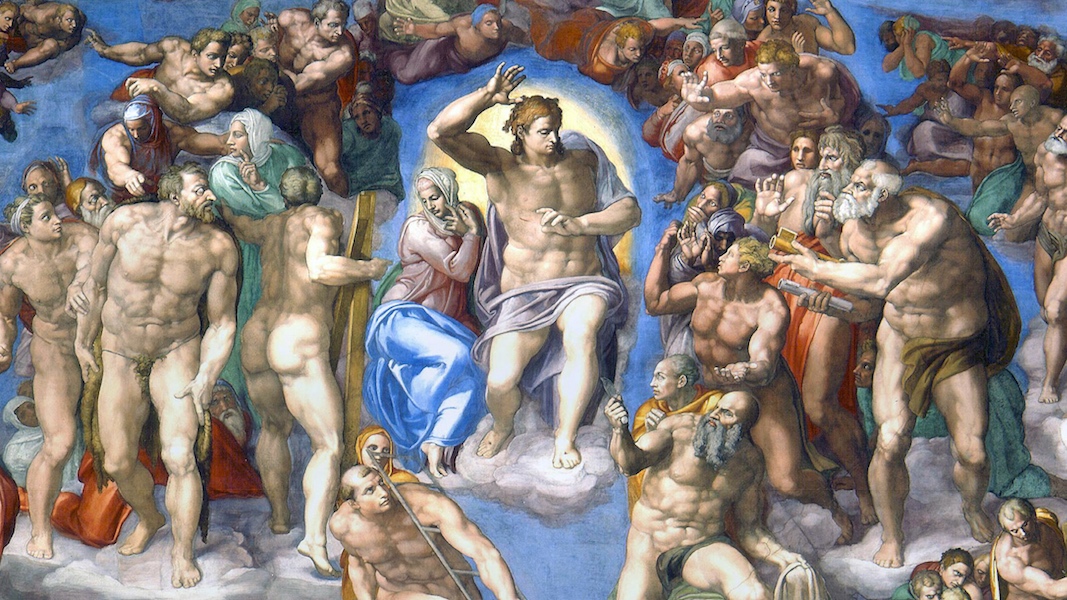
    Finally, there is yet a third adventus of the Messiah, a further way in which Christ comes into our world.  Like the Nativity, and unlike Holy Communion, it is a unique, one-time event: His coming in glory at the end of time. There’s still another meaning here as well, as each one of us receives a preview of sorts when He comes for us individually at death, the end of our own time here on Earth. Whether we are facing our own end, or the Ultimate End, we need to be ready to face our Judge.  As John the Baptist, who figures prominently in the Second sunday of Advent, warns us: “Even now the axe is laid to the root of the trees; every tree therefore that does not bear good fruit is cut down and thrown into the fire” (Matthew 3:10). For this reason Advent, much like Lent, and unlike Christmas, is a penitential season.


From Michelangelo's "Last Judgment"

    And yet Advent is different from Lent, too, as Christmas is a less complicated celebration than the Triduum and Easter, the observances that follow Lent.  Let’s return for a moment to our wedding analogy.  Advent, as I said above, can be compared to the period of engagement before a wedding.  Even though we know that marriage will also entail trials and hardships, it is a fundamentally good and happy thing, and so we anticipate the coming wedding with joy. We start making arrangements in advance (planning a reception, choosing a dress, sending invitations, etc.).  As the wedding day itself draws closer, our preparations intensify with bridal showers, rehearsals, and the rest.  Likewise the celebration of Advent intensifies as we draw nearer to the joy of the Nativity: the 3rd Sunday of Advent is called Gaudete Sunday because the introit for the Mass comes from St. Paul’s letter to the Phillipians, Gaudete in Domino semper: iterum dico, gaudete (“Rejoice in the Lord always, I say again, rejoice”, Philipians 4:4); we show our joyful anticipation with a pink candle on our advent wreaths on this Sunday. Then also, from December 17th (the first day of the O Antiphons) the daily liturgy becomes more Christmas-centric.
    And so, in a spirit of preparation, I will at last relent and put up the tree in my classroom (an artificial tree, of course, in keeping with state law) in the last week before Christmas break. I will remind my students, however, that it’s not Christmas quite yet.  And, when they return the first week of January, when the decorations have already been disappearing out in the world, the tree will still be there to greet them . . . because then ‘twill be The Season To Be Jolly.

Saturday, December 3, 2016

Darmok and Jalod Ad Orientem

Darmok and Jalod at Tanagra

 I recently re-published a post called “Star Trek, Secularism, and Christian Faith”. It had originally been posted on my first blog, Principium et Finis, where it garnered more page views than anything else on the blog – more than anything else I’ve ever published online, in fact.  There seems to be something about imaginative stories like Star Trek (and similar things) that captures our attention, and has done so since our far-distant ancestors gathered around campfires to hear story-tellers recount the communal tales that defined them as a people.
     In my earlier post I was somewhat critical of the creators of the television science-fiction franchise on the grounds that they didn’t really understand the nature of Faith, which was supposed to be a major theme in episode I was discussing.  They are on much firmer ground, however, in the episode called “Darmok”, from the fourth season of the series Star Trek: The Next Generation.  Not only that, I think that this particular story throws an interesting light on some current issues in the Catholic Church.
      In “Darmok” the (mostly human) crew of the starship Enterprise encounters an alien race called the Tamarians, with whom humans have previously had several frustratingly unsuccessful attempts at communication.  It seems that the Earthling’s Universal Translators (ah, the wonders of science fiction!) are able to discover the meaning of the Tamarians’ words, but can’t figure out how the words combine to express meaning.  What is one to make, for instance, of utterances such as “Shaka, when the walls fell”, or “The river Tamarc, in winter”? The aliens seem to be talking in metaphors and allusions drawn from stories known to them and to nobody else.


Data and Troi explain Tamarian Language

     Jean-Luc Picard, the Enterprise’s captain (played by British actor Patrick Stuart) experiences the same frustration as his predecessors in his attempts to communicate with the commander of a Tamarian ship, a frustration clearly shared by his alien counterpart.  Finally, the Tamarian captain holds up two daggers and declares “Darmok and Jalad at Tanagra!”, at which both he and Picard are transported (more sci-fi wizardry) down to the surface of a planet below.  Picard soon learns that the captain is not challenging him to a duel as he at first supposes, but what he does intend, or what he means by his insistent repetition of “Darmok and Jalod at Tanagra!” remains a mystery.
     Finally, after the two captains together encounter a deadly creature (which mortally wounds Picard’s Tamarian counterpart), Picard puts the puzzle together.  Darmok and Jalod were two heroes, perhaps rivals or enemies, who together fought a beast on an island called Tanagra, and formed a bond of friendship.  The alien captain had hoped that, by putting himself and Picard in a similar situation, they might likewise achieve through shared experience what they couldn't find through mere words.  Picard then comforts his dying counterpart by recounting to him the ancient epic of Gil-Gamesh.


We Are Formed by Experience

    The Tamarians, as are all the aliens in Star Trek, are humans in disguise.  In this particular story the creators of the television show have put their finger on something that goes to the very heart of what it is to be human: we are formed by our experiences, not only as individuals but as peoples.  The “aliens” they have created here view the world only through the lens of the stories that have been passed down about the history of their people, and in their everyday experiences they consciously relive the experiences of their forebears. Their only way to communicate abstractions is through the concrete: people, places, and events.


Picard tells Tamarians about death of their captain


    Now, we Earth-dwellers may not look very much like them at first.  We have a wealth of language that communicates abstractions and ideas.  We are however, more Tamarian than we appear at first glance.  Notice how easily, for example, the name of the Nazi’s hand-picked Norwegian puppet Vidkun Quisling has become the common noun “quisling”, a synonym for “traitor” . . . or how easily we use a metaphorical term such as “puppet”, as I did just now. Often,  we quickly forget that the expressions we are using are metaphors at all.  I remember, for instance during the 1992 presidential campaign when former (and present) California governor Jerry Brown was asked about the “anointed front-runner” Bill Clinton.  Brown asked whether he was running for president, or running for pope. Some allusions are even more deeply buried: how many people even know when they use the word “mentor” they are alluding to Homer’s Odyssey, where the goddess Athena, in the guise of a wise old man named Mentor, accompanies Odysseus’s son Telemachus to guide him (or, to speak metaphorically, “show him the ropes”).  


It's a Mystery to Me

    There’s even more going on here than the use of language.  The Tamarian captain understands that actions, experiences, can communicate in ways that words cannot (a point I also discuss in a post I republished this week, “Christ, or Anti-Christ? Art & the Power of Imagination”), which is of course true of human beings as much as it is of the fictional “Children of Tamar”.  This is a large part of why so many religions rely on ritual and formal rites: the actions communicate to us much more deeply than mere words, because we are actually living out what they want to convey.  The true meaning of the term “mystery” (from the Greek μυστήριον) in fact, is not something unknowable, but something that can only be known experientially. Traditional Christianity tells us that God uses these mysteries as a means not only of imparting His Grace, but of revealing himself to us. Once we understand that, we can more easily see why μυστήριον translates into Latin as sacramentum, because sacraments involve not only knowing or thinking, but acting.

The Mystery of the Eucharist
     Most religions rely, to some degree or other, on mystery.  At the very core of Christianity we find the Profoundest Mystery, the Supreme Sacrament: The Infinite God become Man in order to experience our humanity, and to invite us, in turn, to share in His Divinity.  We live out this mystery concretely when we receive the Body and Blood of Christ in the Eucharist which is, as the Second Vatican Council reminds us, the summit and source of the Christian life.  While Catholic Christianity includes countless lesser ways of living out spiritual realities as well, including the other Sacraments, sacramentals, devotions, and so on, the Eucharist, and the Sacrifice of the Mass in which we receive it, is the most important thing we do.


Turning Toward The Lord

    It can be helpful, I think, to bear these considerations in mind when we look at the suggestion recently made by Cardinal Sarah, currently head of the Congregation for Divine Worship and the Discipline of the Sacraments , that priests start re-introducing the practice of saying the Mass ad orientem, “toward the rising sun”, which is to say facing the altar rather than the congregation.  The Cardinal made the suggestion in a talk delivered at a liturgical conference in London this past summer (full text here).   Cardinal Sarah asked his fellow shepherds in the episcopy to support him in this matter, saying:

I very humbly and fraternally would like to appeal also to my brother bishops: please lead your priests and people towards the Lord in this way, particularly at large celebrations in your dioceses and in your cathedral. Please form your seminarians in the reality that we are not called to the priesthood to be at the centre of liturgical worship ourselves, but to lead Christ’s faithful to him as fellow worshippers united in the one same act of adoration.

Implicit in the part of the quote I have italicized above is the idea that what we do, and what the priest does, during the Mass is a part of the message.
Ad Orientem: facing The Lord Together
    I first came across a similar suggestion in regard to
ad orientem worship some years ago in an article by Fr. Joseph Fessio called “The Mass of Vatican II”. In his essay Fr. Fessio explains what the documents of Vatican II actually say about the Mass; for instance, that it should remain mostly in Latin, and that Gregorian Chant “should be given pride of place in liturgical services", and various other directives that appear not to have much influenced the post-conciliar revision of the liturgy. Fr. Fessio points out that one thing that was done does not appear, anywhere, in the Council’s documents, just as it had never been part of the tradition of the Church over the previous 18 centuries: turning the priest at Mass around to face the congregation, rather than having him face the altar, the liturgical East, along with the people he is leading in prayer.  In defending the traditional practice Fr. Fessio more explicitly makes some of the same points that Cardinal Sarah does in his London talk:

It's true that when the priest faces the people for the celebration of the Eucharistic Sacrifice, there may be a sense of greater unity as a community. But there is also a danger of the priest being the performer and you being the spectator - precisely what the Council did not want: priest performers and congregational spectators. But there is something more problematic. You can see it, perhaps, by contrasting Mass facing the people with Mass facing East or facing the Lord. I don't say Mass "with my back to the people" anymore than Patton went through Germany with his "back to the soldiers." Patton led the Third Army across Germany and they followed him to achieve a goal. The Mass is part of the Pilgrim Church on the way to our goal, our heavenly homeland. This world is not our heavenly homeland. We don't sit around in a circle and look at each other. We want to look with each other and with the priest towards the rising sun, the rays of grace, where the Son will come again in glory on the clouds.


The Medium is the Message


    Marshall McLuhan famously said of television that “the medium is the message”.  The same can be said of all media, including sacred media.  How we celebrate the Mass sends a message.  The symbolic “message” of the ad orientem Mass is clear: that all of us together, priest and people, are making an offering to God; we all face our Lord together.  When priest and people face each other, who is offering what to whom? The message seems to be that we are there to see each other, not to turn to Our Lord. The little cartoon to the left (which, I confess, I stole from Fr. Z’s blog) gives a good illustration of the problem. Cardinal Sarah himself recently made the same point in a talk delivered to the bishops of Sri Lanka,

In recent decades in some countries the Sacred Liturgy has become too anthropocentric; man not Almighty God has often become its focus.

But that’s not how it’s supposed to be.  Instead,

In every Catholic liturgy, the Church, made up of both minister and faithful, gives her complete focus – body, heart and mind – to God who is the centre of our lives and the origin of every blessing and grace.

    That’s the beauty of the traditional ad orientem celebration of the Mass: we don’t merely read or hear but experience ourselves the Truth that God is the center of our lives, and our in our worship we all turn to Him together.


It's Greek to Me

    Which brings me to my one real quibble with “Darmok”. In the final scene of the episode we see Captain Picard reading a book when his first officer, Commander Riker, enters the room.  Riker looks at the book curiously, and says, “Greek, sir?” (did I mention that Captain Picard is quite a Renaissance man? Starship captain, student of Latin and Greek, etc.), which leads to this exchange:


PICARD: Oh, the Homeric Hymns. One of the root metaphors of our own culture.

RIKER: For the next time we encounter the Tamarians?

PICARD: More familiarity with our own mythology might help us to relate to theirs. The Tamarian was willing to risk all of us just for the hope of communication, connection. Now the door is open between our peoples. That commitment meant more to him than his own life. Thank you, Number One.

Now, the Homeric Hymns is not a bad place to start, as far as it goes, but if Picard really wants to get at the “root” of what it is to be human, I have a better suggestion for him, one that starts out like this:

Ἐν ἀρχῇ ἦν ὁ Λόγος, καὶ ὁ Λόγος ἦν πρὸς τὸν Θεόν, καὶ Θεὸς ἦν ὁ Λόγος.

In the beginning was The Word, and The Word was with God, and The Word was God (John 1:1)