Nisi Dominus aedificaverit domum, in vanum laborant qui aedificaverunt eam - "Unless the Lord built the house, they worked in vain who built it" Ps. 127
Showing posts with label liturgical year. Show all posts
Showing posts with label liturgical year. Show all posts
Samuel anointing David, by François-Léon Benouville, 1842
"The New Testament in the Old is concealed, the Old Testament in the New is revealed," as St. Augustine once said.* We can see the truth of these words in the amazing event that Christmas commemorates. Consider the opening verses of the first reading for the 4th Sunday of Advent, from the Book of the Prophet Micah:
Thus says the LORD:
You, Bethlehem-Ephrathah
too small to be among the clans of Judah, from you shall come forth for me one who is to be ruler in Israel; whose origin is from of old, from ancient times. (Micah 5:2)
We can see this Old Testament prophecy (as well as other prophecies from Isaiah, et. al.) come to fruition in the New Testament in a literal way in the birth of Jesus the Messiah in Bethlehem. As always, however, there are deeper and deeper layers of truth underneath the surface. Bethlehem is so small as to seem insignificant, but it will produce the Christ, just as it had once produced the great King David (the last two lines of the verse above indicate that the Messiah will be of the line of David). Speaking of great things coming in small packages, David himself was something of a surprise. When the Prophet Samuel comes to Bethlehem to choose a new king for Israel from among Jesse's sons, David is not with his brothers; he has been left behind tending the sheep in the fields, since, as the youngest and the smallest, he seemed the least likely to wield the sceptre . . .
* a remark that sounds as snappy in Latin as it does in English: Novum Testamentum in Vetere latet, Vetus Testamentum in Novo patet (Quaest. in Hept. 2,73: PL 34, 623; cf. DV)
Not everyone, it would seem, is pleased with the current Roman Pontiff. If that hadn't been clear to me already, it would certainly be apparent in many of the comments some of my recent posts (this one and this one, for instance) have received in various online venues. Who would have thought it?
Happily, I'm not writing today to discuss the worthiness (or lack thereof) of Pope Francis for his current job. Instead we're looking at St. Mathias, whose feast we are celebrating. I mention the current Pope because our discussion of St. Mathias will necessarily involve the papal office, if not the papal personality.
St. Mathias was the thirteenth Apostle, chosen to replace Judas Iscariot after Judas betrayed the Lord then took his own life. It's interesting that our scriptural sources actually tell us very little about St. Mathias himself. The only place he is mentioned by name is the passage is the Acts of the Apostles that describes his election:
In those days Peter stood up among the brethren (the company of persons was in all about a hundred and twenty), and said . . .
I often used to admire a stained glass window that looks down on the altar in the cathedral where I used to attend Mass with my family.
The scene in the window is the Annunciation. It depicts the young Mary, kneeling on the floor and surrounded by angels, while God the father looks down on her from above, sending forth a beam on which rests the Holy Spirit in the form of a Dove. God the Son is there, too, although we don’t see him, a human embryo in Mary’s womb, the Omnipotent Divine wrapped in mortal human flesh. That’s how we encounter Jesus in the Gospels: the Eternal Word in human disguise. That’s how we receive him in the Holy Eucharist: the Second Person of the Trinity in the form of simple bread. It’s a marvelous image to contemplate as we approach the Altar of the Lord to receive Holy Communion.
Mary’s willingness to give up herself to be a part in God’s Great Drama of Salvation, perhaps the greatest (solely) human actor, is the big picture; as is often the way, there’s a little picture, too, a way in which the Annunciation is reflected in our own lives. God has a plan for all of us . . .
How odd St. Joseph, the human father of Jesus, must look to so many of us today. We live in an age that distrusts the traditional features of fatherhood, and even denigrates them as "toxic masculinity." Small wonder that fatherhood itself is in steep decline. According to the National Fatherhood Initiative, "19.7 million children in America—more than one in four—live without their biological dad in the home." ("The Father Absence Crisis in America") That unprecedented figure is growing all the time, in spite of the fact that the decline of fatherhood has such devastating and clearly documented consequences: a four times greater likelihood of living in poverty; a greater likelihood of emotional and behavioral problems, infant mortality, crime and imprisonment, teen pregnancy, drug abuse, obesity, dropping out of school, and all the other problems that flow from those circumstances (see the article linked above for citations).
"The Flight into Egypt" by Jacopo Bassano (1544)
As horrific as those consequences are, Christians know that there's something even worse. The Church has always taught us that human fatherhood is merely a reflection: as Jesus himself puts it, "call no man your father on earth, for you have one Father, who is in heaven." (Matthew 23:9) Human fathers are merely stewards, and our authority is not our own, nor do we exercise if for our own sake . . .
“You shall remember that you were a slave in the land of Egypt, and the Lord your God redeemed you; therefore I command you this today” (Deuteronomy 15:14-15)
"St. Patrick Baptizes the King of Munster".*
St. Patrick is, of course, the Patron Saint of Ireland, but he wasn’t originally Irish. He was Romano-British, probably born in what is now southern Scotland, or possibly Wales. His first introduction to the Emerald Isle was as a slave, after he had been kidnapped as a youth by Irish raiders. In his difficulties he came increasingly to rely on God, and he believed that God was calling him out of captivity. He escaped and found his way home. His faith life deepened, and after a time he concluded that he was being called back to save those who had enslaved him. After ordination as a priest he returned to Ireland, where he successfully evangelized his former captors, and eventually became known as the Apostle of Ireland.
There is something profoundly Christian about St. Patrick’s story. Consider just how different is the story about Julius Caesar, as told by the Roman historian Suetonius. When he was a young man, Caesar was kidnapped by pirates . . .
We mortal men and women need stories. I don't mean "stories" in the sense of things that are untrue or simply made up. I mean that we learn and understand some things best, even perfectly true things, when we encounter them in story form. We need the arc of narrative to capture and hold our imagination. In order to really absorb concepts we need to see them embodied, literally, in people like ourselves and in the things that people do.
That is part of the purpose of the cult of the saints. Through intercessory prayer they advocate for us before the throne of God, but they are also examples for us: through the stories of their lives, they show us in a way we can't fail to understand what it is to be a follower of Jesus Christ.
One of those things that they show us is how important each one of us is to God: "the wisdom of this world is folly with God." (1 Corinthians 3:19) One of today's saints, St. Agnes of Bohemia (also known as St. Agnes of Prague) provides a good example of just how foolish the "wisdom" of the world can be . . .
The pink Valentine clutter has not yet completely abandoned the shelves of retailers, as we’re just three days past the feast ofthe most well-known of unknown saints, and yet today we put on ashes and the purple of Lent. Whether by chance or design St. Valentine’s Day and Ash Wednesday often find themselves in close proximity. A few years ago when the two apparently contrary feasts occupied the same day, I saw a post on a certain social media network (which I refuse to name, as I have since renounced it and all its works and empty promises) that caused me to stop and think about the connection between the two . . . [Click HERE to read the entire post at Spes in Domino]
The Letter to the Hebrews tells us that we live out our life of faith here on earth in view of a “cloud of witnesses” (Hebrews 12:1), which is to say our holy predecessors. They watch over us from before the Throne of God, where they cheer us on and intercede on our behalf. At the time the letter was written, all these witnesses were holy men and women from Old Testament times, but that cloud has been expanding constantly over the centuries since to include countless Christian Saints. They are truly our witnesses before God, and also our examples, heroes who show us the path to follow.
Speaking for myself, one of the unintended rewards of dabbling in bloggery over the past few years is that, in researching and writing blog posts on many of these saints, I’ve come to know them so much better. I’ve come to a deeper appreciation of famous heroes of the faith whom I thought I already knew, such as St. Joseph and St. Therese of Lisieux. I’ve also come to know many more obscure saints, some of whom I had never heard of before:St. Peregrinus and St. Mellitus are just two examples. Today, however, we have the curious case of a saint who somehow manages to fall into both of these categories. He is universally “known”, at least insofar as his name is a household word, even among non-Catholics, and in fact among non-Christians. At the same time, a great many people don’t even know they’re speaking the name of a Christian saint, and those who do know it know almost nothing about the man himself, or even whether he was one man, or two . . .
Today we observe the Feast of the Baptism of the Lord, and so on the last day of the Christmas Season we celebrate the first event in the Public Ministry of Jesus.
All four Gospels tell of John’s baptism of Jesus, but all present a slightly different view. Mark’s account is the sparest, except that he gives us the most vivid picture of the Baptist himself: "Now John was clothed with camel's hair, and had a leather girdle around his waist, and ate locusts and wild honey" (Mark 1:6). Luke's account starts with the people "filled with expectation", eagerly anticipating the Messiah, whom they take John to be. John’s Gospel recounts John the Baptist hailing Jesus with the title "Lamb of God". They all tell of John’s recognition of himself as a merely the forerunner to Jesus, to whom he is inferior, but only Matthew records his reluctance to baptize the Lord:
Then Jesus came from Galilee to the Jordan to John, to be baptized by him. John would have prevented him, saying, “I need to be baptized by you, and do you come to me?” But Jesus answered him, “Let it be so now; for thus it is fitting for us to fulfill all righteousness.” Then he consented. (Matthew 3:13-15)
John knows that Jesus, being sinless, requires no Baptism, but Jesus seeks it out in order to show his commitment to being one of us, and to demonstrate to us the path which we should follow. In this account we see Jesus acting out what St. Paul tells the Phillipians:
. . . though he was in the form of God, he did not count equality with God a thing to be grasped, but emptied himself, taking the form of a servant, being born in the likeness of men. (Phillipians 2:6-7)
In all the Gospels, we see the Holy Spirit descend upon Jesus and the voice of the Father proclaim him to be the beloved Son in whom the Father is well pleased. And so Christ’s Public Ministry begins with an icon of all three Persons of the Trinity working together, and an image of Grace in action. This scene sums up the meaning of the Nativity we have just celebrated, and tells us something about the agenda for the ministry that is begun.
As always, there is more, which we see with particular emphasis in Matthew’s Gospel. We are reminded that it is all Grace, a word for which the Latin root gratia means not just favor, but favor freely bestowed (hence related English words “gratuity” and “gratis”); Grace is completely, absolutely, free. God needs nothing, nothing is necessary for Him: He does it all for us, He gives us a share in His own life, as a completely unnecessary gift . . . simply because He loves us.
Merry Christmas, for the Twelfth time this Christmas Season!
Today is the 12th Day since Christmas Day. The formal liturgical Christmas Season will go on until the Feast of the Baptism of Our Lord on Sunday the 10th, which brings us back to Ordinary Time (for a more extensive discussion of the Liturgical Calendar and Christmas, go HERE). Some of us, however, will stubbornly keep the decorations up until the Feast of the Presentation on February 2nd . . . and shouldn't all of us carry at least a little Christmas Joy with us throughout the year?
In that spirit (so to speak), I’d the like to quote the Spirit of Christmas Present from the 1951 film version of Charles Dickens' A Christmas Carol (a speech not found, alas, in Dickens' book itself):
We spirits of Christmas do not live
only one day of our year.
We live the whole 365.
So is it true of the child
born in Bethlehem.
He does not live in men's hearts only
one day of the year,
but in all the days of the year.
And so I think it’s apt, one more time, to hear one of my favorite Christmas songs, “O Holy Night”. This lovely rendition is by the Irish group Affiniti:
For my thoughts are not your thoughts, neither are your ways my ways, says the Lord. For as the heavens are higher than the earth, so are my ways higher than your ways and my thoughts than your thoughts.(Isaiah 55:8-9)
Merry Ninth Day of Christmas! We hear a lot of Isaiah through the seasons of Advent and Christmas, but this passage expresses with particular clarity one of the most striking and curious things about Christmas. Who would expect the Infinite, Almighty Deity to manifest himself as a tiny baby, born in a cattle stall with the beasts? Who would have thought that wise and exalted visitors would come to this baby from strange lands many miles away with their rich gifts of gold, frankincense, and myrrh, as we will commemorate in tomorrow’s liturgical celebration of Epiphany? Ours is a God indeed whose thoughts are not our thoughts, whose ways are not our ways: he constantly confounds our expectations. This is not the Grand Entrance any of us would have devised for God Made Manifest.
The Nativity by Jacopo Tintoretto
Nor did the child grow up to be the sort of Messiah that people expected, not even his own disciples: he rebukes Peter, his chief Apostle, with “Get behind me, Satan!” (Matthew 16:23) because the man who will become the first Pope can’t accept that the Christ must suffer and die in order to save humanity. And nobody at all was really expecting what happened on Easter Sunday.
Of course, none of the above should have been a surprise: it was all foretold by the Prophets, as we saw over and over again in the Advent readings and prayers. In other words, he’s a God of the unexpected mostly because we insist on setting ourselves up to be surprised. But that’s the way we imperfect, broken human beings are: we think we can simply force reality to be what we want it to be . . . but God usually has other plans.
We can glimpse something of this stubborn arrogance in the story of two of tomorrow’s Ssaints (who are graciously yielding their feast day to the celebration of Epiphany in many dioceses):
Zosimus and Athanasius (n.b. – he is not the more well-known Athanasius of Alexandria)d.303 + Martyrs in Cilicia (modern Turkey). They were executed during the persecutions of Emperor Diocletian (r. 284-305). According to one account, Zosimus was tortured and Athanasius, a witness, was so moved that he converted to the faith. Both were then tortured but survived and died in peace after being released. They became hermits. (from www.Catholic.org )
The Roman authorities thought that, if they were brutal enough, they would discourage people from embracing Christianity, but – surprise! – seeing the torture of Zosimus instead drew Athanasius to the Faith. And his is not an isolated incident: “The blood of the martyrs”, wrote Tertullian, “is the seed of the Church.” Up to the present day, we see that Christianity is strongest when it is under attack.
We would do well to remember these things when we contemplate the Child in the manger. However bad, even disastrous, things may seem (and in a world insistently moving further away from God, well, what do you expect?), we should remember that the same child grows up to promise that the Gates of Hell will not prevail against his Church (Matthew 16:18).
Prepare yourself to be surprised.
A beautiful version of Silent Night by the Winchester Cathedral Choir:
It is true that we are nearing the end of the Octave of Christmas: Sunday will be both the tenth day and the great feast of Epiphany, which this year we officially celebrate three days before its traditional date of January 6th. The Christmas season itself continues for another week after that, and for some of us until February 2nd (see "What is the Christmas Season, and Why Does It Matter?")
I once published a post at this point in the season entitled "Don't Touch That Tree!", in reference to all the Christmas trees unceremoniously cast out untimely and thrown to the curb at a time when the Christmas lights should still be burning bright. In this post I'd like to look at the Christmas Tree itself as an institution, a beloved Christian symbol and tradition which is sometimes attacked (erroneously) by self-styled debunkers as a pagan intrusion. We Christians need not be swayed by such nonsense. First of all, even if there were historical evidence of evergreen trees being used in pagan worship, Christ can baptize all things for his use (for more on this point, see my post “Christ is King of All . . . Even the Holidays”). Pagans prayed to their gods, for instance: should we avoid prayer for that reason? Pagans offered sacrifice on their altars; do any of us put the offerings on a similar altar in the Temple of Jerusalem in the same category, much less Christ's Eucharistic Sacrifice on the altars of our churches? Certainly the same would apply to Christmas trees, if they had pagan origins.
As it happens, however, evergreen trees were not worshipped or treated as religious objects among the Germanic and Baltic peoples of Europe, although they were sometimes used as symbols of eternity and the promise of Springtime rebirth. This rather obvious symbolism was recognized in other parts of the world as well. The pre-Christians of the German forests directed their religious veneration, at least as it applied to trees (is dendrolatrya word?), toward the deciduous oak tree. This oak-worship figures prominently in one popular story, in fact, about the origins of the Christmas Tree, which only makes sense if we distinguish between the two different kinds of tree. St. Boniface, who left his native England to evangelize the still pagan Germans of continental Europe in the 8th century, famously chopped down a holy oak to which a young boy was being offered in sacrifice. In one version of the story, after the mighty oak fell a young fir tree could be seen standing behind its stump. The Saint pointed to the evergreen, and told the onlookers (who were impressed that Wotan hadn’t zapped him out of existence) that they should henceforth direct their veneration to this tree, as a symbol of the True God in the Person of Jesus Christ.
Queen Victoria & Family around the tree
The first actual historical references to Christmas trees (Boniface certainly did cut down the oak, but the rest of the story is historically dubious) come in the sixteenth century. It seems very unlikely indeed that almost eight centuries after the heathens of central Europe converted and gave up tree-worship their practices would somehow find their way into Christian homes. Christmas trees were not known beyond some (not even all) German speaking areas, along with Latvia and Estonia, until very recently. Christmas trees were rarely, if ever, seen in the English speaking world until a little over a century and a half ago, when Queen Victoria’s husband Prince Albert, who was German, introduced the custom to the British Royal family. A print that first appeared in the Illustrated London News in 1848 depicting the Queen and family around their tree is generally credited with popularizing Christmas trees both in Britain and in North America.
Today one sees Christmas trees all over the world; in recent decades the popes have put up large and beautiful trees near the crèche in St. Peter’s Square. Saint John Paul II explained some of the Christian symbolism of the tree in his Angelus address on December 19th, 2004:
The feast of Christmas, perhaps the most cherished by popular tradition, is full of symbols connected with the different cultures. Among all, the most important is surely the Nativity scene, as I had the opportunity to point out last Sunday.
Together with the Nativity scene, as is true here in St. Peter’s Square, we find the traditional “Christmas tree.” A very ancient custom, moreover, which exalts the value of life, as in winter the evergreen becomes a sign of undying life. In general, the tree is decorated and Christmas gifts are placed under it. The symbol is also eloquent from a typically Christian point of view: It reminds us of the “tree of life” (see Genesis 2:9), representation of Christ, God’s supreme gift to humanity.
The message of the Christmas tree, therefore, is that life is “ever green” if one gives: not so much material things, but of oneself: in friendship and sincere affection, and fraternal help and forgiveness, in shared time and reciprocal listening.
St. Peter's Square decorated for Christmas, 2001 (Lawrence Journal-World)
With its loftiness, its green [color] and the lights in its branches, the Christmas tree is a symbol of life that points to the mystery of Christmas Eve . . .
Christ, the Son of God, brings to the dark, cold, unredeemed world in which he was born, a new hope and a new splendor . . .
If man allows himself to be touched and enlightened by the splendor of the living truth that is Christ, he will experience an interior peace in his heart and will himself become an instrument of peace in a society that has so much nostalgia for reconciliation and redemption.
There you have it: don’t let the nay-sayers wear you down! We still have some Christmas left this year, so be of good cheer . . . and don’t touch that tree just yet!
Speaking of Christmas trees, here’s a beautiful tri-lingual rendition of “O Tannenbaum” by Andrea Bocelli:
Merry Christmas! The Christmas season is well upon us, and today we see it in all its complexity: we’re still singing carols and chiming bells, while at the same time recoiling from the horror of King Herod’s mass infanticide at Bethlehem, as commemorated in today’s Feast of the Holy Innocents. Today’s feast reminds us not only of enormities committed against innocent life in our own day, but also that the baby lying in the wooden manger has escaped Herod’s wrath only so that he might die thirty years later on the wooden beams of the cross.
St. Anthony of Lerins
In past years my 4th Day of Christmas post has been a meditation on the Holy Innocents (here and here, for instance), but this year I’m taking a different approach: as I said in my post on St. Servulus two days before Christmas, lesser observances are often overwhelmed during great celebrations such as Christmas and Easter. There are, in fact other saints commemorated today, whose memory can be completely buried under the combined weight of the Feast of the Holy Innocents and the ongoing celebration of the Nativity of Our Lord. One of those, St. Anthony of Lerins (also known as St. Anthony the Hermit), will be my main focus today.
As it happens, St. Anthony would probably be just as happy to be ignored, if his life here on earth is any indication. He born in the year 468 AD at Valeria in the region that the Romans had called Lower Pannonia, but which at this time was controlled by the Huns. He grew up among holy men: he lived for a time with St. Severinus of Noricum after his father died in Anthony’s ninth year; when St. Severinus himself died a few years later, Anthony moved to the household of his uncle Constantius, who was the bishop of Lorsch in what is now Bavaria. When he reached adulthood he became a hermit in the area of Lake Como in northern Italy. As is often the case with holy hermits, his sanctity attracted a large number of followers. Seeking to recapture a little of the solitude for which he embraced the eremitical life, Anthony moved on from there, eventually settling in Lerins in France, where he spent his final two years on earth . . . and where the would-be recluse became famous throughout the district for sanctity and miracle-working.
In the story of St. Anthony of Lerins we see a couple of themes that connect him to today’s commemoration of the Holy Innocents, and to the Child in the manger in whose honor we are celebrating this entire liturgical season. St. Paul tells us in his Second Letter to the Corinthians:
[The Lord] said to me, “My grace is sufficient for you, for my power is made perfect in weakness.” I will all the more gladly boast of my weaknesses, that the power of Christ may rest upon me. (2 Corinthians 12:9)
"The Adoration of the Shepherds", by Matthias Stomer
We see God’s propensity to work his power through weakness throughout salvation history, most clearly when the infinite Second Person of the Trinity, the Eternal Word, manifests himself in this world as a tiny baby lying in a feeding trough in a stable. We also see it in helplessness of the Holy Innocents slaughtered at Bethlehem, and in the life of a simple man who wanted nothing more than to live a life of holiness with his Lord. Notice on this day when we commemorate the sacrifice of those children, and the sanctity of St. Anthony, that the power of King Herod who brought so much destruction to the little boys of Bethlehem, and of the fearsome Huns under whose rule Anthony was born, has long since disappeared; their names have become little more than bywords for cruelty and violence.
King Herod
It’s not that the power of the Herods, Huns, and other worldly tyrants has had no lasting effect: it’s just that it doesn’t accomplish what they expect it to. St. Paul again provides us with the key when he says: “We know that all things work for good for those who love God, who are called according to his purpose.” (Romans 8:28) We see this idea applied in the non-scriptural passage in today’s Office of Readings, a homily by St. Quodvultdeus (his name means “What God wills” in Latin) on the slaughter of the Holy Innocents, in which he addresses King Herod:
Yet your throne is threatened by the source of grace – so small, yet so great – who is lying in the manger. He is using you, all unaware of it, to work out his own purposes freeing souls from captivity to the devil. He has taken up the sons of the enemy into the ranks of God’s adopted children.
God makes all things work for the good of those who love him, including the evil machinations of wicked men like Herod. How much more so, then, the good things in the life of a holy man like St. Anthony of Lerins? God gives us his gifts not so much for our own sake, but so that we might use them in the service of others, to help free their souls, as the homilist above puts it, from captivity to the devil. St. Anthony was seeking a quiet life of prayer and contemplation, but God gave him the grace to desire such a life, and the power to perform miracles, so that he might sanctify the people among whom he was living. Let us all pray for the grace to likewise embrace God’s gifts to us, and to use them for What God Wills.
The Slaughter of the Holy Innocents inspired a number of songs during the Middle Ages, of which only the Coventry Carol is still commonly heard today. Below is a haunting version of this beautiful song by the Irish vocal group Anúna:
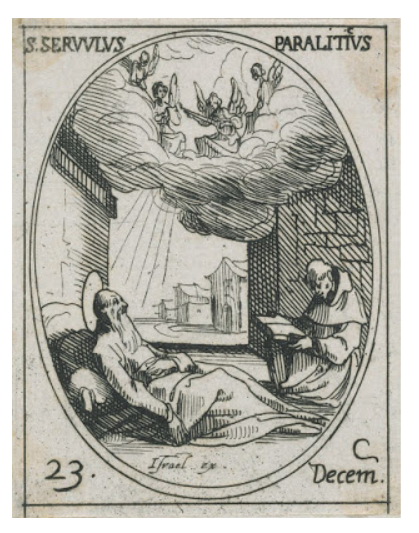
One understandable drawback to the great liturgical feasts, such as the magnificent celebration of the Nativity of Our Lord at Christmas, is that lesser observances can be overlooked in all the excitement. For instance, one of today’s Saints, St. Servulus: he is worth remembering for his own sake, but his life also gives us some very fruitful matter for meditation on the penultimate day of Advent, as we prepare for Christmas itself. Let’s take a look at the story of St. Servulus, from the 1894 edition of Butler’s Lives of the Saints (an account based on a homily by St. Gregory the Great):
December 23.—ST. SERVULUS
SERVULUS was a beggar, and had been so afflicted with palsy from his infancy that he was never able to stand, sit upright, lift his hand to his mouth, or turn himself from one side to another. His mother and brother carried him into the porch of St. Clement's Church at Rome, where he lived on the alms of those that passed by. He used to entreat devout persons to read the Holy Scriptures to him, which he heard with such attention as to learn them by heart. His time he consecrated by assiduously singing hymns of praise and thanksgiving to God. After several years thus spent, his distemper having seized his vitals, he felt his end was drawing nigh. In his last moments he desired the poor and pilgrims, who had often shared in his charity, to sing sacred hymns and psalms for him. While he joined his voice with theirs, he on a sudden cried out: "Silence! do you not hear the sweet melody and praise which resound in the heavens?" Soon after he spoke these words he expired, and his soul was carried by angels into everlasting bliss, about the year 590.
St. Servulus listens to Holy Scripture
Servulus is certainly an admirable model of heroic virtue. In spite of a lifetime of constant suffering, he was filled with gratitude to his Creator, and was completely devoted to Him, as signified by his name (Servulus means “little slave”). Moreover, despite his own absolute poverty, he was keenly aware of the need of others.
But there’s more to the story of this saint and his feast day, coming as it does right before the celebration of the Nativity of Our Lord. When I first read Servulus’ hagiography, in fact, a passage from Charles Dickens immediately came to mind. I was thinking of the scene in A Christmas Carol, where the Ghost of Christmas Present is showing Scrooge the Cratchit family’s Christmas dinner. Scrooge’s underpaid clerk, Bob Cratchit, has just returned from church with his sickly, crippled son Tiny Tim on Christmas day. After Tim is whisked off by his siblings to see “the pudding singing in the copper”, Bob has the following exchange with his wife:“And how did little Tim behave?” asked Mrs. Cratchit, when she had rallied Bob on his credulity, and Bob had hugged his daughter to his heart’s content. “As good as gold,” said Bob, “and better. Somehow he gets thoughtful, sitting by himself so much, and thinks the strangest things you ever heard. He told me, coming home, that he hoped the people saw him in the church, because he was a cripple, and it might be pleasant to them to remember upon Christmas Day, who made lame beggars walk, and blind men see.”
Bob Cratchit & Tiny Tim
Tiny Tim sees himself as a living image of Christ’s mercy, reminding the faithful that the Nativity they’re celebrating is not just the birth of a baby, but the Incarnation of the God of Mercy as a Man. St. Servulus is also an icon, pointing out precisely who the Babe in the manger has come to be. He reminds us that in taking on human flesh, Jesus is taking to himself all that is human, excepting sin. That very emphatically includes human suffering. It is often said that when God took on human form, he sanctified humanity. Likewise, since Jesus has participated in our pain and sorrow, through his suffering we can unite ourselves to the living God. St. Servulus puts flesh on the words of St. Paul: “Now I rejoice in my sufferings for your sake, and in my flesh I complete what is lacking in Christ's afflictions (Colossians 1:24).” Small wonder that the suffering saint could hear the voices of angels even before he left this world for the next. In two days we will be celebrating Christmas, the birth of our Savior, which is indeed, as the angels tell the shepherds of Bethlehem, “good news of a great joy” (Luke 2:10). St. Servulus reminds us that He comes not so much to save us from the hardships of this world, but to save us through those hardships, so that we can be eternally happy with Him in the next. May your Christmas be a merry one . . . and God Bless Us, Every One.