Nisi Dominus aedificaverit domum, in vanum laborant qui aedificaverunt eam - "Unless the Lord built the house, they worked in vain who built it" Ps. 127

Showing posts with label Scripture. Show all posts

Sunday, December 19, 2021

From Small Beginnings: the 4th Sunday of Advent

Samuel anointing David, by François-Léon Benouville, 1842
 "The New Testament in the Old is concealed, the Old Testament in the New is revealed," as St. Augustine once said.*  We can see the truth of these words in the amazing event that Christmas commemorates.  Consider the opening verses of the first reading for the 4th Sunday of Advent, from the Book of the Prophet Micah:


Thus says the LORD:
     You, Bethlehem-Ephrathah
        too small to be among the clans of Judah,
    from you shall come forth for me
        one who is to be ruler in Israel;
    whose origin is from of old,
        from ancient times. (Micah 5:2)

We can see this Old Testament prophecy (as well as other prophecies from Isaiah, et. al.) come to fruition in the New Testament in a literal way in the birth of Jesus the Messiah in Bethlehem.  As always, however, there are deeper and deeper layers of truth underneath the surface.  Bethlehem is so small as to seem insignificant, but it will produce the Christ, just as it had once produced the great King David (the last two lines of the verse above indicate that the Messiah will be of the line of David).  
Speaking of great things coming in small packages, David himself was something of a surprise.  When the Prophet Samuel comes to Bethlehem to choose a new king for Israel from among Jesse's sons, David is not with his brothers; he has been left behind tending the sheep in the fields, since, as the youngest and the smallest, he seemed the least likely to wield the sceptre . . . 

* a remark that sounds as snappy in Latin as it does in English: Novum Testamentum in Vetere latet, Vetus Testamentum in Novo patet (Quaest. in Hept. 2,73: PL 34, 623; cf. DV)

[click HERE to continue reading this post on Spes in Domino]

Friday, July 2, 2021

A Tribute Vice Pays to Itself, or, The Joy of Getting Gelded

"Satan Cast Down From Heaven"
by Gustav Dore, 1866
    A vivid picture of sin has been given to us by St. Augustine: homo incurvatus in se, "man turned in upon himself."  The image that conjures up in my mind is rather like a dog chasing his tail . . . or myself, in some of my less glorious moments.  The point is, we direct ourselves inward, away from God, away from other people, hoping to find within ourselves what can only come from beyond.  The world in which we are living today is becoming more and more a world not so much turned in upon itself, because that would imply that we're doing it together, but a world in which each and every one of us is turned in upon ourselves, eight billion dogs simultaneously chasing their own tails.

   
 Such intense self-absorption is bad for us, of course, because we were made for love by the God Who is Love (1 John 4:8), and love is willing the good of another. And therein lies a problem, because one effect of sin turning us inside out is that it turns love inside out as well, so that we find ourselves actually willing evil for others.

     A few years back I ran across a story that perfectly captures the essence of a world full of people curved in upon themselves.  Please click below to find my exploration of the wonderful world of Vasectomy Showers:

[click HERE to continue reading this post on Spes in Domino]

Tuesday, April 27, 2021

Aborigines, Atheists, and the Authenticity of the Gospels


A few years ago I ran across an amazing story ("Ancient Sea Rise Tale Told Accurately For 10,000 Years") from Scientific American, detailing how aboriginal Australians have preserved, via oral tradition, accurate information about geographical features that have been underwater since the end of the last Ice Age, circa 10,000 years ago. The article is fascinating for its own sake, but it also shows some of the limitations of the modern skeptical, ostensibly scientific (but more accurately “scientistic”) worldview.  Not only that, it has some relevance to our Faith, and particularly to the question of the veracity of Scripture.  In the post below I discuss how the amazing memories of Australia's oldest inhabitants inform our defense of the authenticity of the Gospels.

  Let’s start with the scriptural question.  A common line of attack by well-trained atheist enthusiasts is that the books of the New Testament weren’t even written down until 30-60 years after the death of Jesus: how can we expect them to be reliable?  There are a number of good answers to this . . .

[click HERE to continue reading this post on Spes in Domino]

Wednesday, March 31, 2021

Why did Jesus 'Take the Form of a Slave'?

     Did you know that we are all slaves - and have you noticed how often the topic of slavery comes up in Scripture and in Salvation History?  We can see it in some recent posts here:  last Wednesday we discussed how St. Patrick was kidnapped and sold into slavery, and then returned after his escape to convert his former slave masters.  Two days later we celebrated the Solemnity of St. Joseph, whose forerunner Joseph son of Jacob had also been sold into slavery.  An impressive number saints have been slaves at some point, as recently as St. Josephine Bakhita, who died in 1947.

 Why is slavery so prevalent?  We Catholics know that in the Bible and in the history of God's interaction with humanity there are different levels of meaning.  In another recent post, for instance, we talked about leprosy in scripture as a metaphor for sin; in much the same way slavery represents our attachment to sin . . .

[click HERE to continue reading this post on 

Spes in Domino]

Monday, March 15, 2021

Confession, Jonah, and the Prodigal's Sons (from Spes in Domino)

 There are many things for which I should be more grateful, and one of the greatest is the forgiveness of sins in the Sacrament of Confession. One of the graces of the season of Lent is that there are many things to remind my stubborn, sluggish brain of that fact.  For instance, this past Sunday father dedicated a large part of his homily to explaining how a detailed examination of conscience can help us make a good confession, and illustrated with a model based on the Ten Commandments .  He also very helpfully directed our attention to the stained glass window closest to the confessional, which happened to be a depiction of the Prodigal Son. That reminded me of a Lenten penance I received at confession a few years ago, an assignment which got me thinking . . . and led to the meditation on the Prodigal Son, the Book of Jonah, and the Power of Forgiveness that I have reposted below.

     I was given an interesting penance when I went to confession recently. I was to meditate on the Parable of the Prodigal Son (Luke 15:11-32).  My confessor emphasized that the father in Jesus' story, who extravagantly welcomes back his wastrel son . . .

[click HERE to continue reading this post on Spes in Domino]

"The Return of the Prodigal Son" (1782) by Jean Germain Drouais (angry son at right)


Monday, March 1, 2021

"The Way" to Where, Exactly?

  Beware of anyone whose key concept is power.


   Some years ago I worked in a Catholic school which decided to assign summer reading to the entire school community, including both staff and students. The idea was to have a school wide discussion of the book in September focusing on some key component of our Catholic Identity.  The book chosen for the first year was a dystopian science fiction novel set in a future where water is a scarce commodity, and our "Catholic" theme seems to have been Climate Change (unfortunately, this was about the time of Laudato Si'). When I first saw the prepared questions we were given to guide the discussion with our students I was immediately struck with the fact that every single question was about "power": who had the power in this situation, what did so-and-so do with his power here, what sort of power could such-and-such a person apply there, etc.  

It all seemed very foreign to the Christian, Biblical worldview.  That's not the way St. Paul talks. In his Second Letter to the Corinthians he says, "but he said to me, 'My grace is sufficient for you, for my power is made perfect in weakness . . .

[click HERE to continue reading this post on Spes in Domino]

Sunday, December 27, 2020

3rd Day of Christmas: The Holy Family of Jesus, Mary, and Joseph

Today, the Solemnity of the Holy Family, commemorates the Holy Family of Jesus, Mary, and Joseph, but also reminds us that “the family” in general, composed of father, mother, and children, is itself “holy”, a gift of God.  St. Paul underscores the sanctity of the family itself in his letter to the Ephesians:

 “For this reason a man will leave his father and mother and be united to his wife, and the two will become one flesh.” This is a profound mystery—but I am talking about Christ and the church. (Ephesians 5:31-32)

"The Flight Into Egypt" by Bartolome Murillo
Devotion to the Holy Family had been growing for some time, but the formal feast was not established until 1921, in response to increasing threats to the integrity of the family as traditionally understood.  The trends that already looked alarming a century ago have now grown and metastasized in ways that would have astounded our great grandparents. The family as traditionally understood is tottering under open and sustained attack.
It is in this regard that we see an interesting connection to tomorrow's Feast of the Holy Innocents, which commemorates King Herod’s slaughter of all the male children up to two years old in Bethlehem after he learned from the Magi that the Messiah had recently been born there.  The two different feasts, in fact, are really different sides of the same coin.  Where the Holy Family of Joseph, Mary, and Jesus is a model of God’s plan for the family, the slaughter of the Holy Innocents underscores how far we fall short, right now, of that model.  It is likewise noteworthy that one of the few places in Scripture where we see the Holy Family in action is the same passage from Matthew’s Gospel that describes the Holy Innocents:

And being warned in a dream not to return to Herod, they [the Magi] departed to their own country by another way. Now when they had departed, behold, an angel of the Lord appeared to Joseph in a dream and said, "Rise, take the child and his mother, and flee to Egypt, and remain there till I tell you; for Herod is about to search for the child, to destroy him." And he rose and took the child and his mother by night, and departed to Egypt, and remained there until the death of Herod. This was to fulfil what the Lord had spoken by the prophet, "Out of Egypt have I called my son." Then Herod, when he saw that he had been tricked by the wise men, was in a furious rage, and he sent and killed all the male children in Bethlehem and in all that region who were two years old or under, according to the time which he had ascertained from the wise men. (Matthew 2:12 -16)

Guido Reni, "St. Joseph With The Infant Jesus"
Joseph, like fathers and fatherhood itself today (and the crisis of the family is, to a great degree, a crisis of fatherhood), is often overlooked and forgotten. We know from Matthew’s Gospel, however, that God saw to it that his son would have a human father when he was born (see Matthew 1:18-25).  In the passage from Luke above he is clearly the leader of the family.  Like his Old Testament namesake, and the Wise Men from the East, he is warned in a dream, and takes action: he has the vision to guide and protect his family.
Even our separated brethren in the Protestant communities, who have sometimes feared that our devotion to the earthly parents of Jesus might distract us from the Savior Himself, are coming to a new appreciation of the example of St. Joseph.  In a recent post I quoted Russell Moore, president of the Southern Baptist Ethics and Religious Liberty Commission, who said:

For several years, I’ve been convinced that the model we most need in this day is that of Joseph of Nazareth. In a day when fathers are seen as expendable, we should look at Joseph, who sacrificed his own future for his wife and child. In a world filled with orphans in need of families, we should look at the example of this adopting father who poured out himself to become a father to one who was of no biological relation to him.

The family in our day and age is badly in need of guidance and protection.  On this Feast of the Holy Family, we would do well to pray for the intercession of the head and guardian of that Family, that he help our own families, and the institution of the family throughout the world.

Music for the Feast of the Holy Family: "Once in Royal David's City" by The Seekers


Wednesday, December 23, 2020

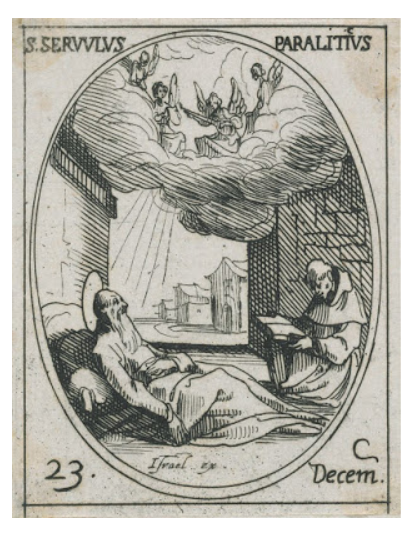
St. Servulus, Tiny Tim, and the Nativity of Our Lord


One understandable drawback to the great liturgical feasts, such as the magnificent celebration of the Nativity of Our Lord at Christmas, is that lesser observances can be overlooked in all the excitement. For instance, one of today’s Saints, St. Servulus: he is worth remembering for his own sake, but his life also gives us some very fruitful matter for meditation on the penultimate day of Advent, as we prepare for Christmas itself. Let’s take a look at the story of St. Servulus, from the 1894 edition of Butler’s Lives of the Saints (an account based on a homily by St. Gregory the Great):

December 23.—ST. SERVULUS

SERVULUS was a beggar, and had been so afflicted with palsy from his infancy that he was never able to stand, sit upright, lift his hand to his mouth, or turn himself from one side to another. His mother and brother carried him into the porch of St. Clement's Church at Rome, where he lived on the alms of those that passed by. He used to entreat devout persons to read the Holy Scriptures to him, which he heard with such attention as to learn them by heart. His time he consecrated by assiduously singing hymns of praise and thanksgiving to God. After several years thus spent, his distemper having seized his vitals, he felt his end was drawing nigh. In his last moments he desired the poor and pilgrims, who had often shared in his charity, to sing sacred hymns and psalms for him. While he joined his voice with theirs, he on a sudden cried out: "Silence! do you not hear the sweet melody and praise which resound in the heavens?" Soon after he spoke these words he expired, and his soul was carried by angels into everlasting bliss, about the year 590.

St. Servulus listens to Holy Scripture
Servulus is certainly an admirable model of heroic virtue.  In spite of a lifetime of constant suffering, he was filled with gratitude to his Creator, and was completely devoted to Him, as signified by his name (Servulus means “little slave”). Moreover, despite his own absolute poverty, he was keenly aware of the need of others.
   But there’s more to the story of this saint and his feast day, coming as it does right before the celebration of the Nativity of Our Lord.  When I first read Servulus’ hagiography, in fact, a passage from Charles Dickens immediately came to mind.  I was thinking of the scene in A Christmas Carol, where the Ghost of Christmas Present is showing Scrooge the Cratchit family’s Christmas dinner.  Scrooge’s underpaid clerk, Bob Cratchit, has just returned from church with his sickly, crippled son Tiny Tim on Christmas day.  After Tim is whisked off by his siblings to see “the pudding singing in the copper”, Bob has the following exchange with his wife:“And how did little Tim behave?” asked Mrs. Cratchit, when she had rallied Bob on his credulity, and Bob had hugged his daughter to his heart’s content.
“As good as gold,” said Bob, “and better. Somehow he gets thoughtful, sitting by himself so much, and thinks the strangest things you ever heard. He told me, coming home, that he hoped the people saw him in the church, because he was a cripple, and it might be pleasant to them to remember upon Christmas Day, who made lame beggars walk, and blind men see.”
Bob Cratchit & Tiny Tim

Tiny Tim sees himself as a living image of Christ’s mercy, reminding the faithful that the Nativity they’re celebrating is not just the birth of a baby, but the Incarnation of the God of Mercy as a Man. St. Servulus is also an icon, pointing out precisely who the Babe in the manger has come to be. He reminds us that in taking on human flesh, Jesus is taking to himself all that is human, excepting sin.  That very emphatically includes human suffering. It is often said that when God took on human form, he sanctified humanity.
Likewise, since Jesus has participated in our pain and sorrow, through his suffering we can unite ourselves to the living God. St. Servulus puts flesh on the words of St. Paul: “Now I rejoice in my sufferings for your sake, and in my flesh I complete what is lacking in Christ's afflictions (Colossians 1:24).”  Small wonder that the suffering saint could hear the voices of angels even before he left this world for the next.
    In two days we will be celebrating Christmas, the birth of our Savior, which is indeed, as the angels tell the shepherds of Bethlehem, “good news of a great joy” (Luke 2:10).  St. Servulus reminds us that He comes not so much to save us from the hardships of this world, but to save us through those hardships, so that we can be eternally happy with Him in the next.
    May your Christmas be a merry one . . . and God Bless Us, Every One.


Sunday, February 2, 2020

The Presentation and God's Strong Hand

"Moses Striking the Rock", by Francesco Bacchiacca
    Today in the secular world (at least in the United States) we observe the venerable tradition of Groundhog Day, which involves allowing an earth-dwelling rodent to forecast our weather for the next few weeks. It's just a fun bit of nonsense, and yet it receives an enormous amount of attention.
The Church, as we should expect, has something much more substantial for us. Today, forty days after the birth of Jesus at Christmas, we observe the Feast of the Presentation, in which we commemorate Mary and Joseph bringing the infant Jesus to the Temple in Jerusalem to consecrate Him to God, as was the Jewish custom with first-born sons. In this event we can see how, as St. Augustine put it, the New Covenant in the Old is concealed, and the Old is in the New revealed; similarly, we can catch a glimpse of the whole of the life and mission of Jesus on earth, from beginning to end.
Let's start with the depiction of the event in Luke 2:22-40, the Gospel reading at today’s Mass, which begins as follows:

When the days were completed for their purification according to the law of Moses, Mary and Joseph took Jesus up to Jerusalem to present him to the Lord, just as it is written in the law of the Lord, Every male that opens the womb shall be consecrated to the Lord, and to offer the sacrifice of a pair of turtledoves or two young pigeons, in accordance with the dictate in the law of the Lord.  (Luke 2:22-24)


The passage from Exodus to which Luke refers above appears in today’s Office of Readings.  There we see the origin of the mandate that Jewish families offer up their eldest male child to the Lord:

And when the LORD brings you into the land of the Canaanites, as he swore to you and your fathers, and shall give it to you, you shall set apart to the LORD all that first opens the womb. All the firstlings of your cattle that are males shall be the LORDs. Every firstling of an ass you shall redeem with a lamb, or if you will not redeem it you shall break its neck. Every first-born of man among your sons you shall redeem. And when in time to come your son asks you, 'What does this mean?' you shall say to him, 'By strength of hand the LORD brought us out of Egypt, from the house of bondage. For when Pharaoh stubbornly refused to let us go, the LORD slew all the first-born in the land of Egypt, both the first-born of man and the first-born of cattle. Therefore I sacrifice to the LORD all the males that first open the womb; but all the first-born of my sons I redeem.'  (Exodus 13:11-15)

   The injunction to consecrate the first-born males sends a powerful, and serious, message: that the chosen people were saved not through any virtue of their own, but through the favor, and by the power, of God.  By dedicating to the Lord their eldest sons, who will someday become the head of their families, they are putting God at the head of every family.  It is a reminder that future generations are in God’s hands as much as the generation that he liberated from Egypt.

   As we commemorate the Presentation of Jesus, we might also want to consider the passage above in its larger context in the Book of Exodus.  The Hebrews have been released by Pharaoh, but their struggle is just beginning; they have a long road ahead of them.  Here are the verses that immediately follow the reading in today’s Office:

When Pharaoh let the people go, God did not lead them by way of the land of the Philistines, although that was near; for God said, "Lest the people repent when they see war, and return to Egypt." But God led the people round by the way of the wilderness toward the Red Sea. And the people of Israel went up out of the land of Egypt equipped for battle. (Exodus 13:17-18)

The Israelites will not be able to simply walk in and take up residence in the land the Lord is giving them; they will need to fight, but God knows they’re not ready for that yet.  Before that time they will be prepared and tempered by a close escape from Pharaoh’s army (again, only by the “strength of the hand the LORD”), and forty years of struggle and hardship in the Sinai desert, punctuated by transcendent reminders of God’s Grace (Manna, Water from the Rock, the Ten Commandments).  God makes his Grace available, but the recipients are expected to cooperate actively with it.
   Now let’s look at Luke’s Gospel.  God has shown his strong hand again, in the birth of Jesus, the firstborn (and only born) son of The Father.  The Holy Family encounters a prophetic old man in the Temple named Simeon, who says:

       Lord, now lettest thou thy servant depart in peace,
according to thy word;
for mine eyes have seen thy salvation
which thou hast prepared in the presence of all peoples,
a light for revelation to the Gentiles,
and for glory to thy people Israel. (Luke 2:29-32)

And yet, as was the case with the escape from Egypt, this is only the beginning.  He also tells Mary:

Behold, this child is set for the fall and rising of many in Israel, and for a sign that is spoken against (and a sword will pierce through your own soul also), that thoughts out of many hearts may be revealed. (Luke 2:34-35)

"The Presentation", Hans Holbein the Elder
Simeon says that he can die content now after seeing the Savior, but also reveals that, here as in Moses’s day, salvation can only come after trial and suffering.


   We can see this reality reflected in the Liturgical Calendar: today is our last celebration of the Christ Child, and so our last glance back at the Christmas Season; in just a few weeks it will be Ash Wednesday, the beginning of Lent.  We can’t separate the Incarnation from the Via Dolorosa and Calvary.  And it’s no different for any one of us: God doesn’t make his Grace available to spare us our forty years in the desert, or release us from our own Way of the Cross.  Rather, it is to help us through them, because there’s no other way to get the Promised Land beyond.

Sunday, December 22, 2019

The Last Sunday of Advent (Lo, How A Rose E'er Blooming)

Nativity With The Torch, Nain Brothers
  The beautiful hymn "Lo, How A Rose E'er Blooming" (originally the 16th century German song "Es Ist Ein Ros Entsprungen") is one of my favorite songs of the Advent Season.  It draws its inspiration from the following Messianic passage from the Prophet Isaiah:
There shall come forth a shoot from the stump of Jesse, and a branch shall grow out of his roots. And the Spirit of the LORD shall rest upon him, the spirit of wisdom and understanding, the spirit of counsel and might, the spirit of knowledge and the fear of the LORD. (Isaiah 11:1-2)
In Isaiah’s time the Davidic kingdom had been destroyed, and the people of Israel were living in exile.  Nonetheless, it was clear to the Jewish people that the Prophet was speaking not only of their return to their earthly homeland and the rebirth a truncated  political entity: he was delivering God’s promise that, when things looked most hopeless in this world, He would send a Savior, his Messiah, to usher in a Kingdom greater that any conceived by mere men. In this song the “shoot” (the Messiah Jesus, descended through his human mother Mary from King David, Jesse’s son) is depicted as a lovely Rose, a small but vibrant manifestation of God’s presence where all seemed dead:
It came, a flow'ret bright,
Amid the cold of winter,
When half spent was the night.
     In the Season of Advent the Church reminds us that God has also promised to send his Messiah again in glory at the end of time.  This past year has given Catholic Christians plenty of reasons to feel that our world is collapsing, and that we are living in a sort of internal exile (we need not go into specific details here).  Our Hope will not be realized in this world, but only in the New Jerusalem in the world to come.
     For this reason, we look to the Blessed Mother as our model, who staked  her life on trusting in the promise of an angel. And so the song invites us to join her in gazing on the Rose springing from the stump of Jesse:
With Mary we behold it,
The virgin mother kind;
To show God's love aright,
She bore to men a Savior,
When half spent was the night.
May the remainder of your Advent be a blessed one, as we waith in hope for the coming of our Savior Jesus Christ!
The Lord is close at hand - come, let us worship Him


Sunday, June 3, 2018

The Solemnity of the Most Holy Body and Blood of Christ

"The Savior" by Juan de Juanes
    It’s so hard for us to fully accept that the Infinite God of the Universe could fully inhabit a human body, and be both True God and True Man. I used to find myself confronting this thorny paradox in a very vivid way when I discussed the Christological Heresies with my adolescent religion students.  The Arians could accept the human Jesus, but not his Divinity; the Docetists had no problem with Christ the Son of God, but they were sure his Humanity was just a show; the Monophysites could understand that Jesus was both man and God, but insisted that he had only one, Divine, nature . . . and so on.  
    These and numerous other incomplete answers to the puzzle presented to our finite minds by the Incarnate Second Person of the Trinity have been with us from the earliest days of the Church to the present day.  The Council of Chalcedon gave a definitive answer in A.D. 451, when it declared that Christ is


made known in two natures without confusion [i.e. mixture], without change, without division, without separation, the difference of the natures being by no means removed because of the union, but the property of each nature being preserved and coalescing in one prosopon [person] and one hypostasis [subsistence]--not parted or divided into two prosopa [persons], but one and the same Son, only-begotten, divine Word, the Lord Jesus Christ.


    As hard as it is to accept that Jesus Christ is both fully God and a true man with a human body, however, we Catholic Christians are asked to accept an even harder teaching: that the same body is truly present in the Eucharistic bread and wine offered up at every Mass.  Furthermore, as Christ Himself tells us,


Truly, truly, I say to you, unless you eat the flesh of the Son of man and drink his blood, you have no life in you; he who eats my flesh and drinks my blood has eternal life, and I will raise him up at the last day.  For my flesh is food indeed, and my blood is drink indeed. (John 6:55-57)


Many of his disciples found this teaching too hard to accept, and went away.  Today’s Solemnity of The Most Holy Body and Blood of Christ reminds, however, as Peter points out (John 6:68), that we have nowhere else to go, and only by eating the Body and Drinking the Blood of the God-Become-Man can we share in his eternal life.  
    There’s the wonder.  Christ has a human body, and so the Infinite God shares in our humanity; not only that, He shares that body with us in the Eucharist, and thereby lets us participate in His divinity.  No wonder we call it “Gospel”, that is, “Good News.” Yes, it is hard to believe, but, as today’s feast reminds us, it is, quite simply, The Truth.

Sunday, May 20, 2018

Pentecost Sunday: Christ's Message is For Everyone and Veni Sancte Spiritus


 Today is Pentecost, one of the great Feasts of the Church, in which we remember how Jesus sent the Holy Spirit upon his Disciples to guide them in their mission of Evangelization and in the governance of his Church.  In the second chapter of the Acts of the Apostles we read that the Apostles, Mary and others were gathered in the Upper Room when there was a rush of mighty wind and tongues of flame.  Not only that, those gathered began speaking “in other tongues”.  The international crowd gathered in Jerusalem, on hearing them, was 

. . .  amazed and wondered, saying, "Are not all these who are speaking Galileans? And how is it that we hear, each of us in his own native language?  Parthians and Medes and Elamites and residents of Mesopotamia, Judea and Cappadocia, Pontus and Asia, Phrygia and Pamphyia, Egypt and the parts of Libya belonging to Cyrene, and visitors from Rome, both Jews and proselytes, Cretans and Arabians, we hear them telling in our own tongues the mighty works of God." (Acts 2:5-11)

Referring to this event, St. Gregory of Agrigentum said:
           
Therefore if somebody should say to one of us, “You have received the Holy Spirit, why do you not speak in tongues?” his reply should be, “I do indeed speak in the tongues of all men, because I belong to the body of Christ, that is, the Church, and she speaks all languages. What else did the presence of the Holy Spirit indicate at Pentecost, except that God’s Church was to speak in the language of every people?”

The Church speaks to everyone because Christ is for everyone, and his language is universal.  Today we have ways of reaching people all over the globe that St. Gregory Agrigentum could not have imagined back in the 6th century, but it's the same Gospel, the same proclamation that the Apostles made 2,000 years ago.


Wednesday, May 9, 2018

What is a Hermeneutic of Suspicion, and Why Does It Matter?

An earlier version of this Worth Revisiting post was first published 15 October 2015 . To enjoy the work of other faithful Catholic bloggers see Worth Revisiting Wednesday, hosted by Elizabeth Reardon at theologyisaverb.com and Allison Gingras at reconciledtoyou.com.


What The Heck Is Hermeneutics?  

Back in my undergraduate days my college roommate took a class called "Hermeneutics". Not surprisingly, I couldn't help but ask, "What exactly is hermeneutics?" He explained that the word comes from the Greek verb ἑρμηνεύω (hermeneuo), "to interpret", and is related to the name of the god Hermes, bringer and interpreter of dreams. Hermeneutics, then, means interpretation, and when we speak of a hermeneutic we mean an interpretive framework through which we evaluate raw information. Even if we have never seen the term before, we all know the concept: if we say that someone "sees the world through rose colored glasses" we mean that they interpret reality through a hermeneutic of optimism, and a person who is always "under a dark cloud" employs a hermeneutic of pessimism. If we wish to use a more sophisticated example, we might say that someone resorts to a Marxist hermeneutic if they see everything through the lens of class struggle.

Hermes the Interpreter
    For most of us it seems a pretty esoteric word, and even if it's a part of our working vocabulary, it's probably not included in our everyday vocabulary.  Nonetheless, it's a handy term to have.  For instance, it gave Joseph Ratzinger (later Pope Benedict XVI) a very clear and precise way of summing up the the foundational error of both the "Spirit of Vatican II" progressives and the Lefebvrist ultra-traditionalists: both camps interpret the Second Vatican Council through a "hermeneutic of rupture", when the council should more properly be viewed through a "hermeneutic of continuity".  In other words, both groups operate with the assumption that Vatican II is a decisive break with the previous nineteen centuries of Catholic Tradition, the only difference being one group thinks that's a good thing, the other decidedly not.  Ratzinger was proposing that instead we should interpret the council with and through that Tradition.


The Hermeneutic of Suspicion

     A similar problem, one that can be found not only among die-hard progressives and rad trads, but also among many people who consider themselves "faithful Catholics, but . . ." (and in fact it's a temptation for all of us), is the "Hermeneutic of Suspicion". In other words, the default position that for any issue on which the Church takes a stance contrary to my preconceived ideas, political loyalties, the prevailing popular wisdom, or whatever else, She must convince me, beyond a shadow of a doubt, that my position is wrong and that her position is right.  This hermeneutic of suspicion is most conspicuously at play in the massive dissent from the traditional Catholic teaching on sexuality and family (which is not limited, by the way, to those who consider themselves "progressive").
    Am I saying that to be a good Catholic we need to stop thinking for ourselves, or "mindlessly" go along with the Church, as anti-Catholics are fond of telling us?  Not at all.   But nobody thinks and decides in a vacuum, we all need some basis for interpreting our world; "give me a place to stand", said Archimedes, "and I will move the world".  Being Catholic has always meant that we stand on the moral and metaphysical framework provided by Christ 's Church, and the Gospel as understood by that Church, not by the conventional wisdom or the prejudices of the cultural elite.


The Pillar and Foundation of Truth

    This demand that the Church must exhaustively prove to my satisfaction any teaching that does not correspond to my preferences before I believe seems to me to be the exact opposite of what has been normative throughout the history of the Church for those who consider themselves faithful Catholics.  St. Paul refers to “the church of the living God” as “the pillar and foundation of truth” (1 Tim. 3:15), and in another place he makes explicit where the believer is to stand in case of conflict between the Truth of God and the conventional wisdom:
           Let no one deceive himself. If any one among you considers himself wise in this age, let him become a fool so as to become wise.  For the wisdom of this world is foolishness in the eyes of God, for it is written: "He catches the wise in their own ruses," and again: "The Lord knows the thoughts of the wise, that they are vain."  (1 Cor. 3:18-20)
It was understood in the early Church, as well, where the authority to make final and binding decisions lay.  St. Augustine once said:
For already two councils on this question have been sent to the apostolic see; and replies have also come from there.  The cause is finished [causa finita est]; would that the error might be sometime finished also! (Sermon 131:10)
The expression causa finita est  comes from the practice of law; the modern expression that most closely corresponds is “case closed!”  To Augustine it seems a given that the replies from Rome have ended the discussion.
           More than a thousand years later St. Ignatius of Loyola is even more explicit in the Spiritual Exercises when he lists the rules “to have the true sentiment which we ought to have in the Church Militant”:  


Pope Paul III and St. Ignatius Loyola

To be right in everything, we ought always to hold that the white which I see, is black, if the Hierarchical Church so decides it, believing that between Christ our Lord, the Bridegroom, and the Church, His Bride, there is the same Spirit see which governs and directs us for the salvation of our souls. Because by the same Spirit and our Lord Who gave the ten Commandments, our holy Mother the Church is directed and governed.
                          
    St. Ignatius is not urging that Catholics leave their brain behind when they enter the Church: notice that he does not refer simply to white, but "the white which I see".  In other words, when it comes to fundamental categories (i.e., right and wrong), we need to trust the Church's judgment over our own, because she has been promised the guidance of the Holy Spirit, while we, as individuals, have not.


Every Man A Pope

    It really could not be any other way.  If we make ourselves the ultimate arbiters of truth instead of deferring to the Church, then the individual believer becomes, in effect, infallible, his or her own little Pope, the result of which could only be thousands upon thousands of little schisms; any sort of real communion becomes impossible.  In fact, that is exactly what we see among our separated brethren in the Protestant communities, whose separate denominations are now said to number in the thousands, a mere five hundred years after Luther nailed his ninety-five theses to the church door in Wittenberg.
    In the end, faith itself becomes an impossibility, if there is no Truth greater than my own personal "truth".  And if I’m the supreme judge, why do I need a church to teach me anything? For that matter, what use is religion at all, or a Divine Savior, if it’s up to me to determine whether there’s any sin from which to save me? Isn’t that the logical end-point of the Hermeneutic of Suspicion?  Just myself, closed in upon myself. That’s an awfully cold, lonely way to spend eternity; it brings to mind what St. Paul says: “Wretched man that I am! Who will deliver me from this body of death?” (Romans 7:24).  Paul, of course, knows the answer: “Thanks be to God through Jesus Christ our Lord!” (Romans 7:25).  Only Christ can save me from myself, I myself who “do not do the good I want, but the evil I do not want” (Romans 7:19).  This same Christ has given His Church the power to bind and loose (Matthew 18:18); who am I, or any of us, to be its judge?