Nisi Dominus aedificaverit domum, in vanum laborant qui aedificaverunt eam - "Unless the Lord built the house, they worked in vain who built it" Ps. 127

Showing posts with label The Eucharist. Show all posts

Sunday, August 15, 2021

Eucharistic Adoration: Sitting at the Feet of the Lord

     As Catholics, we are blessed to have some wonderful devotional practices that help us grow closer to Christ.  One of the most profound of these is Eucharistic Adoration.  My wife and I were recently asked to help encourage participation in Adoration in our parish, in the course of which we ourselves came to see dimensions of this great gift that we hadn’t considered before. 
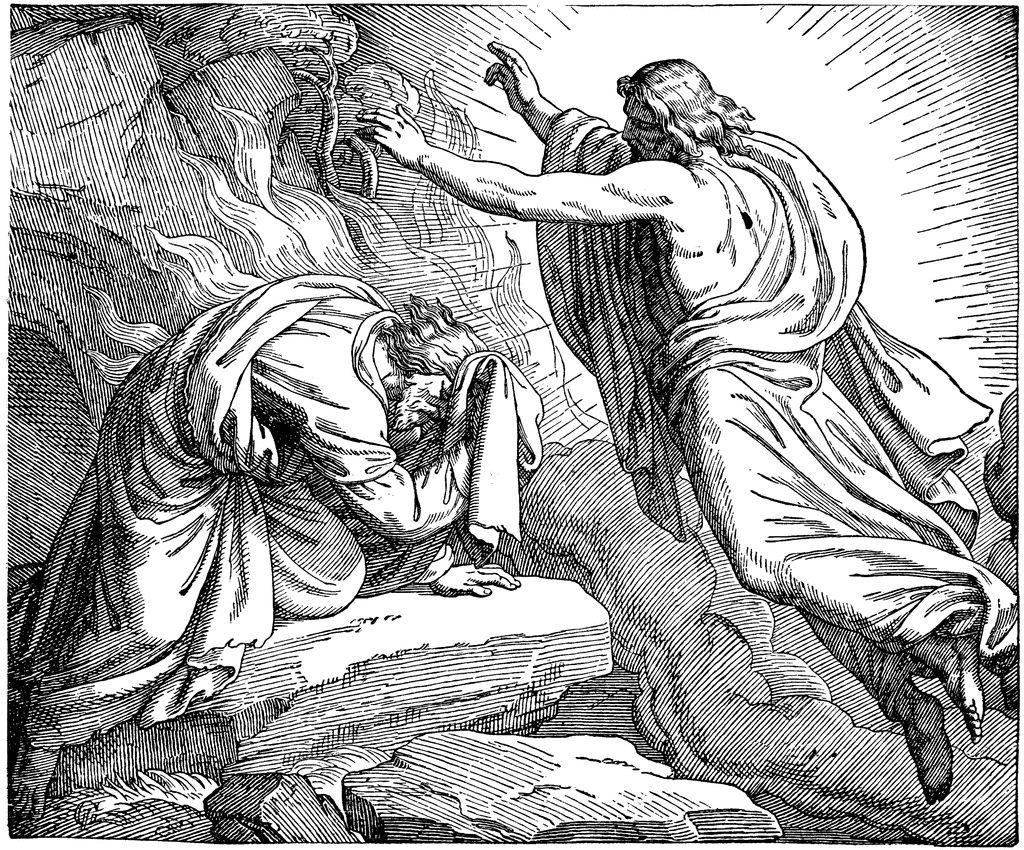
     For one thing, we both thought immediately of scriptural connections. My lovely bride thought of the passage from First Kings (1 Kings 19:10-13) where the Lord tells the prophet Elijah to stand on the mountain, for “The Lord is about to pass by”.  There’s a mighty wind, an earthquake, and a roaring fire, but God is not in any of those things; instead, Elijah encounters the Lord in a “gentle whispering”. 

     Just as God does not appear to Elijah in any of the grand and dramatic forms we might expect, so Jesus enters the world as a tiny baby, and continues to manifest himself to us as a simple piece of bread.  Eucharistic Adoration gives us a chance to shut out all the storm and stress of our daily lives while we contemplate the infinite God embodied in that piece of bread, and hear his gentle whisper.

     My own first thought was the passage from Luke’s Gospel (Luke 10:38-42) where Jesus is visiting the sisters Martha and Mary.  Martha, who is “worried about many things”, is frantically bustling about the house, while Mary simply sits at the feet of Jesus . . . 

[click HERE to continue reading this post on Spes in Domino]

Friday, July 30, 2021

The Bishops, the Politicians, and Abortion: What Would St. John Fisher Do?

  "You may not be interested in war, but war is interested in you."


Joe and Jill Biden at Mass

     The quote above is often attributed to communist revolutionary Leon Trotsky.  There is no record of his actually having said it, but it's widely repeated because it pithily sums up a terrifying truth about the relentlessness of war.  In an age when a large and influential segment of the population wages political warfare on all who seem to stand in the way of their urgent drive to replace reality as it is with a vaguely envisioned utopia, we can amend that to "You may not be interested in politics, but politics is interested in you."

 For a long time now the Catholic bishops in the United States have dabbled in politics, mostly in a manner that we would call "virtue signaling" today: a statement about nuclear war in the 1980s, expressions of concern about capital punishment in the 1990s, some hand-wringing about immigration in more recent years.  All issues with legitimate moral dimensions, it's true, but all likewise issues on which serious Catholics can have legitimate differences of opinion.  In none of them were the bishops confronting Catholics or others who were clearly advocating anything directly contrary to the moral law, or promoting an intrinsic evil.  And for what it's worth, none of them are areas in which Catholic bishops have particular competence.

  Over the same stretch of time there has been another issue looming, one which is indeed a matter of intrinsic evil, about which there is no room for prudential judgment, and which is very much within the competence of the episcopacy: abortion.

[click HERE to continue reading this post on Spes in Domino]

Monday, June 14, 2021

Who's really "politicizing" the Body of Christ?


    An unusual and unfamiliar expression, "Eucharistic Coherence", has been showing up on a lot of Catholic websites lately. I've written about the abuse of language on more than one occasion in the recent past (here and here, for instance), but this term is not itself abusive, rather it's intended to expose and correct abuse.  It refers to the coherence that ought to exist between the way Catholics profess and live out their faith in public on the one hand, and their worthiness to receive the Body and Blood of Our Lord in Communion on the other.  To put it more plainly, it's a fancy way of saying that public figures who actively promote abortion and other egregious violations of the moral law are not "devout Catholics", despite their self-professed devotion to Mother Church, and ought not receive communion.

   Seems pretty simple, doesn't it?  And yet it's not.  Here's the short version of the story: given the
exuberance with which certain nominally Catholic politicians in the United States promote the killing of the unborn, the dismantling of the family as an institution, and other unlovely manifestations of the Culture of Death, the U.S. Catholic Bishops are preparing to discuss Eucharistic Coherence (i.e., what to do about the scandal caused by said politicians) at their annual meeting later this month. You will no doubt be surprised to hear that a group of 68 American bishops (I could name names, but you probably know them already) have written to Archbishop Gomez, head of the Bishops Conference, asking him to halt the discussion . . . 

[click HERE to continue reading this post on Spes in Domino]

Tuesday, April 27, 2021

Why the Church is not a Granfalloon

    The word "community" must test well in focus groups. It pops up everywhere.  Pay attention to advertisements, and you'll find that all sorts of people and businesses are claiming to be able to provide it to you. Just one example: I heard an ad on the radio last week from a local savings bank suggesting I go there for "community" - and here I thought the bank was just a place to keep my money.  


  I'm not the only one to notice how often the term community is tossed around. Casey Chalk had an article in Crisis this past week called "The Problem with Peloton and Other Faux Communities." Peloton, apparently, is a self-proclaimed community in which one can commune online with other people around the world while pedalling a false bicycle that never actually goes anywhere . . . and the starting price is only $1,900.  Chalk contrasts the simulacrum of community offered by Peloton and other online entities  . . . 

{Go HERE to read the rest of this post on Spes in Domino]

Sunday, February 21, 2021

The Christian Cannot Live Without The Eucharist

 Babies need to be touched. They need human touch not just for their general emotional well-being, but in some very specific, measurable ways. There is good evidence that sufficient physical contact with another human being is necessary for proper brain development [see here and here, for instance].  


  We need the Second Person of the Holy Trinity to become man so that we can look on the Face of our Creator (St. Paul calls him “the image of the invisible God”, Colossians 1:15).


     Less publicity has been given to the fact that contact, including physical contact, with other human beings continues to be important as we grow older. One study shows that Professional basketball teams “whose players touch each other more often win more games.” Another demonstrates that “those who had more hugs had a better immune response to the cold virus”. I could go on, but you get the idea: touching other human beings is essential for human flourishing.  

      It’s often the way that modern science breathlessly discovers what people have known all along.  The Church has always known that we’re both spiritual and physical, and need each other not just to “be there”, but literally to be there: that’s why the Church is an ecclesia, from the Greek ἐκκλησία, an assembly of the people.  We need to believe and worship in the company of other people.  We need physical means like the sacraments to fully experience God’s grace.  We need the Second Person of the Holy Trinity to become man so that we can look on the Face of our Creator (St. Paul calls him “the image of the invisible God”, Colossians 1:15). We need the Eucharist.

     [Click HERE to continue reading this article on Spes in Domino]