Nisi Dominus aedificaverit domum, in vanum laborant qui aedificaverunt eam - "Unless the Lord built the house, they worked in vain who built it" Ps. 127

Showing posts with label adoration. Show all posts

Sunday, August 15, 2021

Eucharistic Adoration: Sitting at the Feet of the Lord

     As Catholics, we are blessed to have some wonderful devotional practices that help us grow closer to Christ.  One of the most profound of these is Eucharistic Adoration.  My wife and I were recently asked to help encourage participation in Adoration in our parish, in the course of which we ourselves came to see dimensions of this great gift that we hadn’t considered before. 
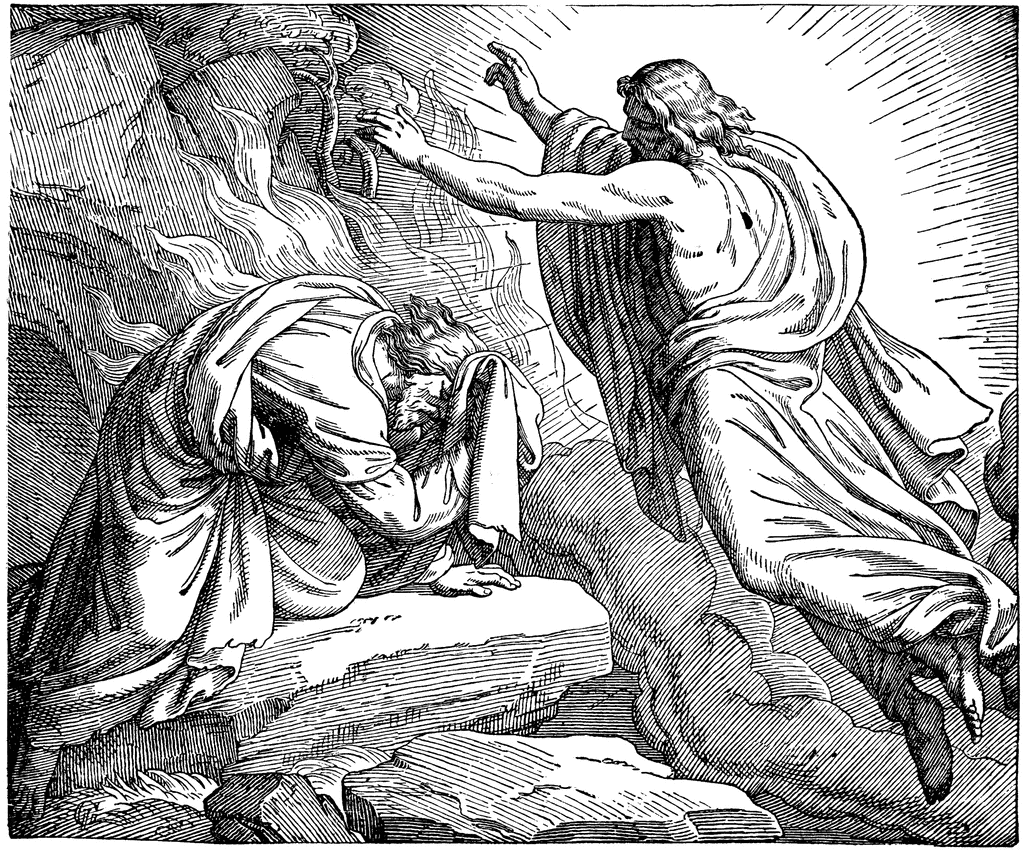
     For one thing, we both thought immediately of scriptural connections. My lovely bride thought of the passage from First Kings (1 Kings 19:10-13) where the Lord tells the prophet Elijah to stand on the mountain, for “The Lord is about to pass by”.  There’s a mighty wind, an earthquake, and a roaring fire, but God is not in any of those things; instead, Elijah encounters the Lord in a “gentle whispering”. 

     Just as God does not appear to Elijah in any of the grand and dramatic forms we might expect, so Jesus enters the world as a tiny baby, and continues to manifest himself to us as a simple piece of bread.  Eucharistic Adoration gives us a chance to shut out all the storm and stress of our daily lives while we contemplate the infinite God embodied in that piece of bread, and hear his gentle whisper.

     My own first thought was the passage from Luke’s Gospel (Luke 10:38-42) where Jesus is visiting the sisters Martha and Mary.  Martha, who is “worried about many things”, is frantically bustling about the house, while Mary simply sits at the feet of Jesus . . . 

[click HERE to continue reading this post on Spes in Domino]

Wednesday, December 30, 2015

6th Day of Christmas - Do You Hear What I Hear?

Now here’s a treat.  I was looking for a song that involved the star of Bethlehem as a complement to my post on Principium et Finis, “Day 6 of Christmas: God Is Light.”  My first thought was of the song “Do You Hear What I Hear?”, because it’s first verse goes:

Said the night wind to the little lamb
Do you see what I see
Way up in the sky little lamb
Do you see what I see
A star, a star
Dancing in the night
With a tail as big as a kite

As I was perusing the various renditions available on YouTube, I found a clip of none other than Bing Crosby singing this delightful Christmas song back in 1963.  Enjoy, and Merry Christmas!  The Season is still young!


Thursday, April 16, 2015

Mozart, Herbert, John the Baptist, And Why We Can't Be Angels (from Principium et Finis)


All in the Head

     The great composer W.A. Mozart (who, I must admit, has made more than one appearance on this blog) is reported to have said that “Protestantism was all in the head”, and that “Protestants did not know the meaning of the Agnus Dei qui tollis peccata mundi [Lamb of God who takes away the sins of the world]”.  I would not put it so harshly, but with all due respect to my friends among the separated brethren, there is at least an element of truth to this observation.   Protestantism on the whole is very uncomfortable with the corporeality of more traditional expressions of Christianity, starting with the Protestant rejection of the True Presence of Christ in the Eucharist and the efficacy of sacraments in general, and carrying that same mind-set through to a suspicion of any physical expression of faith apart from the Scriptures themselves (and, in some congregations, speaking in tongues).  As a consequence, the Sign of the Cross, genuflection, rosaries, icons and statues all seem foreign to them. It almost appears that many of our Protestant friends, relying on Sola Scriptura and focusing on just The Word, are trying to uncarnate (so to speak) the Word made Flesh.

Sure, they may not look naked . . . 


     Many of them, but by no means all: there have always been some members of the reformation churches who understand and embrace the sacramental outlook that has been preserved in the Catholic and Orthodox Churches.  One such is the 17th century English religious poet George Herbert.  Herbert was an Anglican cleric in addition to being a poet, and so he devoted a portion of his poetry to defending his church.  Being an Anglican, he directed some of his fire at the Catholic Church, as one would expect, mostly criticism of the papacy and what he considered a certain superficiality (needless to say, I don’t concur in these objections).  He reserves his harshest and most substantive criticism, however, for the protestant Puritans, whom he accuses in his poem “The British Church” of being “undrest” . . . 

(Please read the entire post HERE at Principium et Finis)

Eucharistic Adoration: Sitting at the Feet of the Lord

 
Vermeer's Christ in the House of Mary and Martha
   As Catholics, we are blessed to have some wonderful devotional practices that help us grow closer to Christ.  One of the most profound of these is Eucharistic Adoration.  My wife and I were recently asked to help encourage participation in Adoration in our parish, in the course of which we ourselves came to see dimensions of this great gift that we hadn’t considered before. 
     For one thing, we both thought immediately of scriptural connections. My lovely bride thought of the passage from First Kings (1 Kings 19:10-13) where the Lord tells the prophet Elijah to stand on the mountain, for “The Lord is about to pass by”.  There’s a mighty wind, an earthquake, and a roaring fire, but God is not in any of those things; instead, Elijah encounters the Lord in a “gentle whispering”. 
     Just as God does not appear to Elijah in any of the grand and dramatic forms we might expect, so Jesus enters the world as a tiny baby, and continues to manifest himself to us as a simple piece of bread.  Eucharistic Adoration gives us a chance to shut out all the storm and stress of our daily lives while we contemplate the infinite God embodied in that piece of bread, and hear his gentle whisper.
     My own first thought was the passage from Luke’s Gospel (Luke 10:38-42) where Jesus is visiting the sisters Martha and Mary.  Martha, who is “worried about many things”, is frantically bustling about the house, while Mary simply sits at the feet of Jesus, watching and listening.  When Martha complains that Mary isn’t helping her, Jesus answers that Mary has chosen “the better part, and it will not be taken away from her”. 
     Most of us can probably identify with Martha: always “worried about many things”, and too distracted to notice the Lord.  Adoration is a great opportunity to give our “inner Martha” a rest and, like Mary, choose “the better part”. After all, what is Eucharistic Adoration, if not watching and listening at the feet of Jesus?
     What’s true for us as individuals also applies to us communally.  However important, even necessary, all of our various activities, committees, and causes may be, they can overshadow “the one thing”, as Jesus tells Martha, “that is needful”.  What better reminder that Christ is the Center than a parish putting aside twelve hours in the middle of the week to sit at the Master’s feet?  It keeps us from becoming nothing but noisy gongs and clanging cymbals (1 Corinthians 13:1).

     My brief comments here can’t even begin to explore the depth of meaning contained in the Eucharist. God who created us knows what we need; having given us both body and soul, he knows we need material means to understand spiritual realities.  The opportunity to kneel in adoration before our Eucharistic Lord is a gift we can’t afford to pass up. 

(This post first appeared on my blog Principium et Finis July 18th 2014)